Jia Liu, Xiujie Han, Xin Wen, Hao Yu, Bao Li, Ming Wang, Minghua Liu and Guanglu Wu
{"title":"Chiral ring-in-ring complexes with torsion-induced circularly polarized luminescence†","authors":"Jia Liu, Xiujie Han, Xin Wen, Hao Yu, Bao Li, Ming Wang, Minghua Liu and Guanglu Wu","doi":"10.1039/D5SC00624D","DOIUrl":null,"url":null,"abstract":"<p >We introduce a class of supramolecular precursors, termed ‘folda-bonders’, which utilize macrocycles to fold and precisely align reactive groups, effectively acting as bonding facilitators. This design enables highly efficient, selective, and mild ‘click-like’ reactions, making them particularly well-suited for the modular synthesis of complex structures. In this study, we highlight the versatility of folda-bonders in the one-pot aqueous synthesis of chiral ring-in-ring complexes exhibiting torsion-induced circularly polarized luminescence (CPL). Cucurbit[8]uril macrocycles facilitate the pseudostatic pre-folding of bis(4-phenyl pyridinium) derivatives, which act as folda-bonders, enabling efficient, purification-free covalent cyclization mediated by an axially chiral fragment. The single-crystal structure, obtained directly from the product solution, confirms the formation of a chiral ring-in-ring configuration. The macrocycle-imparted rigidity, combined with the tunable flexibility of alkyl linkers, drives the emergence of distinct chiroptical properties in the ring-in-ring complexes. Remarkably, torsion within the strained shorter alkyl linker is responsible for generating CPL, whereas longer linkers retain chirality, as evidenced by CD signals, but do not exhibit CPL. These findings demonstrate the potential of integrating noncovalent and covalent strategies to design sophisticated molecular architectures with tailored functional properties.</p>","PeriodicalId":9909,"journal":{"name":"Chemical Science","volume":" 18","pages":" 7858-7863"},"PeriodicalIF":7.4000,"publicationDate":"2025-03-28","publicationTypes":"Journal Article","fieldsOfStudy":null,"isOpenAccess":false,"openAccessPdf":"https://pubs.rsc.org/en/content/articlepdf/2025/sc/d5sc00624d?page=search","citationCount":"0","resultStr":null,"platform":"Semanticscholar","paperid":null,"PeriodicalName":"Chemical Science","FirstCategoryId":"92","ListUrlMain":"https://pubs.rsc.org/en/content/articlelanding/2025/sc/d5sc00624d","RegionNum":1,"RegionCategory":"化学","ArticlePicture":[],"TitleCN":null,"AbstractTextCN":null,"PMCID":null,"EPubDate":"","PubModel":"","JCR":"Q1","JCRName":"CHEMISTRY, MULTIDISCIPLINARY","Score":null,"Total":0}
引用次数: 0
Abstract
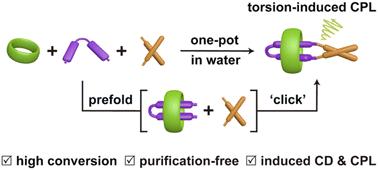
We introduce a class of supramolecular precursors, termed ‘folda-bonders’, which utilize macrocycles to fold and precisely align reactive groups, effectively acting as bonding facilitators. This design enables highly efficient, selective, and mild ‘click-like’ reactions, making them particularly well-suited for the modular synthesis of complex structures. In this study, we highlight the versatility of folda-bonders in the one-pot aqueous synthesis of chiral ring-in-ring complexes exhibiting torsion-induced circularly polarized luminescence (CPL). Cucurbit[8]uril macrocycles facilitate the pseudostatic pre-folding of bis(4-phenyl pyridinium) derivatives, which act as folda-bonders, enabling efficient, purification-free covalent cyclization mediated by an axially chiral fragment. The single-crystal structure, obtained directly from the product solution, confirms the formation of a chiral ring-in-ring configuration. The macrocycle-imparted rigidity, combined with the tunable flexibility of alkyl linkers, drives the emergence of distinct chiroptical properties in the ring-in-ring complexes. Remarkably, torsion within the strained shorter alkyl linker is responsible for generating CPL, whereas longer linkers retain chirality, as evidenced by CD signals, but do not exhibit CPL. These findings demonstrate the potential of integrating noncovalent and covalent strategies to design sophisticated molecular architectures with tailored functional properties.
期刊介绍:
Chemical Science is a journal that encompasses various disciplines within the chemical sciences. Its scope includes publishing ground-breaking research with significant implications for its respective field, as well as appealing to a wider audience in related areas. To be considered for publication, articles must showcase innovative and original advances in their field of study and be presented in a manner that is understandable to scientists from diverse backgrounds. However, the journal generally does not publish highly specialized research.




 京公网安备 11010802042870号
京ICP备2023020795号-1
京公网安备 11010802042870号
京ICP备2023020795号-1

 分享
分享
 求助内容:
求助内容: 应助结果提醒方式:
 扫码关注我们
