Dilipkumar N. Asthagiri, Arjun Valiya Parambathu and Thomas L. Beck
{"title":"Consequences of the failure of equipartition for the p–V behavior of liquid water and the hydration free energy components of a small protein†","authors":"Dilipkumar N. Asthagiri, Arjun Valiya Parambathu and Thomas L. Beck","doi":"10.1039/D4SC08437C","DOIUrl":null,"url":null,"abstract":"<p >Earlier we showed that in the molecular dynamics simulation of a rigid model of water it is necessary to use an integration time-step <em>δ</em><small><sub>t</sub></small> ≤ 0.5 fs to ensure equipartition between translational and rotational modes. Here we extend that study in the <em>NVT</em> ensemble to <em>NpT</em> conditions and to an aqueous protein. We study neat liquid water with the rigid, SPC/E model and the protein BBA (PDB ID: 1FME) solvated in the rigid, TIP3P model. We examine integration time-steps ranging from 0.5 fs to 4.0 fs for various thermostat plus barostat combinations. We find that a small <em>δ</em><small><sub>t</sub></small> is necessary to ensure consistent prediction of the simulation volume. Hydrogen mass repartitioning alleviates the problem somewhat, but is ineffective for the typical time-step used with this approach. The compressibility, a measure of volume fluctuations, and the dielectric constant, a measure of dipole moment fluctuations, are also seen to be sensitive to <em>δ</em><small><sub>t</sub></small>. Using the mean volume estimated from the <em>NpT</em> simulation, we examine the electrostatic and van der Waals contribution to the hydration free energy of the protein in the <em>NVT</em> ensemble. These contributions are also sensitive to <em>δ</em><small><sub>t</sub></small>. In going from <em>δ</em><small><sub>t</sub></small> = 2 fs to <em>δ</em><small><sub>t</sub></small> = 0.5 fs, the change in the net electrostatic plus van der Waals contribution to the hydration of BBA is already in excess of the folding free energy reported for this protein.</p>","PeriodicalId":9909,"journal":{"name":"Chemical Science","volume":" 17","pages":" 7503-7512"},"PeriodicalIF":7.4000,"publicationDate":"2025-03-28","publicationTypes":"Journal Article","fieldsOfStudy":null,"isOpenAccess":false,"openAccessPdf":"https://pubs.rsc.org/en/content/articlepdf/2025/sc/d4sc08437c?page=search","citationCount":"0","resultStr":null,"platform":"Semanticscholar","paperid":null,"PeriodicalName":"Chemical Science","FirstCategoryId":"92","ListUrlMain":"https://pubs.rsc.org/en/content/articlelanding/2025/sc/d4sc08437c","RegionNum":1,"RegionCategory":"化学","ArticlePicture":[],"TitleCN":null,"AbstractTextCN":null,"PMCID":null,"EPubDate":"","PubModel":"","JCR":"Q1","JCRName":"CHEMISTRY, MULTIDISCIPLINARY","Score":null,"Total":0}
引用次数: 0
Abstract
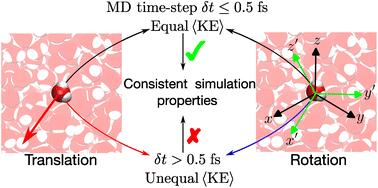
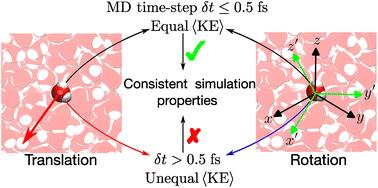
Earlier we showed that in the molecular dynamics simulation of a rigid model of water it is necessary to use an integration time-step δt ≤ 0.5 fs to ensure equipartition between translational and rotational modes. Here we extend that study in the NVT ensemble to NpT conditions and to an aqueous protein. We study neat liquid water with the rigid, SPC/E model and the protein BBA (PDB ID: 1FME) solvated in the rigid, TIP3P model. We examine integration time-steps ranging from 0.5 fs to 4.0 fs for various thermostat plus barostat combinations. We find that a small δt is necessary to ensure consistent prediction of the simulation volume. Hydrogen mass repartitioning alleviates the problem somewhat, but is ineffective for the typical time-step used with this approach. The compressibility, a measure of volume fluctuations, and the dielectric constant, a measure of dipole moment fluctuations, are also seen to be sensitive to δt. Using the mean volume estimated from the NpT simulation, we examine the electrostatic and van der Waals contribution to the hydration free energy of the protein in the NVT ensemble. These contributions are also sensitive to δt. In going from δt = 2 fs to δt = 0.5 fs, the change in the net electrostatic plus van der Waals contribution to the hydration of BBA is already in excess of the folding free energy reported for this protein.
期刊介绍:
Chemical Science is a journal that encompasses various disciplines within the chemical sciences. Its scope includes publishing ground-breaking research with significant implications for its respective field, as well as appealing to a wider audience in related areas. To be considered for publication, articles must showcase innovative and original advances in their field of study and be presented in a manner that is understandable to scientists from diverse backgrounds. However, the journal generally does not publish highly specialized research.




 京公网安备 11010802042870号
京ICP备2023020795号-1
京公网安备 11010802042870号
京ICP备2023020795号-1

 分享
分享
 求助内容:
求助内容: 应助结果提醒方式:
 扫码关注我们
