Joonhyeok Park, Jiwoon Kim, Jaeik Kim, Minsung Kim, Taeseup Song and Ungyu Paik
{"title":"Sustainable and cost-effective electrode manufacturing for advanced lithium batteries: the roll-to-roll dry coating process","authors":"Joonhyeok Park, Jiwoon Kim, Jaeik Kim, Minsung Kim, Taeseup Song and Ungyu Paik","doi":"10.1039/D5SC00059A","DOIUrl":null,"url":null,"abstract":"<p >The transition to electric vehicles motivated by global carbon neutrality targets has intensified the demand for lithium-ion batteries (LIBs) with high energy density. While the innovation of cathode/anode active materials has reached a plateau, development of thick electrodes has emerged as a critical breakthrough to achieving high-energy-density LIBs. However, the conventional wet coating process has intrinsic limitations, such as binder migration during the solvent drying process, which becomes increasingly problematic with thick electrodes. To address these challenges, dry coating processes have been actively explored in three main forms: electrostatic spraying, hot pressing with thermoplastic polymers, and roll-to-roll dry coating utilizing the polytetrafluoroethylene binder. This review highlights the roll-to-roll dry coating process, a scalable and industrially viable approach, by introducing its underlying mechanisms, latest developments, and applications in all-solid-state batteries and lithium–sulfur batteries. By combining technical advancements with manufacturing scalability, the roll-to-roll dry coating process demonstrates significant potential to enable next-generation battery systems.</p>","PeriodicalId":9909,"journal":{"name":"Chemical Science","volume":" 16","pages":" 6598-6619"},"PeriodicalIF":7.4000,"publicationDate":"2025-03-28","publicationTypes":"Journal Article","fieldsOfStudy":null,"isOpenAccess":false,"openAccessPdf":"https://pubs.rsc.org/en/content/articlepdf/2025/sc/d5sc00059a?page=search","citationCount":"0","resultStr":null,"platform":"Semanticscholar","paperid":null,"PeriodicalName":"Chemical Science","FirstCategoryId":"92","ListUrlMain":"https://pubs.rsc.org/en/content/articlelanding/2025/sc/d5sc00059a","RegionNum":1,"RegionCategory":"化学","ArticlePicture":[],"TitleCN":null,"AbstractTextCN":null,"PMCID":null,"EPubDate":"","PubModel":"","JCR":"Q1","JCRName":"CHEMISTRY, MULTIDISCIPLINARY","Score":null,"Total":0}
引用次数: 0
Abstract
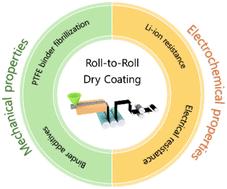
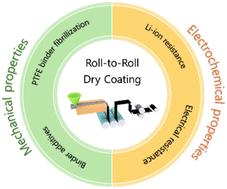
The transition to electric vehicles motivated by global carbon neutrality targets has intensified the demand for lithium-ion batteries (LIBs) with high energy density. While the innovation of cathode/anode active materials has reached a plateau, development of thick electrodes has emerged as a critical breakthrough to achieving high-energy-density LIBs. However, the conventional wet coating process has intrinsic limitations, such as binder migration during the solvent drying process, which becomes increasingly problematic with thick electrodes. To address these challenges, dry coating processes have been actively explored in three main forms: electrostatic spraying, hot pressing with thermoplastic polymers, and roll-to-roll dry coating utilizing the polytetrafluoroethylene binder. This review highlights the roll-to-roll dry coating process, a scalable and industrially viable approach, by introducing its underlying mechanisms, latest developments, and applications in all-solid-state batteries and lithium–sulfur batteries. By combining technical advancements with manufacturing scalability, the roll-to-roll dry coating process demonstrates significant potential to enable next-generation battery systems.
期刊介绍:
Chemical Science is a journal that encompasses various disciplines within the chemical sciences. Its scope includes publishing ground-breaking research with significant implications for its respective field, as well as appealing to a wider audience in related areas. To be considered for publication, articles must showcase innovative and original advances in their field of study and be presented in a manner that is understandable to scientists from diverse backgrounds. However, the journal generally does not publish highly specialized research.




 京公网安备 11010802042870号
京ICP备2023020795号-1
京公网安备 11010802042870号
京ICP备2023020795号-1

 分享
分享
 求助内容:
求助内容: 应助结果提醒方式:
 扫码关注我们
