Yujia Song, Li Tian, Ruidan Li, Yanjia Guo, Pengfei Han, Guangping Ma, Hanyue Jiang, Wenzhuo Wang, Juan Lu
{"title":"Electrochemiluminescence platform for curcumin detection based on g-C3N4 of N-rich vacancy and Ti2AlC","authors":"Yujia Song, Li Tian, Ruidan Li, Yanjia Guo, Pengfei Han, Guangping Ma, Hanyue Jiang, Wenzhuo Wang, Juan Lu","doi":"10.1016/j.foodchem.2025.144084","DOIUrl":null,"url":null,"abstract":"<div><div>In this work, g-C<sub>3</sub>N<sub>4</sub> of N-rich vacancy (CNNV) and mesoporous SiO<sub>2</sub> were synthesized. A novel electrochemiluminescence (ECL) sensor for curcumin (Cur) based on CNNV@SiO<sub>2</sub> and Ti<sub>2</sub>AlC was constructed. An initial ECL signal was generated from the CNNV-S<sub>2</sub>O<sub>8</sub><sup>2</sup><sup>−</sup> system. SiO<sub>2</sub> significantly adsorbed more S<sub>2</sub>O<sub>8</sub><sup>2</sup><sup>−</sup>, thereby enhancing the ECL signal. Ti<sub>2</sub>AlC served as an effective co-reaction promoter, further amplifying the ECL signal of CNNV@SiO<sub>2</sub>-S<sub>2</sub>O<sub>8</sub><sup>2</sup><sup>−</sup> system. With the addition of Cur, the ECL signal also decreased, which can be attributed to the resonance energy transfer (RET) mechanism between CNNV (donor) and Cur (acceptor). Under optimal conditions, a strong linear relationship was observed between the change in ECL signal (ΔI) and the logarithm of Cur concentration (lgC<sub>Cur</sub>), spanning from 5 × 10<sup>−15</sup> to 5 × 10<sup>−9</sup> mol L<sup>−1</sup> with a detection limit of 1.7 × 10<sup>−15</sup> mol L<sup>−1</sup>. The constructed ECL sensor was successfully applied to detect Cur in real samples.</div></div>","PeriodicalId":318,"journal":{"name":"Food Chemistry","volume":"481 ","pages":"Article 144084"},"PeriodicalIF":9.8000,"publicationDate":"2025-07-30","publicationTypes":"Journal Article","fieldsOfStudy":null,"isOpenAccess":false,"openAccessPdf":"","citationCount":"0","resultStr":null,"platform":"Semanticscholar","paperid":null,"PeriodicalName":"Food Chemistry","FirstCategoryId":"97","ListUrlMain":"https://www.sciencedirect.com/science/article/pii/S0308814625013354","RegionNum":1,"RegionCategory":"农林科学","ArticlePicture":[],"TitleCN":null,"AbstractTextCN":null,"PMCID":null,"EPubDate":"2025/3/27 0:00:00","PubModel":"Epub","JCR":"Q1","JCRName":"CHEMISTRY, APPLIED","Score":null,"Total":0}
引用次数: 0
Abstract
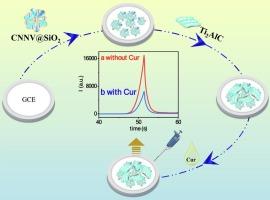
In this work, g-C3N4 of N-rich vacancy (CNNV) and mesoporous SiO2 were synthesized. A novel electrochemiluminescence (ECL) sensor for curcumin (Cur) based on CNNV@SiO2 and Ti2AlC was constructed. An initial ECL signal was generated from the CNNV-S2O82− system. SiO2 significantly adsorbed more S2O82−, thereby enhancing the ECL signal. Ti2AlC served as an effective co-reaction promoter, further amplifying the ECL signal of CNNV@SiO2-S2O82− system. With the addition of Cur, the ECL signal also decreased, which can be attributed to the resonance energy transfer (RET) mechanism between CNNV (donor) and Cur (acceptor). Under optimal conditions, a strong linear relationship was observed between the change in ECL signal (ΔI) and the logarithm of Cur concentration (lgCCur), spanning from 5 × 10⁻¹⁵ to 5 × 10⁻⁹ mol L−1 with a detection limit of 1.7 × 10⁻¹⁵ mol L−1. The constructed ECL sensor was successfully applied to detect Cur in real samples.
期刊介绍:
Food Chemistry publishes original research papers dealing with the advancement of the chemistry and biochemistry of foods or the analytical methods/ approach used. All papers should focus on the novelty of the research carried out.




 京公网安备 11010802042870号
京ICP备2023020795号-1
京公网安备 11010802042870号
京ICP备2023020795号-1

 分享
分享
 求助内容:
求助内容: 应助结果提醒方式:
 扫码关注我们
