Synergistic Enhancement of Light Harvesting and Interfacial Defect Reduction Using Metal–Organic Frameworks for Efficient and Stable Perovskite Solar Cells
Chenyu Zhao, Meihan Liu, Xiaoye Liu, Xinxuan Yang, Lin Fan, Maobin Wei, Huilian Liu, Xin Li, Tie Liu, Bin Li, Jinghai Yang, Fengyou Wang, Lili Yang
{"title":"Synergistic Enhancement of Light Harvesting and Interfacial Defect Reduction Using Metal–Organic Frameworks for Efficient and Stable Perovskite Solar Cells","authors":"Chenyu Zhao, Meihan Liu, Xiaoye Liu, Xinxuan Yang, Lin Fan, Maobin Wei, Huilian Liu, Xin Li, Tie Liu, Bin Li, Jinghai Yang, Fengyou Wang, Lili Yang","doi":"10.1021/acssuschemeng.5c00297","DOIUrl":null,"url":null,"abstract":"Perovskite solar cells (PSCs) employing a SnO<sub>2</sub> electron transport layer (ETL) have consistently broken efficiency records over the past decade by developing new active materials and optimizing device structures. As a key functional layer of PSCs, the SnO<sub>2</sub> ETL directly dictates the performance and stability of the entire device. However, the defect-induced recombination losses and the optical losses caused by suboptimal optical paths on the SnO<sub>2</sub>/perovskite interface remain major barriers to PSCs performance improvement. Therefore, from the perspective of interfacial engineering, this study designs and synthesizes a metal–organic framework (MOF) material based on tin sulfate (SnSO<sub>4</sub>) and 2-nitroterephthalic acid (NTA), namely, Sn-NTA, which combines the functions of regulating the incident optical path and passivating interface defects. The Sn-NTA nanocluster enhances light scattering at the SnO<sub>2</sub>/perovskite interface, thus increasing perovskite light absorption. Moreover, the mesoporous MOF with carboxyl groups templates the crystallization of the perovskite and enables the formation of a radial MOF/perovskite junction, accelerating charge transfer. As a result, devices based on Sn-NTA show significantly improved photovoltaic properties, achieving a high power conversion efficiency of 24.04%. This work not only provides a new method for preparing multifunctional MOF materials but also inspires future researchers to focus on the collaborative design of interface optical structures and defect termination.","PeriodicalId":25,"journal":{"name":"ACS Sustainable Chemistry & Engineering","volume":"89 1","pages":""},"PeriodicalIF":7.3000,"publicationDate":"2025-03-28","publicationTypes":"Journal Article","fieldsOfStudy":null,"isOpenAccess":false,"openAccessPdf":"","citationCount":"0","resultStr":null,"platform":"Semanticscholar","paperid":null,"PeriodicalName":"ACS Sustainable Chemistry & Engineering","FirstCategoryId":"92","ListUrlMain":"https://doi.org/10.1021/acssuschemeng.5c00297","RegionNum":1,"RegionCategory":"化学","ArticlePicture":[],"TitleCN":null,"AbstractTextCN":null,"PMCID":null,"EPubDate":"","PubModel":"","JCR":"Q1","JCRName":"CHEMISTRY, MULTIDISCIPLINARY","Score":null,"Total":0}
引用次数: 0
Abstract
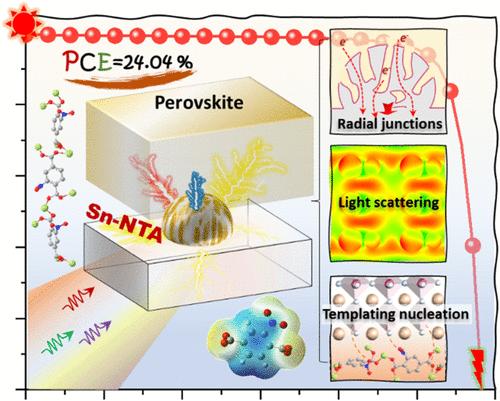
Perovskite solar cells (PSCs) employing a SnO2 electron transport layer (ETL) have consistently broken efficiency records over the past decade by developing new active materials and optimizing device structures. As a key functional layer of PSCs, the SnO2 ETL directly dictates the performance and stability of the entire device. However, the defect-induced recombination losses and the optical losses caused by suboptimal optical paths on the SnO2/perovskite interface remain major barriers to PSCs performance improvement. Therefore, from the perspective of interfacial engineering, this study designs and synthesizes a metal–organic framework (MOF) material based on tin sulfate (SnSO4) and 2-nitroterephthalic acid (NTA), namely, Sn-NTA, which combines the functions of regulating the incident optical path and passivating interface defects. The Sn-NTA nanocluster enhances light scattering at the SnO2/perovskite interface, thus increasing perovskite light absorption. Moreover, the mesoporous MOF with carboxyl groups templates the crystallization of the perovskite and enables the formation of a radial MOF/perovskite junction, accelerating charge transfer. As a result, devices based on Sn-NTA show significantly improved photovoltaic properties, achieving a high power conversion efficiency of 24.04%. This work not only provides a new method for preparing multifunctional MOF materials but also inspires future researchers to focus on the collaborative design of interface optical structures and defect termination.
期刊介绍:
ACS Sustainable Chemistry & Engineering is a prestigious weekly peer-reviewed scientific journal published by the American Chemical Society. Dedicated to advancing the principles of green chemistry and green engineering, it covers a wide array of research topics including green chemistry, green engineering, biomass, alternative energy, and life cycle assessment.
The journal welcomes submissions in various formats, including Letters, Articles, Features, and Perspectives (Reviews), that address the challenges of sustainability in the chemical enterprise and contribute to the advancement of sustainable practices. Join us in shaping the future of sustainable chemistry and engineering.



 京公网安备 11010802042870号
京ICP备2023020795号-1
京公网安备 11010802042870号
京ICP备2023020795号-1

 分享
分享
 求助内容:
求助内容: 应助结果提醒方式:
 扫码关注我们
