Yu Zhang, Zhenyu Hu, Yiyang Bi, Songlin Tian, Haoran Sun, Kai Li, Wanqiang Liu, Lianshan Sun, Wei Liu, Dong Wang
{"title":"Cold-Pressing Strategy for Constructing Simple and High-Performance Dendrite-Free Zinc Anodes for Aqueous Zinc-Ion Batteries","authors":"Yu Zhang, Zhenyu Hu, Yiyang Bi, Songlin Tian, Haoran Sun, Kai Li, Wanqiang Liu, Lianshan Sun, Wei Liu, Dong Wang","doi":"10.1021/acssuschemeng.5c00832","DOIUrl":null,"url":null,"abstract":"Dendrite growth, corrosion, and side reactions on zinc anodes significantly hinder the commercialization of aqueous zinc-ion batteries (AZIBs). To address these challenges, we propose a simple and cost-effective room-temperature cold-pressing process to build dendrite-free zinc anodes by means of a special collector-composite structure. Specifically, the symmetric cell assembled with copper mesh (CM) based Zn anodes exhibited remarkable cycling stability over 4000 h at 1 mA cm<sup>–2</sup> current density and also exhibited an exceptionally long life of over 2800 h at 5 mA cm<sup>–2</sup> current density, reflecting the Stability of Zn zinc plating/stripping cycles. In situ optical microscopy was employed to investigate the deposition behavior of the CM electrode during repeated plating and stripping processes. Density functional theory (DFT) calculates that Zn<sup>2+</sup> ions are preferentially adsorbed on the copper surface, while COMSOL simulation elucidates the homogeneous electric field and current density distribution due to the unique three-dimensional structure of the CM electrode. These synergistic effects effectively inhibited the growth of dendrites, ensuring a stable zinc deposition process. This work provides a scalable approach for designing dendrite-free zinc anodes for practical AZIB applications.","PeriodicalId":25,"journal":{"name":"ACS Sustainable Chemistry & Engineering","volume":"31 1","pages":""},"PeriodicalIF":7.3000,"publicationDate":"2025-03-28","publicationTypes":"Journal Article","fieldsOfStudy":null,"isOpenAccess":false,"openAccessPdf":"","citationCount":"0","resultStr":null,"platform":"Semanticscholar","paperid":null,"PeriodicalName":"ACS Sustainable Chemistry & Engineering","FirstCategoryId":"92","ListUrlMain":"https://doi.org/10.1021/acssuschemeng.5c00832","RegionNum":1,"RegionCategory":"化学","ArticlePicture":[],"TitleCN":null,"AbstractTextCN":null,"PMCID":null,"EPubDate":"","PubModel":"","JCR":"Q1","JCRName":"CHEMISTRY, MULTIDISCIPLINARY","Score":null,"Total":0}
引用次数: 0
Abstract
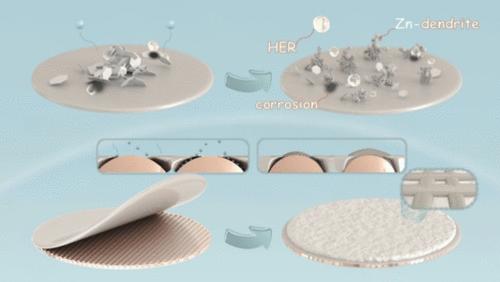
Dendrite growth, corrosion, and side reactions on zinc anodes significantly hinder the commercialization of aqueous zinc-ion batteries (AZIBs). To address these challenges, we propose a simple and cost-effective room-temperature cold-pressing process to build dendrite-free zinc anodes by means of a special collector-composite structure. Specifically, the symmetric cell assembled with copper mesh (CM) based Zn anodes exhibited remarkable cycling stability over 4000 h at 1 mA cm–2 current density and also exhibited an exceptionally long life of over 2800 h at 5 mA cm–2 current density, reflecting the Stability of Zn zinc plating/stripping cycles. In situ optical microscopy was employed to investigate the deposition behavior of the CM electrode during repeated plating and stripping processes. Density functional theory (DFT) calculates that Zn2+ ions are preferentially adsorbed on the copper surface, while COMSOL simulation elucidates the homogeneous electric field and current density distribution due to the unique three-dimensional structure of the CM electrode. These synergistic effects effectively inhibited the growth of dendrites, ensuring a stable zinc deposition process. This work provides a scalable approach for designing dendrite-free zinc anodes for practical AZIB applications.
锌阳极上的枝晶生长、腐蚀和副反应严重阻碍了水性锌离子电池(azib)的商业化。为了解决这些挑战,我们提出了一种简单且具有成本效益的室温冷压工艺,通过特殊的收集器-复合结构来构建无枝晶锌阳极。具体来说,用铜网(CM)锌阳极组装的对称电池在1 mA CM - 2电流密度下表现出超过4000 h的显著循环稳定性,在5 mA CM - 2电流密度下也表现出超过2800 h的超长寿命,反映了锌镀锌/剥离循环的稳定性。采用原位光学显微镜研究了CM电极在重复电镀和剥离过程中的沉积行为。密度泛函理论(DFT)计算得出Zn2+离子优先吸附在铜表面,而COMSOL模拟表明,由于CM电极独特的三维结构,其电场和电流密度分布均匀。这些协同效应有效地抑制了枝晶的生长,确保了锌沉积过程的稳定。这项工作为设计用于AZIB实际应用的无枝晶锌阳极提供了一种可扩展的方法。
期刊介绍:
ACS Sustainable Chemistry & Engineering is a prestigious weekly peer-reviewed scientific journal published by the American Chemical Society. Dedicated to advancing the principles of green chemistry and green engineering, it covers a wide array of research topics including green chemistry, green engineering, biomass, alternative energy, and life cycle assessment.
The journal welcomes submissions in various formats, including Letters, Articles, Features, and Perspectives (Reviews), that address the challenges of sustainability in the chemical enterprise and contribute to the advancement of sustainable practices. Join us in shaping the future of sustainable chemistry and engineering.



 京公网安备 11010802042870号
京ICP备2023020795号-1
京公网安备 11010802042870号
京ICP备2023020795号-1

 分享
分享
 求助内容:
求助内容: 应助结果提醒方式:
 扫码关注我们
