{"title":"Controlling outer-sphere solvent reorganization energy to turn on or off the function of artificial metalloenzymes","authors":"Divyansh Prakash, Suchitra Mitra, Simran Sony, Morgan Murphy, Babak Andi, Landon Ashley, Pallavi Prasad, Saumen Chakraborty","doi":"10.1038/s41467-025-57904-5","DOIUrl":null,"url":null,"abstract":"<p>Metalloenzymes play essential roles in biology. However, unraveling how outer-sphere interactions can be predictably controlled to influence their functions remains a significant challenge. Inspired by Cu enzymes, we demonstrate how variations in the primary, secondary, and outer coordination-sphere interactions of de novo designed artificial copper proteins (ArCuPs) within trimeric (3SCC) and tetrameric (4SCC) self-assemblies—featuring a trigonal Cu(His)<sub>3</sub> and a square pyramidal Cu(His)<sub>4</sub>(OH<sub>2</sub>) coordination—influence their catalytic and electron transfer properties. While 3SCC electrocatalyzes C-H oxidation, 4SCC does not. Cu<sup>I</sup>-3SCC reacts more rapidly with H<sub>2</sub>O<sub>2</sub> than O<sub>2</sub>, whereas 4SCC is less active. Electron transfer, reorganization energies, and extended H<sub>2</sub>O-mediated hydrogen bonding patterns provide insights into the observed reactivity differences. The inactivity of 4SCC is attributed to a significant solvent reorganization energy barrier mediated by a specific His---Glu hydrogen bond. When this hydrogen bond is disrupted, the solvent reorganization energy is reduced, and C-H peroxidation activity is restored.</p>","PeriodicalId":19066,"journal":{"name":"Nature Communications","volume":"2 1","pages":""},"PeriodicalIF":15.7000,"publicationDate":"2025-03-28","publicationTypes":"Journal Article","fieldsOfStudy":null,"isOpenAccess":false,"openAccessPdf":"","citationCount":"0","resultStr":null,"platform":"Semanticscholar","paperid":null,"PeriodicalName":"Nature Communications","FirstCategoryId":"103","ListUrlMain":"https://doi.org/10.1038/s41467-025-57904-5","RegionNum":1,"RegionCategory":"综合性期刊","ArticlePicture":[],"TitleCN":null,"AbstractTextCN":null,"PMCID":null,"EPubDate":"","PubModel":"","JCR":"Q1","JCRName":"MULTIDISCIPLINARY SCIENCES","Score":null,"Total":0}
引用次数: 0
Abstract
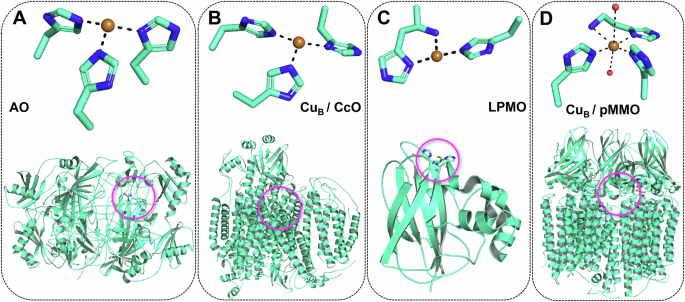
Metalloenzymes play essential roles in biology. However, unraveling how outer-sphere interactions can be predictably controlled to influence their functions remains a significant challenge. Inspired by Cu enzymes, we demonstrate how variations in the primary, secondary, and outer coordination-sphere interactions of de novo designed artificial copper proteins (ArCuPs) within trimeric (3SCC) and tetrameric (4SCC) self-assemblies—featuring a trigonal Cu(His)3 and a square pyramidal Cu(His)4(OH2) coordination—influence their catalytic and electron transfer properties. While 3SCC electrocatalyzes C-H oxidation, 4SCC does not. CuI-3SCC reacts more rapidly with H2O2 than O2, whereas 4SCC is less active. Electron transfer, reorganization energies, and extended H2O-mediated hydrogen bonding patterns provide insights into the observed reactivity differences. The inactivity of 4SCC is attributed to a significant solvent reorganization energy barrier mediated by a specific His---Glu hydrogen bond. When this hydrogen bond is disrupted, the solvent reorganization energy is reduced, and C-H peroxidation activity is restored.
期刊介绍:
Nature Communications, an open-access journal, publishes high-quality research spanning all areas of the natural sciences. Papers featured in the journal showcase significant advances relevant to specialists in each respective field. With a 2-year impact factor of 16.6 (2022) and a median time of 8 days from submission to the first editorial decision, Nature Communications is committed to rapid dissemination of research findings. As a multidisciplinary journal, it welcomes contributions from biological, health, physical, chemical, Earth, social, mathematical, applied, and engineering sciences, aiming to highlight important breakthroughs within each domain.



 京公网安备 11010802042870号
京ICP备2023020795号-1
京公网安备 11010802042870号
京ICP备2023020795号-1

 分享
分享
 求助内容:
求助内容: 应助结果提醒方式:
 扫码关注我们
