{"title":"Coreactant-free Electrochemiluminescence: ROS Generation via Upconversion Nanoparticles-Sensitized Inverse Opal TiO2 Photocatalysis under NIR Irradiation","authors":"Li-Bang Zhu, Shou-Nian Ding","doi":"10.1021/acs.analchem.5c01132","DOIUrl":null,"url":null,"abstract":"Conventional electrochemiluminescence (ECL) systems typically rely on coreactants, such as hydrogen peroxide or dissolved oxygen, to generate reactive oxygen species (ROS), which are essential for effective light emission. However, these coreactants are inherently limited by self-decomposition and solubility constraints, which can hinder the detection accuracy and light emission efficiency of ECL systems. In this work, we propose an innovative method that eliminates the need for coreactants by utilizing inverse opal TiO<sub>2</sub> (IO-TiO<sub>2</sub>) coupled with upconversion nanoparticles (UCNPs) as a coreaction accelerator. By harnessing near-infrared (NIR) irradiation, UCNPs efficiently convert this light into ultraviolet (UV) light, stimulating IO-TiO<sub>2</sub> to generate ROS through water oxidation. The generated ROS subsequently reacts with luminol anion radicals, producing robust ECL emission while eliminating interference from luminescence caused by coreactants. Electron paramagnetic resonance (EPR) results confirm the generation of hydroxyl (•OH), singlet oxygen (<sup>1</sup>O<sub>2</sub>), and superoxide anion radicals (O<sub>2</sub><sup>•–</sup>) during the electrochemical water oxidation process, which ensured the feasibility of the experimental approach. To demonstrate the practical application of this method, human chorionic gonadotropin (HCG) was selected as a model analyte. This proposed ECL immunoassay exhibited high sensitivity and stability in detecting HCG, with a linear range of 4 pg/mL to 1 μg/mL and a low limit of detection (LoD) of 1.33 pg/mL (<i>S</i>/<i>N</i> = 3). This breakthrough offers a promising avenue for developing ECL systems that are more sensitive, efficient, and highly versatile, expanding the range of applications in bioanalysis and environmental monitoring.","PeriodicalId":27,"journal":{"name":"Analytical Chemistry","volume":"30 1","pages":""},"PeriodicalIF":6.7000,"publicationDate":"2025-03-28","publicationTypes":"Journal Article","fieldsOfStudy":null,"isOpenAccess":false,"openAccessPdf":"","citationCount":"0","resultStr":null,"platform":"Semanticscholar","paperid":null,"PeriodicalName":"Analytical Chemistry","FirstCategoryId":"92","ListUrlMain":"https://doi.org/10.1021/acs.analchem.5c01132","RegionNum":1,"RegionCategory":"化学","ArticlePicture":[],"TitleCN":null,"AbstractTextCN":null,"PMCID":null,"EPubDate":"","PubModel":"","JCR":"Q1","JCRName":"CHEMISTRY, ANALYTICAL","Score":null,"Total":0}
引用次数: 0
Abstract
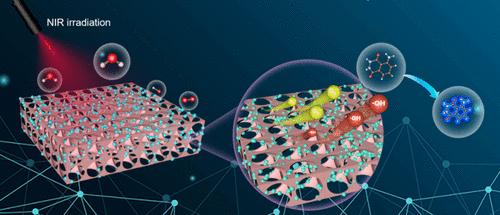
Conventional electrochemiluminescence (ECL) systems typically rely on coreactants, such as hydrogen peroxide or dissolved oxygen, to generate reactive oxygen species (ROS), which are essential for effective light emission. However, these coreactants are inherently limited by self-decomposition and solubility constraints, which can hinder the detection accuracy and light emission efficiency of ECL systems. In this work, we propose an innovative method that eliminates the need for coreactants by utilizing inverse opal TiO2 (IO-TiO2) coupled with upconversion nanoparticles (UCNPs) as a coreaction accelerator. By harnessing near-infrared (NIR) irradiation, UCNPs efficiently convert this light into ultraviolet (UV) light, stimulating IO-TiO2 to generate ROS through water oxidation. The generated ROS subsequently reacts with luminol anion radicals, producing robust ECL emission while eliminating interference from luminescence caused by coreactants. Electron paramagnetic resonance (EPR) results confirm the generation of hydroxyl (•OH), singlet oxygen (1O2), and superoxide anion radicals (O2•–) during the electrochemical water oxidation process, which ensured the feasibility of the experimental approach. To demonstrate the practical application of this method, human chorionic gonadotropin (HCG) was selected as a model analyte. This proposed ECL immunoassay exhibited high sensitivity and stability in detecting HCG, with a linear range of 4 pg/mL to 1 μg/mL and a low limit of detection (LoD) of 1.33 pg/mL (S/N = 3). This breakthrough offers a promising avenue for developing ECL systems that are more sensitive, efficient, and highly versatile, expanding the range of applications in bioanalysis and environmental monitoring.
期刊介绍:
Analytical Chemistry, a peer-reviewed research journal, focuses on disseminating new and original knowledge across all branches of analytical chemistry. Fundamental articles may explore general principles of chemical measurement science and need not directly address existing or potential analytical methodology. They can be entirely theoretical or report experimental results. Contributions may cover various phases of analytical operations, including sampling, bioanalysis, electrochemistry, mass spectrometry, microscale and nanoscale systems, environmental analysis, separations, spectroscopy, chemical reactions and selectivity, instrumentation, imaging, surface analysis, and data processing. Papers discussing known analytical methods should present a significant, original application of the method, a notable improvement, or results on an important analyte.




 京公网安备 11010802042870号
京ICP备2023020795号-1
京公网安备 11010802042870号
京ICP备2023020795号-1

 分享
分享
 求助内容:
求助内容: 应助结果提醒方式:
 扫码关注我们
