{"title":"Target-Responsive Conformation Switch of Bihairpin Molecular Beacon to Illustrate Ratiometric Fluorescence Biosensing of Dual-Emissive Silver Nanoclusters","authors":"Zhihan Zhang, Yuqing Zhang, Chunli Yang, Jiayang He, Xinyue Jia, Min Long, Ruo Yuan, Wenju Xu","doi":"10.1021/acs.analchem.5c00202","DOIUrl":null,"url":null,"abstract":"It might be intriguing to explore the tailored ability of a bihairpin-structured molecular beacon (<i>bh</i>MB) for improving reaction kinetics and assay sensitivity for a label-free ratiometric fluorescence assay of a specific trigger (<i><b>T</b></i>*), in which red and green silver nanoclusters (<i>r</i>SNC and <i>g</i>SNC) were utilized as two reverse emitting reporters. Unlike traditional dually labeled MB, herein the proposed <i>bh</i>MB was designed with two hairpin subunits for specific recognition and signaling readout. Four functional modules were included: the complement of <i><b>T</b></i>* in the identifiable hairpin, the template sequence of <i>r</i>SNC and <i>g</i>SNC in the signaling hairpin, two variable consensus loops capable of complementarily hybridizing to form one paired stem, and two stems able to merge into one new loop. Upon introducing <i><b>T</b></i>*, the conformation switch of <i>bh</i>MB was triggered via affinity linking to a cognate consensus sequence, thereby reconstructing a perfect stem–loop monohairpin structure. As such, the mutual transition of loops and stems between nonbinding and binding states was powered by a population-shift mechanism to shift the thermodynamic equilibrium toward the binding state. Benefiting from the structure confinement of <i>bh</i>MB, the local concentration of reactive species was increased to speed up the reaction kinetics. In a tailored response route, the template sequence for <i>r</i>SNC clustering was merged with increased red fluorescence, while the emission of <i>g</i>SNC was decreased, pointing to the obtained specific and sensitive ratiometric signal via built-in correction. Thus, this label-free strategy would be the first example to integrate recognizing and signaling subunits in a double-hairpin beacon for label-free biosensing and potential applications.","PeriodicalId":27,"journal":{"name":"Analytical Chemistry","volume":"36 1","pages":""},"PeriodicalIF":6.7000,"publicationDate":"2025-03-28","publicationTypes":"Journal Article","fieldsOfStudy":null,"isOpenAccess":false,"openAccessPdf":"","citationCount":"0","resultStr":null,"platform":"Semanticscholar","paperid":null,"PeriodicalName":"Analytical Chemistry","FirstCategoryId":"92","ListUrlMain":"https://doi.org/10.1021/acs.analchem.5c00202","RegionNum":1,"RegionCategory":"化学","ArticlePicture":[],"TitleCN":null,"AbstractTextCN":null,"PMCID":null,"EPubDate":"","PubModel":"","JCR":"Q1","JCRName":"CHEMISTRY, ANALYTICAL","Score":null,"Total":0}
引用次数: 0
Abstract
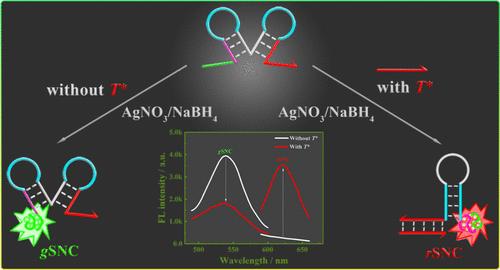
It might be intriguing to explore the tailored ability of a bihairpin-structured molecular beacon (bhMB) for improving reaction kinetics and assay sensitivity for a label-free ratiometric fluorescence assay of a specific trigger (T*), in which red and green silver nanoclusters (rSNC and gSNC) were utilized as two reverse emitting reporters. Unlike traditional dually labeled MB, herein the proposed bhMB was designed with two hairpin subunits for specific recognition and signaling readout. Four functional modules were included: the complement of T* in the identifiable hairpin, the template sequence of rSNC and gSNC in the signaling hairpin, two variable consensus loops capable of complementarily hybridizing to form one paired stem, and two stems able to merge into one new loop. Upon introducing T*, the conformation switch of bhMB was triggered via affinity linking to a cognate consensus sequence, thereby reconstructing a perfect stem–loop monohairpin structure. As such, the mutual transition of loops and stems between nonbinding and binding states was powered by a population-shift mechanism to shift the thermodynamic equilibrium toward the binding state. Benefiting from the structure confinement of bhMB, the local concentration of reactive species was increased to speed up the reaction kinetics. In a tailored response route, the template sequence for rSNC clustering was merged with increased red fluorescence, while the emission of gSNC was decreased, pointing to the obtained specific and sensitive ratiometric signal via built-in correction. Thus, this label-free strategy would be the first example to integrate recognizing and signaling subunits in a double-hairpin beacon for label-free biosensing and potential applications.
期刊介绍:
Analytical Chemistry, a peer-reviewed research journal, focuses on disseminating new and original knowledge across all branches of analytical chemistry. Fundamental articles may explore general principles of chemical measurement science and need not directly address existing or potential analytical methodology. They can be entirely theoretical or report experimental results. Contributions may cover various phases of analytical operations, including sampling, bioanalysis, electrochemistry, mass spectrometry, microscale and nanoscale systems, environmental analysis, separations, spectroscopy, chemical reactions and selectivity, instrumentation, imaging, surface analysis, and data processing. Papers discussing known analytical methods should present a significant, original application of the method, a notable improvement, or results on an important analyte.




 京公网安备 11010802042870号
京ICP备2023020795号-1
京公网安备 11010802042870号
京ICP备2023020795号-1

 分享
分享
 求助内容:
求助内容: 应助结果提醒方式:
 扫码关注我们
