Diego Fernando Nieto-Giraldo, José Mauricio Rodas Rodríguez and Javier Ignacio Torres-Osorio
{"title":"Analysis of the impact of protein conformational dynamics and intermolecular interactions on water flux through TIP3;1 aquaporins of Zea mays L.","authors":"Diego Fernando Nieto-Giraldo, José Mauricio Rodas Rodríguez and Javier Ignacio Torres-Osorio","doi":"10.1039/D4CP04661G","DOIUrl":null,"url":null,"abstract":"<p >The discovery of aquaporins (AQPs) in 1992 had a profound impact on our understanding of the mechanisms underlying the transport of substances across cell membranes. To further understand water mobilization through AQPs, this study focuses on the characterization of water flux through the TIP3;1 aquaporins of <em>Zea mays</em> L. using molecular dynamics. The primary objective is to elucidate how protein–water intermolecular interactions and protein conformational dynamics impact water mobility across the cell membrane. To conduct this analysis, the three-dimensional structure of TIP3;1 was modeled using AlphaFold2, from which the complete system was constructed. This system consisted of a homotetramer of TIP3;1 immersed in a fragment of cell membrane and solvated with water molecules and ions. Subsequently, molecular dynamics simulations were conducted for 90 ns, resulting in the determination of an osmotic permeability coefficient (<em>p</em><small><sub>f</sub></small>) of 0.8172 ± 0.146 × 10<small><sup>−14</sup></small> cm<small><sup>3</sup></small> s<small><sup>−1</sup></small>. In general, the mobility of water along the single-file water channel is influenced by the complex interplay of protein conformational dynamics and hydrogen bonding. The conformational dynamics of the protein channel modify the pore radius available for the passage of water, which affects the frequency of protein–water interactions and consequently influences the mobility of water in the channel. This study contributes to our understanding of the molecular mechanisms by which AQP activity is modulated without involving changes in protein chemical composition.</p>","PeriodicalId":99,"journal":{"name":"Physical Chemistry Chemical Physics","volume":" 15","pages":" 7797-7804"},"PeriodicalIF":2.9000,"publicationDate":"2025-03-27","publicationTypes":"Journal Article","fieldsOfStudy":null,"isOpenAccess":false,"openAccessPdf":"","citationCount":"0","resultStr":null,"platform":"Semanticscholar","paperid":null,"PeriodicalName":"Physical Chemistry Chemical Physics","FirstCategoryId":"92","ListUrlMain":"https://pubs.rsc.org/en/content/articlelanding/2025/cp/d4cp04661g","RegionNum":3,"RegionCategory":"化学","ArticlePicture":[],"TitleCN":null,"AbstractTextCN":null,"PMCID":null,"EPubDate":"","PubModel":"","JCR":"Q3","JCRName":"CHEMISTRY, PHYSICAL","Score":null,"Total":0}
引用次数: 0
Abstract
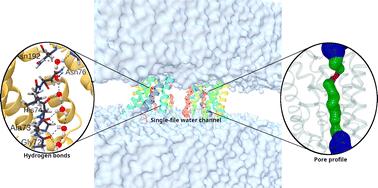
The discovery of aquaporins (AQPs) in 1992 had a profound impact on our understanding of the mechanisms underlying the transport of substances across cell membranes. To further understand water mobilization through AQPs, this study focuses on the characterization of water flux through the TIP3;1 aquaporins of Zea mays L. using molecular dynamics. The primary objective is to elucidate how protein–water intermolecular interactions and protein conformational dynamics impact water mobility across the cell membrane. To conduct this analysis, the three-dimensional structure of TIP3;1 was modeled using AlphaFold2, from which the complete system was constructed. This system consisted of a homotetramer of TIP3;1 immersed in a fragment of cell membrane and solvated with water molecules and ions. Subsequently, molecular dynamics simulations were conducted for 90 ns, resulting in the determination of an osmotic permeability coefficient (pf) of 0.8172 ± 0.146 × 10⁻¹⁴ cm3 s−1. In general, the mobility of water along the single-file water channel is influenced by the complex interplay of protein conformational dynamics and hydrogen bonding. The conformational dynamics of the protein channel modify the pore radius available for the passage of water, which affects the frequency of protein–water interactions and consequently influences the mobility of water in the channel. This study contributes to our understanding of the molecular mechanisms by which AQP activity is modulated without involving changes in protein chemical composition.
期刊介绍:
Physical Chemistry Chemical Physics (PCCP) is an international journal co-owned by 19 physical chemistry and physics societies from around the world. This journal publishes original, cutting-edge research in physical chemistry, chemical physics and biophysical chemistry. To be suitable for publication in PCCP, articles must include significant innovation and/or insight into physical chemistry; this is the most important criterion that reviewers and Editors will judge against when evaluating submissions.
The journal has a broad scope and welcomes contributions spanning experiment, theory, computation and data science. Topical coverage includes spectroscopy, dynamics, kinetics, statistical mechanics, thermodynamics, electrochemistry, catalysis, surface science, quantum mechanics, quantum computing and machine learning. Interdisciplinary research areas such as polymers and soft matter, materials, nanoscience, energy, surfaces/interfaces, and biophysical chemistry are welcomed if they demonstrate significant innovation and/or insight into physical chemistry. Joined experimental/theoretical studies are particularly appreciated when complementary and based on up-to-date approaches.





 京公网安备 11010802042870号
京ICP备2023020795号-1
京公网安备 11010802042870号
京ICP备2023020795号-1

 分享
分享
 求助内容:
求助内容: 应助结果提醒方式:
 扫码关注我们
