Gonzalo H. Soto , Daniel Balsalobre-Lorente , Xavier Martinez-Cobas
{"title":"Environmental legislative shaping or green competitive advantages? The role of FDI among environmental regulations","authors":"Gonzalo H. Soto , Daniel Balsalobre-Lorente , Xavier Martinez-Cobas","doi":"10.1016/j.eneco.2025.108445","DOIUrl":null,"url":null,"abstract":"<div><div>In this study, our aim was to investigate global patterns across a group of 98 countries spanning a 32-year timeframe, focusing on the connections between different forms of Foreign Direct Investment (FDI) and the emergence of new green fiscal measures within the context of transitioning to green economies. By utilizing machine learning methods and conducting Granger causality analyses, we based our conclusions on two core hypotheses—the impact of environmental regulations on legislation and the competitive advantages of green initiatives—centered on two primary environmental policy types: taxes and subsidies. Our results confirm a reciprocal relationship between FDI metrics and environmental policy indicators, supporting both hypotheses and indicating that FDI can prompt the development of new environmental standards, particularly evident in outward FDI scenarios, which serve as incentives for subsidy programs. Furthermore, the context of environmental fiscal policies can shape the direction of international financial flows, underscoring the importance for policymakers to endorse targeted strategies that not only attract FDI but also foster the sustainability of inbound foreign direct investments.</div></div>","PeriodicalId":11665,"journal":{"name":"Energy Economics","volume":"145 ","pages":"Article 108445"},"PeriodicalIF":14.2000,"publicationDate":"2025-03-24","publicationTypes":"Journal Article","fieldsOfStudy":null,"isOpenAccess":false,"openAccessPdf":"","citationCount":"0","resultStr":null,"platform":"Semanticscholar","paperid":null,"PeriodicalName":"Energy Economics","FirstCategoryId":"96","ListUrlMain":"https://www.sciencedirect.com/science/article/pii/S0140988325002695","RegionNum":2,"RegionCategory":"经济学","ArticlePicture":[],"TitleCN":null,"AbstractTextCN":null,"PMCID":null,"EPubDate":"","PubModel":"","JCR":"Q1","JCRName":"ECONOMICS","Score":null,"Total":0}
引用次数: 0
Abstract
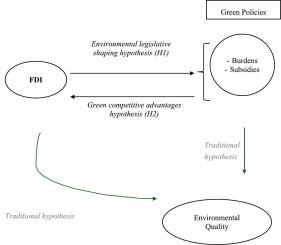
In this study, our aim was to investigate global patterns across a group of 98 countries spanning a 32-year timeframe, focusing on the connections between different forms of Foreign Direct Investment (FDI) and the emergence of new green fiscal measures within the context of transitioning to green economies. By utilizing machine learning methods and conducting Granger causality analyses, we based our conclusions on two core hypotheses—the impact of environmental regulations on legislation and the competitive advantages of green initiatives—centered on two primary environmental policy types: taxes and subsidies. Our results confirm a reciprocal relationship between FDI metrics and environmental policy indicators, supporting both hypotheses and indicating that FDI can prompt the development of new environmental standards, particularly evident in outward FDI scenarios, which serve as incentives for subsidy programs. Furthermore, the context of environmental fiscal policies can shape the direction of international financial flows, underscoring the importance for policymakers to endorse targeted strategies that not only attract FDI but also foster the sustainability of inbound foreign direct investments.
期刊介绍:
Energy Economics is a field journal that focuses on energy economics and energy finance. It covers various themes including the exploitation, conversion, and use of energy, markets for energy commodities and derivatives, regulation and taxation, forecasting, environment and climate, international trade, development, and monetary policy. The journal welcomes contributions that utilize diverse methods such as experiments, surveys, econometrics, decomposition, simulation models, equilibrium models, optimization models, and analytical models. It publishes a combination of papers employing different methods to explore a wide range of topics. The journal's replication policy encourages the submission of replication studies, wherein researchers reproduce and extend the key results of original studies while explaining any differences. Energy Economics is indexed and abstracted in several databases including Environmental Abstracts, Fuel and Energy Abstracts, Social Sciences Citation Index, GEOBASE, Social & Behavioral Sciences, Journal of Economic Literature, INSPEC, and more.




 京公网安备 11010802042870号
京ICP备2023020795号-1
京公网安备 11010802042870号
京ICP备2023020795号-1

 分享
分享
 求助内容:
求助内容: 应助结果提醒方式:
 扫码关注我们
