Jonathan Cavallo, Jared Raynes , Samuel Mandacaru , Deepa Agarwal , Lloyd Condict, Stefan Kasapis
{"title":"Physicochemical and functional comparison of food-grade and precision-fermented bovine lactoferrin","authors":"Jonathan Cavallo, Jared Raynes , Samuel Mandacaru , Deepa Agarwal , Lloyd Condict, Stefan Kasapis","doi":"10.1016/j.foodhyd.2025.111380","DOIUrl":null,"url":null,"abstract":"<div><div>This study provided a comprehensive physicochemical and functional comparison between food-grade, commercially available bovine lactoferrin (cLF) and two precision-fermented variants (pfLF_highFe and pfLF_lowFe) at varying iron saturation levels. LC-MS and FTIR/CD spectroscopy confirmed high purity and structural fidelity at primary and secondary levels, while UV–vis analysis revealed comparable molar absorptivity across all preparations. Fluorescence spectroscopy demonstrated tertiary structural variability with redshifts observed as a result of iron binding. Molecular weight (M<sub>w</sub>) comparisons made using SDS-PAGE showed pfLF_highFe and pfLF_lowFe closely resembled cLF, while glycosylation analysis demonstrated very similar N-glycan compositions and site occupancy across low iron samples. The isoelectric points (pI) of pfLF_highFe and pfLF_lowFe were similar to cLF; however, varied slightly as a function of iron saturation, as did surface hydrophobicity (S<sub>0</sub>) measurements. Thermal denaturation analyses revealed characteristic behaviour of bovine lactoferrin preparations, with differences again observed according to the preparation's iron saturation. Functional studies highlighted the iron chelating ability of native-LF preparations, cLF and pfLF_lowFe, and accompanying antimicrobial activity, but comparable interaction capacity with Lipid A (LPS) demonstrates preservation of structural and certain functional capabilities in precision-fermented bovine lactoferrin irrespective of iron saturation levels.</div></div>","PeriodicalId":320,"journal":{"name":"Food Hydrocolloids","volume":"166 ","pages":"Article 111380"},"PeriodicalIF":11.0000,"publicationDate":"2025-10-01","publicationTypes":"Journal Article","fieldsOfStudy":null,"isOpenAccess":false,"openAccessPdf":"","citationCount":"0","resultStr":null,"platform":"Semanticscholar","paperid":null,"PeriodicalName":"Food Hydrocolloids","FirstCategoryId":"97","ListUrlMain":"https://www.sciencedirect.com/science/article/pii/S0268005X25003406","RegionNum":1,"RegionCategory":"农林科学","ArticlePicture":[],"TitleCN":null,"AbstractTextCN":null,"PMCID":null,"EPubDate":"2025/3/24 0:00:00","PubModel":"Epub","JCR":"Q1","JCRName":"CHEMISTRY, APPLIED","Score":null,"Total":0}
引用次数: 0
Abstract
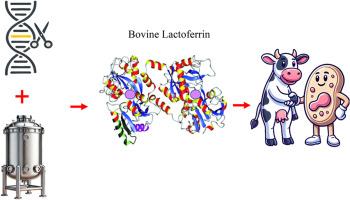
This study provided a comprehensive physicochemical and functional comparison between food-grade, commercially available bovine lactoferrin (cLF) and two precision-fermented variants (pfLF_highFe and pfLF_lowFe) at varying iron saturation levels. LC-MS and FTIR/CD spectroscopy confirmed high purity and structural fidelity at primary and secondary levels, while UV–vis analysis revealed comparable molar absorptivity across all preparations. Fluorescence spectroscopy demonstrated tertiary structural variability with redshifts observed as a result of iron binding. Molecular weight (Mw) comparisons made using SDS-PAGE showed pfLF_highFe and pfLF_lowFe closely resembled cLF, while glycosylation analysis demonstrated very similar N-glycan compositions and site occupancy across low iron samples. The isoelectric points (pI) of pfLF_highFe and pfLF_lowFe were similar to cLF; however, varied slightly as a function of iron saturation, as did surface hydrophobicity (S0) measurements. Thermal denaturation analyses revealed characteristic behaviour of bovine lactoferrin preparations, with differences again observed according to the preparation's iron saturation. Functional studies highlighted the iron chelating ability of native-LF preparations, cLF and pfLF_lowFe, and accompanying antimicrobial activity, but comparable interaction capacity with Lipid A (LPS) demonstrates preservation of structural and certain functional capabilities in precision-fermented bovine lactoferrin irrespective of iron saturation levels.
期刊介绍:
Food Hydrocolloids publishes original and innovative research focused on the characterization, functional properties, and applications of hydrocolloid materials used in food products. These hydrocolloids, defined as polysaccharides and proteins of commercial importance, are added to control aspects such as texture, stability, rheology, and sensory properties. The research's primary emphasis should be on the hydrocolloids themselves, with thorough descriptions of their source, nature, and physicochemical characteristics. Manuscripts are expected to clearly outline specific aims and objectives, include a fundamental discussion of research findings at the molecular level, and address the significance of the results. Studies on hydrocolloids in complex formulations should concentrate on their overall properties and mechanisms of action, while simple formulation development studies may not be considered for publication.
The main areas of interest are:
-Chemical and physicochemical characterisation
Thermal properties including glass transitions and conformational changes-
Rheological properties including viscosity, viscoelastic properties and gelation behaviour-
The influence on organoleptic properties-
Interfacial properties including stabilisation of dispersions, emulsions and foams-
Film forming properties with application to edible films and active packaging-
Encapsulation and controlled release of active compounds-
The influence on health including their role as dietary fibre-
Manipulation of hydrocolloid structure and functionality through chemical, biochemical and physical processes-
New hydrocolloids and hydrocolloid sources of commercial potential.
The Journal also publishes Review articles that provide an overview of the latest developments in topics of specific interest to researchers in this field of activity.




 京公网安备 11010802042870号
京ICP备2023020795号-1
京公网安备 11010802042870号
京ICP备2023020795号-1

 分享
分享
 求助内容:
求助内容: 应助结果提醒方式:
 扫码关注我们
