Jeremy W. Jacobs, Luiz Amorim, France Pirenne, Claude Tayou, Ijele Adimora, Lydia H. Pecker, Aaron A. R. Tobian, Jeannie Callum, Julie Makani, Mark T. Gladwin, Meghan Delaney, Darrell J. Triulzi, Isaac Odame, Evan M. Bloch
{"title":"The wider perspective: Barriers and recommendations for transfusion support for patients with sickle cell disease in low- and middle-income countries","authors":"Jeremy W. Jacobs, Luiz Amorim, France Pirenne, Claude Tayou, Ijele Adimora, Lydia H. Pecker, Aaron A. R. Tobian, Jeannie Callum, Julie Makani, Mark T. Gladwin, Meghan Delaney, Darrell J. Triulzi, Isaac Odame, Evan M. Bloch","doi":"10.1111/bjh.20055","DOIUrl":null,"url":null,"abstract":"<p>Globally, sickle cell disease (SCD) is the most common inherited haemoglobinopathy. The highest burden of SCD is encountered in low- and middle-income countries (LMICs), most of which lack the resources to contend with the disease. There is a marked divide between care for individuals with SCD in high-income countries (HICs) versus LMICs, whereby the few disease-modifying therapies and curative regimens are only accessible to those in HICs. As such, blood transfusion remains central to the emergent treatment and prevention of complications of SCD. However, there are a myriad of related challenges in LMICs, which have impeded efforts to treat patients with SCD effectively. In addition to blood safety and availability, examples that impact SCD specifically include capabilities to detect and/or manage red blood cell alloimmunization, capacity for automated red cell exchange, limited immunohematology, suboptimal quality oversight with a lack of safeguards to prevent transfusion of incompatible blood and limited or absent post-transfusion surveillance to detect and/or manage transfusion-associated adverse events. Consequently, clinical practices that are otherwise regarded as standard of care in HICs remain the exception in LMICs, highlighting disparities in care. A multifaceted approach that prioritizes transfusion support in LMICs is needed to improve care for patients with SCD.</p>","PeriodicalId":135,"journal":{"name":"British Journal of Haematology","volume":"206 6","pages":"1585-1592"},"PeriodicalIF":3.8000,"publicationDate":"2025-03-27","publicationTypes":"Journal Article","fieldsOfStudy":null,"isOpenAccess":false,"openAccessPdf":"https://onlinelibrary.wiley.com/doi/epdf/10.1111/bjh.20055","citationCount":"0","resultStr":null,"platform":"Semanticscholar","paperid":null,"PeriodicalName":"British Journal of Haematology","FirstCategoryId":"3","ListUrlMain":"https://onlinelibrary.wiley.com/doi/10.1111/bjh.20055","RegionNum":2,"RegionCategory":"医学","ArticlePicture":[],"TitleCN":null,"AbstractTextCN":null,"PMCID":null,"EPubDate":"","PubModel":"","JCR":"Q1","JCRName":"HEMATOLOGY","Score":null,"Total":0}
引用次数: 0
Abstract
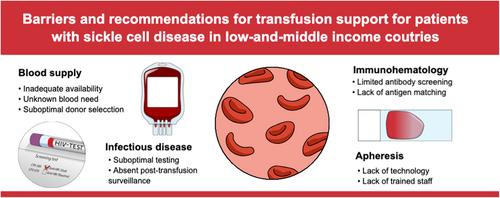
Globally, sickle cell disease (SCD) is the most common inherited haemoglobinopathy. The highest burden of SCD is encountered in low- and middle-income countries (LMICs), most of which lack the resources to contend with the disease. There is a marked divide between care for individuals with SCD in high-income countries (HICs) versus LMICs, whereby the few disease-modifying therapies and curative regimens are only accessible to those in HICs. As such, blood transfusion remains central to the emergent treatment and prevention of complications of SCD. However, there are a myriad of related challenges in LMICs, which have impeded efforts to treat patients with SCD effectively. In addition to blood safety and availability, examples that impact SCD specifically include capabilities to detect and/or manage red blood cell alloimmunization, capacity for automated red cell exchange, limited immunohematology, suboptimal quality oversight with a lack of safeguards to prevent transfusion of incompatible blood and limited or absent post-transfusion surveillance to detect and/or manage transfusion-associated adverse events. Consequently, clinical practices that are otherwise regarded as standard of care in HICs remain the exception in LMICs, highlighting disparities in care. A multifaceted approach that prioritizes transfusion support in LMICs is needed to improve care for patients with SCD.
期刊介绍:
The British Journal of Haematology publishes original research papers in clinical, laboratory and experimental haematology. The Journal also features annotations, reviews, short reports, images in haematology and Letters to the Editor.



 京公网安备 11010802042870号
京ICP备2023020795号-1
京公网安备 11010802042870号
京ICP备2023020795号-1

 分享
分享
 求助内容:
求助内容: 应助结果提醒方式:
 扫码关注我们
