{"title":"Crystal Structure Engineering Enables Enhanced Ionic Conductivity in LAGP Solid-State Electrolytes","authors":"Miaomiao Lyu, Ying Li, Chao Zhang, Wenhao Li, Chaofei Yuan, Sida Huo, Wendong Xue","doi":"10.1002/chem.202500820","DOIUrl":null,"url":null,"abstract":"<p>Solid-state lithium batteries (SSLBs) have emerged as promising energy storage systems, offering superior safety and energy density compared to conventional liquid electrolyte-based lithium-ion batteries. Among solid-state electrolytes, NASICON-type lithium aluminum germanium phosphate (LAGP) has attracted significant attention due to its exceptional air stability and wide electrochemical window. However, its practical ionic conductivity remains substantially below theoretical predictions. This study demonstrates a crystal structure engineering strategy using γ-Al<sub>2</sub>O<sub>3</sub> instead of conventional α-Al<sub>2</sub>O<sub>3</sub> as the aluminum source. The weaker Al─O bonds and higher reactivity of γ-Al<sub>2</sub>O<sub>3</sub> facilitate increased Al<sup>3</sup>⁺ incorporation into the LAGP framework, enhancing free Li⁺ concentration at M2 sites and boosting bulk ionic conductivity. Furthermore, γ-Al<sub>2</sub>O<sub>3</sub> addition reduces AlPO<sub>4</sub> impurities and improves morphological uniformity, thereby optimizing grain boundary conductivity. The optimized γ-Al<sub>2</sub>O<sub>3</sub>-derived LAGP achieves a threefold enhancement in lithium-ion conductivity, reaching 6.04 × 10<sup>−4</sup> (total) and 2.77 × 10<sup>−3</sup> S cm<sup>−1</sup> (intracrystalline), representing a significant advancement in solid electrolyte performance.</p>","PeriodicalId":144,"journal":{"name":"Chemistry - A European Journal","volume":"31 27","pages":""},"PeriodicalIF":3.7000,"publicationDate":"2025-03-28","publicationTypes":"Journal Article","fieldsOfStudy":null,"isOpenAccess":false,"openAccessPdf":"","citationCount":"0","resultStr":null,"platform":"Semanticscholar","paperid":null,"PeriodicalName":"Chemistry - A European Journal","FirstCategoryId":"92","ListUrlMain":"https://chemistry-europe.onlinelibrary.wiley.com/doi/10.1002/chem.202500820","RegionNum":2,"RegionCategory":"化学","ArticlePicture":[],"TitleCN":null,"AbstractTextCN":null,"PMCID":null,"EPubDate":"","PubModel":"","JCR":"Q2","JCRName":"CHEMISTRY, MULTIDISCIPLINARY","Score":null,"Total":0}
引用次数: 0
Abstract
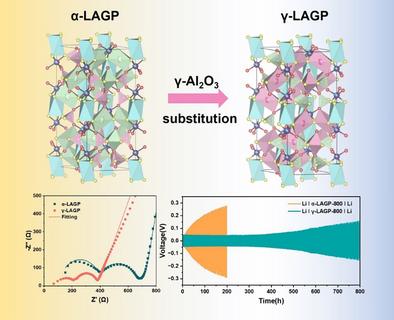
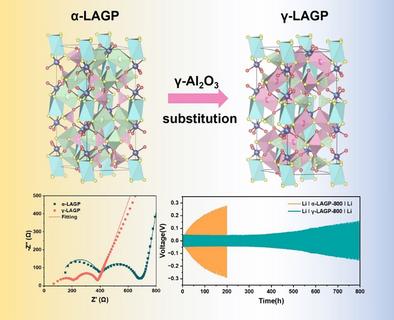
Solid-state lithium batteries (SSLBs) have emerged as promising energy storage systems, offering superior safety and energy density compared to conventional liquid electrolyte-based lithium-ion batteries. Among solid-state electrolytes, NASICON-type lithium aluminum germanium phosphate (LAGP) has attracted significant attention due to its exceptional air stability and wide electrochemical window. However, its practical ionic conductivity remains substantially below theoretical predictions. This study demonstrates a crystal structure engineering strategy using γ-Al2O3 instead of conventional α-Al2O3 as the aluminum source. The weaker Al─O bonds and higher reactivity of γ-Al2O3 facilitate increased Al3⁺ incorporation into the LAGP framework, enhancing free Li⁺ concentration at M2 sites and boosting bulk ionic conductivity. Furthermore, γ-Al2O3 addition reduces AlPO4 impurities and improves morphological uniformity, thereby optimizing grain boundary conductivity. The optimized γ-Al2O3-derived LAGP achieves a threefold enhancement in lithium-ion conductivity, reaching 6.04 × 10⁻⁴ (total) and 2.77 × 10⁻³ S cm−1 (intracrystalline), representing a significant advancement in solid electrolyte performance.
固态锂电池(sslb)已经成为一种很有前途的储能系统,与传统的液体电解质锂离子电池相比,它具有更高的安全性和能量密度。在固态电解质中,nasicon型磷酸锂铝锗(LAGP)因其优异的空气稳定性和宽的电化学窗口而备受关注。然而,它的实际离子电导率仍然大大低于理论预测。本研究展示了以γ-Al2O3代替传统α-Al2O3作为铝源的晶体结构工程策略。较弱的Al-O键和较高的γ-Al2O3反应活性有助于增加Al3+在LAGP框架中的掺入,提高M2位点的自由Li+浓度,提高整体离子电导率。此外,γ-Al2O3的加入减少了AlPO4杂质,提高了形貌均匀性,从而优化了晶界电导率。优化后的γ- al2o3衍生LAGP实现了锂离子电导率的三倍增强,达到6.04 × 10⁻⁴ S cm-1(总)和2.77 × 10⁻³ S cm-1(晶内),代表了固体电解质性能的显着进步。
期刊介绍:
Chemistry—A European Journal is a truly international journal with top quality contributions (2018 ISI Impact Factor: 5.16). It publishes a wide range of outstanding Reviews, Minireviews, Concepts, Full Papers, and Communications from all areas of chemistry and related fields.
Based in Europe Chemistry—A European Journal provides an excellent platform for increasing the visibility of European chemistry as well as for featuring the best research from authors from around the world.
All manuscripts are peer-reviewed, and electronic processing ensures accurate reproduction of text and data, plus short publication times.
The Concepts section provides nonspecialist readers with a useful conceptual guide to unfamiliar areas and experts with new angles on familiar problems.
Chemistry—A European Journal is published on behalf of ChemPubSoc Europe, a group of 16 national chemical societies from within Europe, and supported by the Asian Chemical Editorial Societies. The ChemPubSoc Europe family comprises: Angewandte Chemie, Chemistry—A European Journal, European Journal of Organic Chemistry, European Journal of Inorganic Chemistry, ChemPhysChem, ChemBioChem, ChemMedChem, ChemCatChem, ChemSusChem, ChemPlusChem, ChemElectroChem, and ChemistryOpen.





 京公网安备 11010802042870号
京ICP备2023020795号-1
京公网安备 11010802042870号
京ICP备2023020795号-1

 分享
分享
 求助内容:
求助内容: 应助结果提醒方式:
 扫码关注我们
