Elena-Daniela Lotos, Roxana Dinu, Marcela Mihai, Bogdan C. Simionescu, Alice Mija
{"title":"Development of Eco-Friendly Thermosetting Resins From Zein and Diglycidyl Ether of Vanillyl Alcohol. A Step Toward Sustainable Materials","authors":"Elena-Daniela Lotos, Roxana Dinu, Marcela Mihai, Bogdan C. Simionescu, Alice Mija","doi":"10.1002/chem.202500624","DOIUrl":null,"url":null,"abstract":"<p>Herein, bisphenol A-free, biobased, and sustainable thermosets were obtained for the first time by using two naturally derived compounds. Zein, a renewable biopolymer extracted from maize, exhibited excellent reactivity and versatility, while the diglycidyl ether of vanillyl alcohol (DGEVA), a biobased epoxy monomer derived from vanillin, served as a sustainable alternative to petrochemical epoxides. By chemically integrating Zein into DGEVA thermosetting networks, environmentally friendly resins with excellent thermomechanical properties were developed. A comprehensive analysis of seven formulations, incorporating up to 30 wt.% Zein, provided critical insights into the relationship between protein content and resin properties. Differential scanning calorimetry (DSC) analysis highlighted a strong interaction between Zein and DGEVA's epoxy groups, resulting in significantly higher polymerization enthalpies compared to neat DGEVA homopolymerization. This indicates the formation of robust crosslinked networks driven by Zein's multifunctional groups. Dynamic mechanical analysis (DMA) demonstrated substantial improvements in the thermosets’ glass transition (<i>T</i><sub>g</sub>), with values increasing from 52°C in neat DGEVA to 73°C in DGEVA/30% Zein systems, indicating enhanced stiffness and thermal performance. Furthermore, thermogravimetric analysis (TGA) confirmed good thermal stability of the bioresins, with degradation temperatures exceeding 300°C. Beyond these technical achievements, this study underscores the broader significance of incorporating Zein, a byproduct of corn agriculture, into biobased thermosets.</p>","PeriodicalId":144,"journal":{"name":"Chemistry - A European Journal","volume":"31 27","pages":""},"PeriodicalIF":3.7000,"publicationDate":"2025-03-28","publicationTypes":"Journal Article","fieldsOfStudy":null,"isOpenAccess":false,"openAccessPdf":"https://onlinelibrary.wiley.com/doi/epdf/10.1002/chem.202500624","citationCount":"0","resultStr":null,"platform":"Semanticscholar","paperid":null,"PeriodicalName":"Chemistry - A European Journal","FirstCategoryId":"92","ListUrlMain":"https://chemistry-europe.onlinelibrary.wiley.com/doi/10.1002/chem.202500624","RegionNum":2,"RegionCategory":"化学","ArticlePicture":[],"TitleCN":null,"AbstractTextCN":null,"PMCID":null,"EPubDate":"","PubModel":"","JCR":"Q2","JCRName":"CHEMISTRY, MULTIDISCIPLINARY","Score":null,"Total":0}
引用次数: 0
Abstract
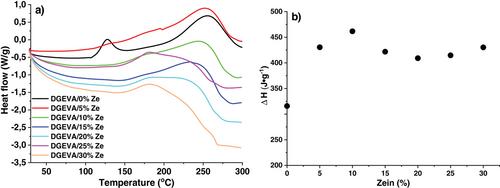
Herein, bisphenol A-free, biobased, and sustainable thermosets were obtained for the first time by using two naturally derived compounds. Zein, a renewable biopolymer extracted from maize, exhibited excellent reactivity and versatility, while the diglycidyl ether of vanillyl alcohol (DGEVA), a biobased epoxy monomer derived from vanillin, served as a sustainable alternative to petrochemical epoxides. By chemically integrating Zein into DGEVA thermosetting networks, environmentally friendly resins with excellent thermomechanical properties were developed. A comprehensive analysis of seven formulations, incorporating up to 30 wt.% Zein, provided critical insights into the relationship between protein content and resin properties. Differential scanning calorimetry (DSC) analysis highlighted a strong interaction between Zein and DGEVA's epoxy groups, resulting in significantly higher polymerization enthalpies compared to neat DGEVA homopolymerization. This indicates the formation of robust crosslinked networks driven by Zein's multifunctional groups. Dynamic mechanical analysis (DMA) demonstrated substantial improvements in the thermosets’ glass transition (Tg), with values increasing from 52°C in neat DGEVA to 73°C in DGEVA/30% Zein systems, indicating enhanced stiffness and thermal performance. Furthermore, thermogravimetric analysis (TGA) confirmed good thermal stability of the bioresins, with degradation temperatures exceeding 300°C. Beyond these technical achievements, this study underscores the broader significance of incorporating Zein, a byproduct of corn agriculture, into biobased thermosets.
期刊介绍:
Chemistry—A European Journal is a truly international journal with top quality contributions (2018 ISI Impact Factor: 5.16). It publishes a wide range of outstanding Reviews, Minireviews, Concepts, Full Papers, and Communications from all areas of chemistry and related fields.
Based in Europe Chemistry—A European Journal provides an excellent platform for increasing the visibility of European chemistry as well as for featuring the best research from authors from around the world.
All manuscripts are peer-reviewed, and electronic processing ensures accurate reproduction of text and data, plus short publication times.
The Concepts section provides nonspecialist readers with a useful conceptual guide to unfamiliar areas and experts with new angles on familiar problems.
Chemistry—A European Journal is published on behalf of ChemPubSoc Europe, a group of 16 national chemical societies from within Europe, and supported by the Asian Chemical Editorial Societies. The ChemPubSoc Europe family comprises: Angewandte Chemie, Chemistry—A European Journal, European Journal of Organic Chemistry, European Journal of Inorganic Chemistry, ChemPhysChem, ChemBioChem, ChemMedChem, ChemCatChem, ChemSusChem, ChemPlusChem, ChemElectroChem, and ChemistryOpen.






 京公网安备 11010802042870号
京ICP备2023020795号-1
京公网安备 11010802042870号
京ICP备2023020795号-1

 分享
分享
 求助内容:
求助内容: 应助结果提醒方式:
 扫码关注我们
