Fruzsina Bencs, Loránd Románszki, Viktor Farkas, András Perczel
{"title":"Structural Insights Into Amyloid Polymorphism: The Impact of Glutamine to Norleucine Substitutions in GNNQQNY Aggregation","authors":"Fruzsina Bencs, Loránd Románszki, Viktor Farkas, András Perczel","doi":"10.1002/chem.202404255","DOIUrl":null,"url":null,"abstract":"<p>Polypeptides can self-assemble into highly organized amyloid structures through complex and poorly understood mechanisms. To better understand the key parameters governing amyloidogenesis, we investigated the aggregation of the Sup35 prion-derived GNNQQNY sequence alongside two rationally designed mutants, glutamine to norleucine in the 4th or 5th position, where selective removal of hydrogen bonding capacity reduces amyloid structural stability. Our findings reveal that <b>β-sheet arrays</b> form rapidly as an initial step, followed by π–π aromatic interactions between Tyr residues, which drive hierarchical self-assembly into 3D fibrillar structures via hydrophobic zippers and partial water exclusion. As the oligomers grow, they also acquire twist and chirality at the protofilament level, with Tyr ladders serving as key interaction surfaces that dictate the final amyloid architecture. These ladders guide protofibrils to assemble into either oppositely twisted chiral fibers or achiral nanocrystals, contributing to amyloid polymorphism. The emergence of distinct polymorphs is influenced by multiple factors, including fibril twisting, side-chain interactions, solvent exclusion, and local microenvironmental conditions. Our study provides crucial insights into the hierarchical nature of amyloid self-assembly and highlights the structural adaptability of amyloid fibrils, which is essential for designing functional amyloids and understanding the pathogenicity of disease-associated aggregates.</p>","PeriodicalId":144,"journal":{"name":"Chemistry - A European Journal","volume":"31 26","pages":""},"PeriodicalIF":3.7000,"publicationDate":"2025-03-28","publicationTypes":"Journal Article","fieldsOfStudy":null,"isOpenAccess":false,"openAccessPdf":"https://onlinelibrary.wiley.com/doi/epdf/10.1002/chem.202404255","citationCount":"0","resultStr":null,"platform":"Semanticscholar","paperid":null,"PeriodicalName":"Chemistry - A European Journal","FirstCategoryId":"92","ListUrlMain":"https://chemistry-europe.onlinelibrary.wiley.com/doi/10.1002/chem.202404255","RegionNum":2,"RegionCategory":"化学","ArticlePicture":[],"TitleCN":null,"AbstractTextCN":null,"PMCID":null,"EPubDate":"","PubModel":"","JCR":"Q2","JCRName":"CHEMISTRY, MULTIDISCIPLINARY","Score":null,"Total":0}
引用次数: 0
Abstract
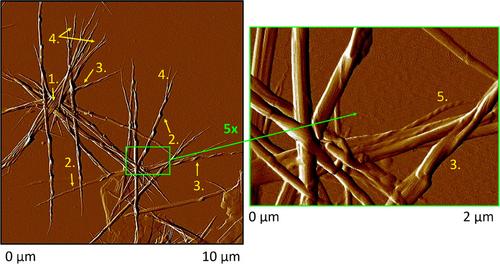
Polypeptides can self-assemble into highly organized amyloid structures through complex and poorly understood mechanisms. To better understand the key parameters governing amyloidogenesis, we investigated the aggregation of the Sup35 prion-derived GNNQQNY sequence alongside two rationally designed mutants, glutamine to norleucine in the 4th or 5th position, where selective removal of hydrogen bonding capacity reduces amyloid structural stability. Our findings reveal that β-sheet arrays form rapidly as an initial step, followed by π–π aromatic interactions between Tyr residues, which drive hierarchical self-assembly into 3D fibrillar structures via hydrophobic zippers and partial water exclusion. As the oligomers grow, they also acquire twist and chirality at the protofilament level, with Tyr ladders serving as key interaction surfaces that dictate the final amyloid architecture. These ladders guide protofibrils to assemble into either oppositely twisted chiral fibers or achiral nanocrystals, contributing to amyloid polymorphism. The emergence of distinct polymorphs is influenced by multiple factors, including fibril twisting, side-chain interactions, solvent exclusion, and local microenvironmental conditions. Our study provides crucial insights into the hierarchical nature of amyloid self-assembly and highlights the structural adaptability of amyloid fibrils, which is essential for designing functional amyloids and understanding the pathogenicity of disease-associated aggregates.
期刊介绍:
Chemistry—A European Journal is a truly international journal with top quality contributions (2018 ISI Impact Factor: 5.16). It publishes a wide range of outstanding Reviews, Minireviews, Concepts, Full Papers, and Communications from all areas of chemistry and related fields.
Based in Europe Chemistry—A European Journal provides an excellent platform for increasing the visibility of European chemistry as well as for featuring the best research from authors from around the world.
All manuscripts are peer-reviewed, and electronic processing ensures accurate reproduction of text and data, plus short publication times.
The Concepts section provides nonspecialist readers with a useful conceptual guide to unfamiliar areas and experts with new angles on familiar problems.
Chemistry—A European Journal is published on behalf of ChemPubSoc Europe, a group of 16 national chemical societies from within Europe, and supported by the Asian Chemical Editorial Societies. The ChemPubSoc Europe family comprises: Angewandte Chemie, Chemistry—A European Journal, European Journal of Organic Chemistry, European Journal of Inorganic Chemistry, ChemPhysChem, ChemBioChem, ChemMedChem, ChemCatChem, ChemSusChem, ChemPlusChem, ChemElectroChem, and ChemistryOpen.





 京公网安备 11010802042870号
京ICP备2023020795号-1
京公网安备 11010802042870号
京ICP备2023020795号-1

 分享
分享
 求助内容:
求助内容: 应助结果提醒方式:
 扫码关注我们
