Lara A Ray, Erica N Grodin, Wave-Ananda Baskerville, Suzanna Donato, Alondra Cruz, Amanda K Montoya
{"title":"Identifying responders to gabapentin for the treatment of alcohol use disorder: an exploratory machine learning approach.","authors":"Lara A Ray, Erica N Grodin, Wave-Ananda Baskerville, Suzanna Donato, Alondra Cruz, Amanda K Montoya","doi":"10.1093/alcalc/agaf010","DOIUrl":null,"url":null,"abstract":"<p><strong>Background: </strong>Gabapentin, an anticonvulsant medication, has been proposed as a treatment for alcohol use disorder (AUD). A multisite study tested gabapentin enacarbil extended-release (GE-XR; 600 mg/twice a day), a prodrug formulation, combined with a computerized behavioral intervention, for AUD. In this multisite trial, the gabapentin GE-XR group did not differ significantly from placebo on the primary outcome of percent of subjects with no heavy drinking days. Despite the null findings, there is considerable interest in using machine learning methods to identify responders to GE-XR. The present study applies interaction tree machine learning methods to identify positive and iatrogenic (i.e. individuals who responded better to placebo than to GE-XR) treatment responders in the trial.</p><p><strong>Methods: </strong>Baseline characteristics taken from the multisite trial were examined as potential moderators of treatment response using qualitative interaction trees (QUINT; N = 338; 223 M/115F). QUINT models are an exploratory decision tree approach that iteratively splits the data into leaves based on predictor variables to maximize a specific criterion.</p><p><strong>Results: </strong>Analyses identified key factors that are associated with the efficacy (or iatrogenic effects) of GE-XR for AUD. Such factors are baseline drinking levels, motivation for change, confidence in their ability to reach drinking goals (i.e. self-efficacy), cognitive impulsivity, and baseline anxiety levels.</p><p><strong>Conclusion: </strong>Baseline drinking levels and anxiety levels may be associated with the protracted withdrawal syndrome, previously implicated in the clinical response to gabapentin. However, these analyses underscore motivation for change and self-efficacy as predictors of clinical response to GE-XR, suggesting these established constructs should receive further attention in gabapentin research and clinical practice. Multiple studies using different machine learning methods are valuable as these novel analytic tools are applied to medication development for AUD.</p>","PeriodicalId":7407,"journal":{"name":"Alcohol and alcoholism","volume":"60 3","pages":""},"PeriodicalIF":2.2000,"publicationDate":"2025-03-25","publicationTypes":"Journal Article","fieldsOfStudy":null,"isOpenAccess":false,"openAccessPdf":"https://www.ncbi.nlm.nih.gov/pmc/articles/PMC11938997/pdf/","citationCount":"0","resultStr":null,"platform":"Semanticscholar","paperid":null,"PeriodicalName":"Alcohol and alcoholism","FirstCategoryId":"3","ListUrlMain":"https://doi.org/10.1093/alcalc/agaf010","RegionNum":4,"RegionCategory":"医学","ArticlePicture":[],"TitleCN":null,"AbstractTextCN":null,"PMCID":null,"EPubDate":"","PubModel":"","JCR":"Q3","JCRName":"SUBSTANCE ABUSE","Score":null,"Total":0}
引用次数: 0
Abstract
Background: Gabapentin, an anticonvulsant medication, has been proposed as a treatment for alcohol use disorder (AUD). A multisite study tested gabapentin enacarbil extended-release (GE-XR; 600 mg/twice a day), a prodrug formulation, combined with a computerized behavioral intervention, for AUD. In this multisite trial, the gabapentin GE-XR group did not differ significantly from placebo on the primary outcome of percent of subjects with no heavy drinking days. Despite the null findings, there is considerable interest in using machine learning methods to identify responders to GE-XR. The present study applies interaction tree machine learning methods to identify positive and iatrogenic (i.e. individuals who responded better to placebo than to GE-XR) treatment responders in the trial.
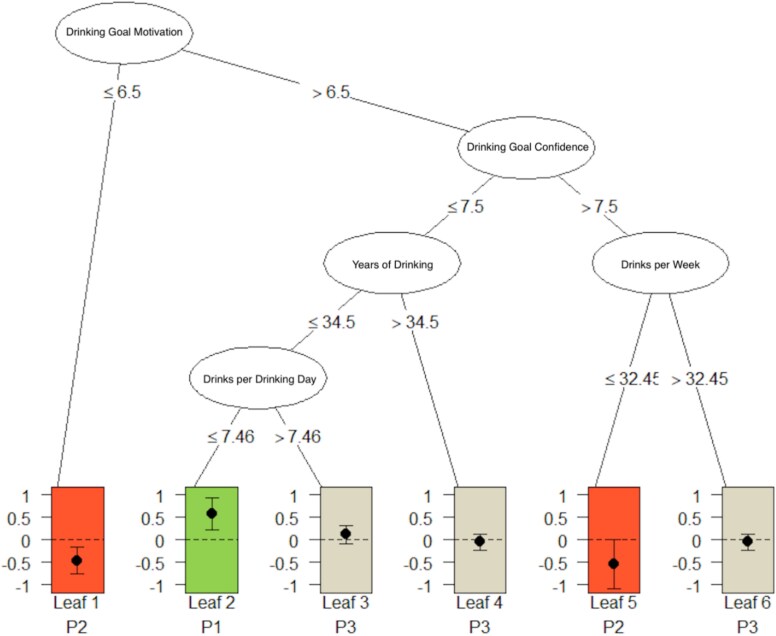
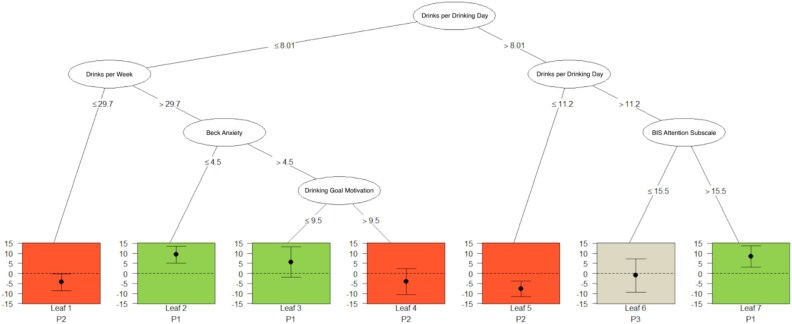
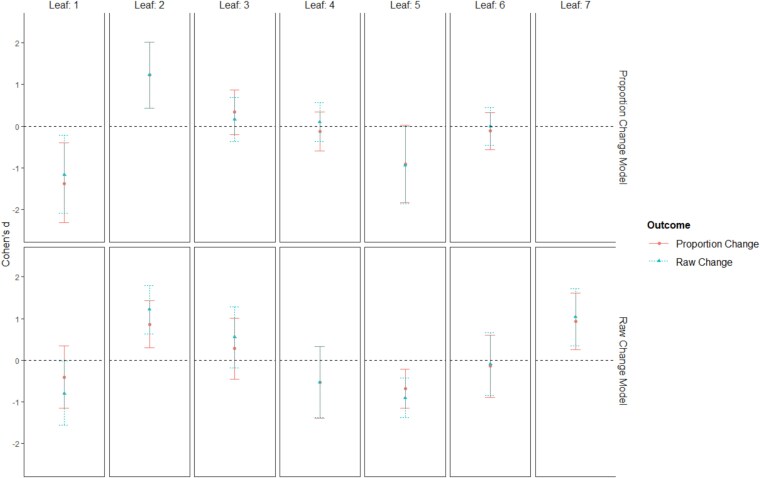
Methods: Baseline characteristics taken from the multisite trial were examined as potential moderators of treatment response using qualitative interaction trees (QUINT; N = 338; 223 M/115F). QUINT models are an exploratory decision tree approach that iteratively splits the data into leaves based on predictor variables to maximize a specific criterion.
Results: Analyses identified key factors that are associated with the efficacy (or iatrogenic effects) of GE-XR for AUD. Such factors are baseline drinking levels, motivation for change, confidence in their ability to reach drinking goals (i.e. self-efficacy), cognitive impulsivity, and baseline anxiety levels.
Conclusion: Baseline drinking levels and anxiety levels may be associated with the protracted withdrawal syndrome, previously implicated in the clinical response to gabapentin. However, these analyses underscore motivation for change and self-efficacy as predictors of clinical response to GE-XR, suggesting these established constructs should receive further attention in gabapentin research and clinical practice. Multiple studies using different machine learning methods are valuable as these novel analytic tools are applied to medication development for AUD.
期刊介绍:
About the Journal
Alcohol and Alcoholism publishes papers on the biomedical, psychological, and sociological aspects of alcoholism and alcohol research, provided that they make a new and significant contribution to knowledge in the field.
Papers include new results obtained experimentally, descriptions of new experimental (including clinical) methods of importance to the field of alcohol research and treatment, or new interpretations of existing results.
Theoretical contributions are considered equally with papers dealing with experimental work provided that such theoretical contributions are not of a largely speculative or philosophical nature.



 京公网安备 11010802042870号
京ICP备2023020795号-1
京公网安备 11010802042870号
京ICP备2023020795号-1

 分享
分享
 求助内容:
求助内容: 应助结果提醒方式:
 扫码关注我们
