The effect of home-based behavioural weight loss combined with pelvic floor muscle training in women seeking weight loss combined with stress urinary incontinence: protocol for a randomised controlled trial.
Zhao Tian, Xiuqi Wang, Linru Fu, Zhe Du, Tangdi Lin, Wei Chen, Zhijing Sun
{"title":"The effect of home-based behavioural weight loss combined with pelvic floor muscle training in women seeking weight loss combined with stress urinary incontinence: protocol for a randomised controlled trial.","authors":"Zhao Tian, Xiuqi Wang, Linru Fu, Zhe Du, Tangdi Lin, Wei Chen, Zhijing Sun","doi":"10.1136/bmjopen-2024-092789","DOIUrl":null,"url":null,"abstract":"<p><strong>Introduction: </strong>Recent guidelines suggest behavioural weight loss (BWL) and pelvic floor muscle training (PFMT) as first-line treatment approaches for women with both obesity and stress urinary incontinence (SUI). However, the optimal therapeutic and management strategies for these populations remain uncertain.</p><p><strong>Methods and analysis: </strong>This assessor-blinded parallel-group randomised controlled trial aims to compare the efficacy of BWL alone, BWL plus conventional PFMT and BWL plus PFMT with a biofeedback device for women who are overweight or obese experiencing SUI or SUI-predominant mixed urinary incontinence. A total of 120 eligible women will be randomly assigned at a 1:1:1 ratio. All the three groups will be subjected to a 3-month self-supervision intervention after randomisation and will be assessed at baseline, after the 3-month intervention, 6 months after the intervention and 12 months after the intervention. The primary outcome measure is the self-reported severity of urinary incontinence assessed by the International Consultation on Incontinence Questionnaire-Urinary Incontinence short form. The secondary outcomes include weight loss effectiveness, pelvic muscle strength, pelvic floor ultrasound, three-dimensional body posture, adherence to the intervention and questionnaires for symptoms of pelvic organ prolapse, quality of life and sexual function.</p><p><strong>Ethics and dissemination: </strong>This study has been approved by the Peking Union Medical College Hospital ethics committee (K5504). All results from the study will be submitted to international journals and international conferences.</p><p><strong>Trial registration number: </strong>This trial has been registered with the Chinese Clinical Trial Registry (ChiCTR2400084015).</p>","PeriodicalId":9158,"journal":{"name":"BMJ Open","volume":"15 3","pages":"e092789"},"PeriodicalIF":2.3000,"publicationDate":"2025-03-27","publicationTypes":"Journal Article","fieldsOfStudy":null,"isOpenAccess":false,"openAccessPdf":"https://www.ncbi.nlm.nih.gov/pmc/articles/PMC11956368/pdf/","citationCount":"0","resultStr":null,"platform":"Semanticscholar","paperid":null,"PeriodicalName":"BMJ Open","FirstCategoryId":"3","ListUrlMain":"https://doi.org/10.1136/bmjopen-2024-092789","RegionNum":3,"RegionCategory":"医学","ArticlePicture":[],"TitleCN":null,"AbstractTextCN":null,"PMCID":null,"EPubDate":"","PubModel":"","JCR":"Q1","JCRName":"MEDICINE, GENERAL & INTERNAL","Score":null,"Total":0}
引用次数: 0
Abstract
Introduction: Recent guidelines suggest behavioural weight loss (BWL) and pelvic floor muscle training (PFMT) as first-line treatment approaches for women with both obesity and stress urinary incontinence (SUI). However, the optimal therapeutic and management strategies for these populations remain uncertain.
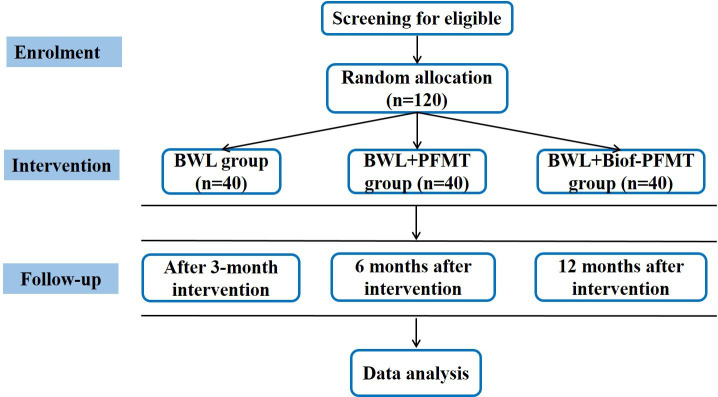
Methods and analysis: This assessor-blinded parallel-group randomised controlled trial aims to compare the efficacy of BWL alone, BWL plus conventional PFMT and BWL plus PFMT with a biofeedback device for women who are overweight or obese experiencing SUI or SUI-predominant mixed urinary incontinence. A total of 120 eligible women will be randomly assigned at a 1:1:1 ratio. All the three groups will be subjected to a 3-month self-supervision intervention after randomisation and will be assessed at baseline, after the 3-month intervention, 6 months after the intervention and 12 months after the intervention. The primary outcome measure is the self-reported severity of urinary incontinence assessed by the International Consultation on Incontinence Questionnaire-Urinary Incontinence short form. The secondary outcomes include weight loss effectiveness, pelvic muscle strength, pelvic floor ultrasound, three-dimensional body posture, adherence to the intervention and questionnaires for symptoms of pelvic organ prolapse, quality of life and sexual function.
Ethics and dissemination: This study has been approved by the Peking Union Medical College Hospital ethics committee (K5504). All results from the study will be submitted to international journals and international conferences.
Trial registration number: This trial has been registered with the Chinese Clinical Trial Registry (ChiCTR2400084015).
期刊介绍:
BMJ Open is an online, open access journal, dedicated to publishing medical research from all disciplines and therapeutic areas. The journal publishes all research study types, from study protocols to phase I trials to meta-analyses, including small or specialist studies. Publishing procedures are built around fully open peer review and continuous publication, publishing research online as soon as the article is ready.



 京公网安备 11010802042870号
京ICP备2023020795号-1
京公网安备 11010802042870号
京ICP备2023020795号-1

 分享
分享
 求助内容:
求助内容: 应助结果提醒方式:
 扫码关注我们
