{"title":"Evaluation of Hologic LOCalizer™ RFID Tags for Preoperative Localization of Breast Lesions: A Single-Center Experience.","authors":"Charlotte Munday, Anmol Malhotra, Sawsan Taif, Adeola Omotade, Arathi Menon, Kefah Mokbel","doi":"10.3390/diagnostics15060746","DOIUrl":null,"url":null,"abstract":"<p><p><b>Background</b>: The increasing detection of non-palpable breast lesions necessitates accurate preoperative localization to ensure complete excision while preserving healthy tissue and optimizing cosmetic outcomes. Traditional wire-guided localization (WL) has been the gold standard; however, it has several drawbacks, including patient discomfort and scheduling challenges. This study evaluates the accuracy and feasibility of radiofrequency identification (RFID) tag localization using the Hologic LOCalizer™ system as an alternative technique. <b>Methods</b>: This retrospective study included 258 consecutive patients who underwent image-guided RFID tag localization from March 2021 to February 2023 from a single-center London breast unit. The primary outcome measured was the accuracy of RFID tag placement, defined as within 10 mm of the target lesion on post-clip mammograms. Secondary outcomes included type and size of lesions, re-excision rates, review of post-operative specimen radiographs, and patient demographics. <b>Results</b>: A total of 297 RFID tags were placed, with 95.6% accurately positioned within the target range. The median target size was 29 mm, with the most common abnormalities being mass lesions (64%). Among the 13 inaccurately placed RFID tags (4.4%), all were identified preoperatively, with two requiring additional wire placements. RFID tags were successfully identified in 92% of specimen radiographs, and 8% of patients required re-excision due to positive or close margins. Notably, patients with multiple RFID tags showed a higher incidence of re-excision. <b>Conclusions</b>: The LOCalizer™ RFID system demonstrated a high accuracy rate for preoperative localization of breast lesions, presenting a viable alternative to WL. This technique improves surgical scheduling flexibility and enhances patient comfort. Comparative studies with other wire-free localization technologies, such as magnetic seeds and radar reflectors, are needed to determine the optimal approach for clinical practice.</p>","PeriodicalId":11225,"journal":{"name":"Diagnostics","volume":"15 6","pages":""},"PeriodicalIF":3.3000,"publicationDate":"2025-03-17","publicationTypes":"Journal Article","fieldsOfStudy":null,"isOpenAccess":false,"openAccessPdf":"https://www.ncbi.nlm.nih.gov/pmc/articles/PMC11941596/pdf/","citationCount":"0","resultStr":null,"platform":"Semanticscholar","paperid":null,"PeriodicalName":"Diagnostics","FirstCategoryId":"3","ListUrlMain":"https://doi.org/10.3390/diagnostics15060746","RegionNum":3,"RegionCategory":"医学","ArticlePicture":[],"TitleCN":null,"AbstractTextCN":null,"PMCID":null,"EPubDate":"","PubModel":"","JCR":"Q1","JCRName":"MEDICINE, GENERAL & INTERNAL","Score":null,"Total":0}
引用次数: 0
Abstract
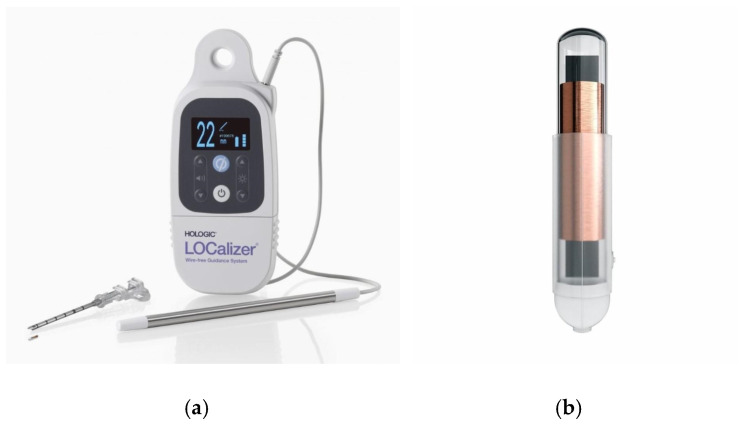
Background: The increasing detection of non-palpable breast lesions necessitates accurate preoperative localization to ensure complete excision while preserving healthy tissue and optimizing cosmetic outcomes. Traditional wire-guided localization (WL) has been the gold standard; however, it has several drawbacks, including patient discomfort and scheduling challenges. This study evaluates the accuracy and feasibility of radiofrequency identification (RFID) tag localization using the Hologic LOCalizer™ system as an alternative technique. Methods: This retrospective study included 258 consecutive patients who underwent image-guided RFID tag localization from March 2021 to February 2023 from a single-center London breast unit. The primary outcome measured was the accuracy of RFID tag placement, defined as within 10 mm of the target lesion on post-clip mammograms. Secondary outcomes included type and size of lesions, re-excision rates, review of post-operative specimen radiographs, and patient demographics. Results: A total of 297 RFID tags were placed, with 95.6% accurately positioned within the target range. The median target size was 29 mm, with the most common abnormalities being mass lesions (64%). Among the 13 inaccurately placed RFID tags (4.4%), all were identified preoperatively, with two requiring additional wire placements. RFID tags were successfully identified in 92% of specimen radiographs, and 8% of patients required re-excision due to positive or close margins. Notably, patients with multiple RFID tags showed a higher incidence of re-excision. Conclusions: The LOCalizer™ RFID system demonstrated a high accuracy rate for preoperative localization of breast lesions, presenting a viable alternative to WL. This technique improves surgical scheduling flexibility and enhances patient comfort. Comparative studies with other wire-free localization technologies, such as magnetic seeds and radar reflectors, are needed to determine the optimal approach for clinical practice.
DiagnosticsBiochemistry, Genetics and Molecular Biology-Clinical Biochemistry
CiteScore
4.70
自引率
8.30%
发文量
2699
审稿时长
19.64 days
期刊介绍:
Diagnostics (ISSN 2075-4418) is an international scholarly open access journal on medical diagnostics. It publishes original research articles, reviews, communications and short notes on the research and development of medical diagnostics. There is no restriction on the length of the papers. Our aim is to encourage scientists to publish their experimental and theoretical research in as much detail as possible. Full experimental and/or methodological details must be provided for research articles.



 京公网安备 11010802042870号
京ICP备2023020795号-1
京公网安备 11010802042870号
京ICP备2023020795号-1

 分享
分享
 求助内容:
求助内容: 应助结果提醒方式:
 扫码关注我们
