{"title":"Growth inhibitory peptides: a potential novel therapeutic approach to cancer treatment","authors":"Aixin Wang , G.J. Mizejewski , Chao Zhang","doi":"10.1016/j.ejphar.2025.177554","DOIUrl":null,"url":null,"abstract":"<div><div>Cancer remains a major global public health concern, with considerable interest in exploring biological molecules for cancer treatment and prevention. Growth inhibitory peptide (GIP), a promising new class of biological therapeutics, has drawn attention for its distinct anti-tumor properties. Derived from human alpha-fetoprotein (HAFP), this synthetic 34-amino-acid peptide has demonstrated substantial anti-tumor effects across various cancer cell lines, effectively inhibiting tumor cell proliferation, migration, and metastasis. Studies reveal that GIP mediates its effects through a range of mechanisms, including interactions with G protein-coupled receptors (GPCRs), anti-cell adhesion activities, inhibition of cell spreading and metastatic processes, morphological alterations, platelet aggregation inhibition, immune enhancement, cell membrane disruption, ion channel blockade, and cell cycle arrest. While GIP has exhibited promising anti-tumor activity in both <em>in vitro</em> and <em>in vivo</em> models, further investigation is essential to advance its development as a therapeutic drug, particularly regarding pharmacokinetics, safety profiles, storage stability, and clinical efficacy.</div></div>","PeriodicalId":12004,"journal":{"name":"European journal of pharmacology","volume":"996 ","pages":"Article 177554"},"PeriodicalIF":4.7000,"publicationDate":"2025-03-25","publicationTypes":"Journal Article","fieldsOfStudy":null,"isOpenAccess":false,"openAccessPdf":"","citationCount":"0","resultStr":null,"platform":"Semanticscholar","paperid":null,"PeriodicalName":"European journal of pharmacology","FirstCategoryId":"3","ListUrlMain":"https://www.sciencedirect.com/science/article/pii/S0014299925003085","RegionNum":3,"RegionCategory":"医学","ArticlePicture":[],"TitleCN":null,"AbstractTextCN":null,"PMCID":null,"EPubDate":"","PubModel":"","JCR":"Q1","JCRName":"PHARMACOLOGY & PHARMACY","Score":null,"Total":0}
引用次数: 0
Abstract
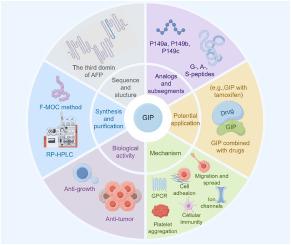
Cancer remains a major global public health concern, with considerable interest in exploring biological molecules for cancer treatment and prevention. Growth inhibitory peptide (GIP), a promising new class of biological therapeutics, has drawn attention for its distinct anti-tumor properties. Derived from human alpha-fetoprotein (HAFP), this synthetic 34-amino-acid peptide has demonstrated substantial anti-tumor effects across various cancer cell lines, effectively inhibiting tumor cell proliferation, migration, and metastasis. Studies reveal that GIP mediates its effects through a range of mechanisms, including interactions with G protein-coupled receptors (GPCRs), anti-cell adhesion activities, inhibition of cell spreading and metastatic processes, morphological alterations, platelet aggregation inhibition, immune enhancement, cell membrane disruption, ion channel blockade, and cell cycle arrest. While GIP has exhibited promising anti-tumor activity in both in vitro and in vivo models, further investigation is essential to advance its development as a therapeutic drug, particularly regarding pharmacokinetics, safety profiles, storage stability, and clinical efficacy.
期刊介绍:
The European Journal of Pharmacology publishes research papers covering all aspects of experimental pharmacology with focus on the mechanism of action of structurally identified compounds affecting biological systems.
The scope includes:
Behavioural pharmacology
Neuropharmacology and analgesia
Cardiovascular pharmacology
Pulmonary, gastrointestinal and urogenital pharmacology
Endocrine pharmacology
Immunopharmacology and inflammation
Molecular and cellular pharmacology
Regenerative pharmacology
Biologicals and biotherapeutics
Translational pharmacology
Nutriceutical pharmacology.



 京公网安备 11010802042870号
京ICP备2023020795号-1
京公网安备 11010802042870号
京ICP备2023020795号-1

 分享
分享
 求助内容:
求助内容: 应助结果提醒方式:
 扫码关注我们
