Livia Maccio, Damiano Arciuolo, Angela Santoro, Antonio Raffone, Diego Raimondo, Susanna Ronchi, Nicoletta D'Alessandris, Giulia Scaglione, Michele Valente, Belen Padial Urtueta, Francesca Addante, Nadine Narducci, Emma Bragantini, Jvan Casarin, Giuseppe Angelico, Stefano La Rosa, Gian Franco Zannoni, Antonio Travaglino
{"title":"Clinicopathological Comparison Between <i>GREB1</i>- and <i>ESR1</i>-Rearranged Uterine Tumors Resembling Ovarian Sex Cord Tumors (UTROSCTs): A Systematic Review.","authors":"Livia Maccio, Damiano Arciuolo, Angela Santoro, Antonio Raffone, Diego Raimondo, Susanna Ronchi, Nicoletta D'Alessandris, Giulia Scaglione, Michele Valente, Belen Padial Urtueta, Francesca Addante, Nadine Narducci, Emma Bragantini, Jvan Casarin, Giuseppe Angelico, Stefano La Rosa, Gian Franco Zannoni, Antonio Travaglino","doi":"10.3390/diagnostics15060792","DOIUrl":null,"url":null,"abstract":"<p><p><b>Introduction:</b> Among uterine tumors resembling ovarian sex cord tumors (UTROSCTs), it has been suggested that <i>GREB1</i>-rearranged cases are biologically distinct from <i>ESR1</i>-rearranged cases and might be considered as a separate entity. <b>Objectives:</b> The aim of this systematic review was to assess the difference between <i>GREB1</i>- and <i>ESR1</i>-rearranged UTROSCTs with regard to several clinico-pathological parameters. <b>Methods:</b> Three electronic databases were searched from their inception to February 2025 for all studies assessing the presence of <i>GREB1</i> and <i>ESR1</i> rearrangements in UTROSCTs. Exclusion criteria comprised overlapping patient data, case reports, and reviews. Statistical analysis was performed to compare clinicopathological variables between <i>GREB1</i>- and <i>ESR1</i>-rearranged UTROSCTs. Dichotomous variables were compared by using Fisher's exact test; continuous variables were compared by using Student's <i>t</i>-test. A <i>p</i>-value < 0.05 was considered significant. <b>Results:</b> Six studies with 88 molecularly classified UTROSCTs were included. A total of 36 cases were <i>GREB1</i>-rearranged, and 52 cases were <i>ESR1</i>-rearranged. <i>GREB1</i>-rearranged UTROSCTs showed a significantly older age (<i>p</i> < 0.001), larger tumor size (<i>p</i> = 0.002), less common submucosal/polypoid growth (<i>p</i> = 0.005), higher mitotic index (<i>p</i> = 0.010), more common LVSI (<i>p</i> = 0.049), and higher likelihood to undergo hysterectomy (<i>p</i> = 0.008) compared to <i>ESR1</i>-rearranged cases. No significant differences were detected with regard to margins, cytological atypia, necrosis, retiform pattern, and rhabdoid cells. No significant differences were found in the immunohistochemical expression of any of the assessed markers (wide-spectrum cytokeratins, α-inhibin, calretinin, WT1, CD10, CD56, CD99, smooth muscle actin, desmin, h-caldesmon, Melan-A/MART1, SF1, or Ki67). <i>GREB1</i>-rearranged UTROSCTs showed significantly lower disease-free survival compared to <i>ESR1</i>-rearranged UTROSTCs (<i>p</i> = 0.049). <b>Conclusions:</b> In conclusion, <i>GREB1</i>-rearranged UTROSCTs occur at an older age, are less likely to display a submucosal/polypoid growth, and exhibit larger size, a higher mitotic index, more common lymphovascular space invasion, and lower disease-free survival compared to <i>ESR1</i>-rearranged UTROSCTs. Nonetheless, the similar immunophenotype suggests that they belong to the same tumor family. Further studies are necessary to confirm this point.</p>","PeriodicalId":11225,"journal":{"name":"Diagnostics","volume":"15 6","pages":""},"PeriodicalIF":3.3000,"publicationDate":"2025-03-20","publicationTypes":"Journal Article","fieldsOfStudy":null,"isOpenAccess":false,"openAccessPdf":"https://www.ncbi.nlm.nih.gov/pmc/articles/PMC11941665/pdf/","citationCount":"0","resultStr":null,"platform":"Semanticscholar","paperid":null,"PeriodicalName":"Diagnostics","FirstCategoryId":"3","ListUrlMain":"https://doi.org/10.3390/diagnostics15060792","RegionNum":3,"RegionCategory":"医学","ArticlePicture":[],"TitleCN":null,"AbstractTextCN":null,"PMCID":null,"EPubDate":"","PubModel":"","JCR":"Q1","JCRName":"MEDICINE, GENERAL & INTERNAL","Score":null,"Total":0}
引用次数: 0
Abstract
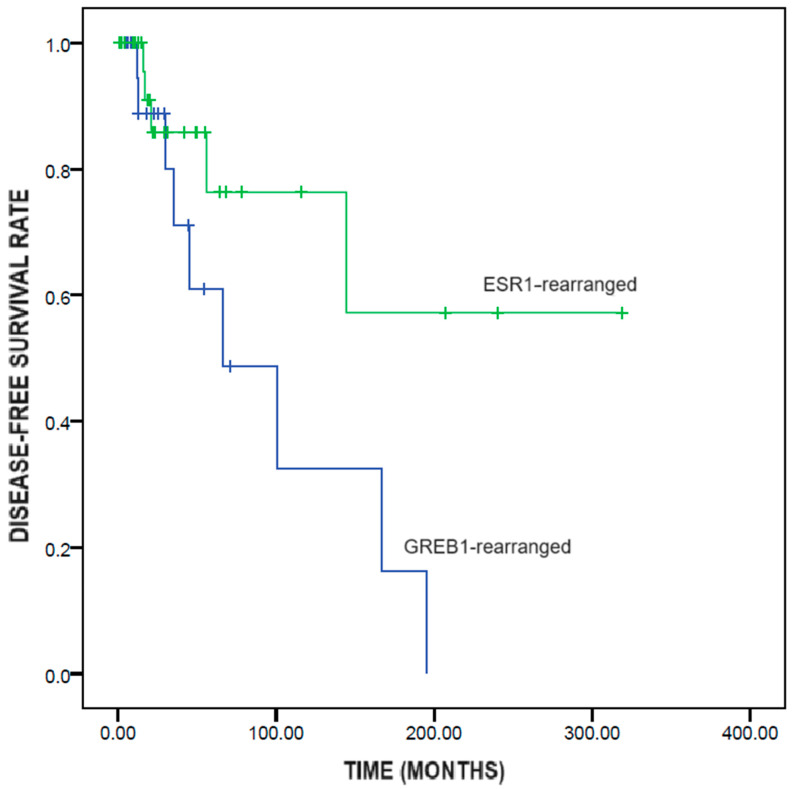
Introduction: Among uterine tumors resembling ovarian sex cord tumors (UTROSCTs), it has been suggested that GREB1-rearranged cases are biologically distinct from ESR1-rearranged cases and might be considered as a separate entity. Objectives: The aim of this systematic review was to assess the difference between GREB1- and ESR1-rearranged UTROSCTs with regard to several clinico-pathological parameters. Methods: Three electronic databases were searched from their inception to February 2025 for all studies assessing the presence of GREB1 and ESR1 rearrangements in UTROSCTs. Exclusion criteria comprised overlapping patient data, case reports, and reviews. Statistical analysis was performed to compare clinicopathological variables between GREB1- and ESR1-rearranged UTROSCTs. Dichotomous variables were compared by using Fisher's exact test; continuous variables were compared by using Student's t-test. A p-value < 0.05 was considered significant. Results: Six studies with 88 molecularly classified UTROSCTs were included. A total of 36 cases were GREB1-rearranged, and 52 cases were ESR1-rearranged. GREB1-rearranged UTROSCTs showed a significantly older age (p < 0.001), larger tumor size (p = 0.002), less common submucosal/polypoid growth (p = 0.005), higher mitotic index (p = 0.010), more common LVSI (p = 0.049), and higher likelihood to undergo hysterectomy (p = 0.008) compared to ESR1-rearranged cases. No significant differences were detected with regard to margins, cytological atypia, necrosis, retiform pattern, and rhabdoid cells. No significant differences were found in the immunohistochemical expression of any of the assessed markers (wide-spectrum cytokeratins, α-inhibin, calretinin, WT1, CD10, CD56, CD99, smooth muscle actin, desmin, h-caldesmon, Melan-A/MART1, SF1, or Ki67). GREB1-rearranged UTROSCTs showed significantly lower disease-free survival compared to ESR1-rearranged UTROSTCs (p = 0.049). Conclusions: In conclusion, GREB1-rearranged UTROSCTs occur at an older age, are less likely to display a submucosal/polypoid growth, and exhibit larger size, a higher mitotic index, more common lymphovascular space invasion, and lower disease-free survival compared to ESR1-rearranged UTROSCTs. Nonetheless, the similar immunophenotype suggests that they belong to the same tumor family. Further studies are necessary to confirm this point.
DiagnosticsBiochemistry, Genetics and Molecular Biology-Clinical Biochemistry
CiteScore
4.70
自引率
8.30%
发文量
2699
审稿时长
19.64 days
期刊介绍:
Diagnostics (ISSN 2075-4418) is an international scholarly open access journal on medical diagnostics. It publishes original research articles, reviews, communications and short notes on the research and development of medical diagnostics. There is no restriction on the length of the papers. Our aim is to encourage scientists to publish their experimental and theoretical research in as much detail as possible. Full experimental and/or methodological details must be provided for research articles.




 京公网安备 11010802042870号
京ICP备2023020795号-1
京公网安备 11010802042870号
京ICP备2023020795号-1

 分享
分享
 求助内容:
求助内容: 应助结果提醒方式:
 扫码关注我们
