Real-world Effectiveness and Safety of Bictegravir/Emtricitabine/Tenofovir Alafenamide in Comparison With Other Regimens in People With HIV Starting Therapy With AIDS-Defining Conditions: Results From the CoRIS Cohort-The ACTUAS II Study.
Ignacio Pérez-Valero, Diana Corona Mata, Angela Camacho Espejo, Marina Gallo, Alejandro G García-Ruiz de Morales, Chiara Fanciulli, Luz Martín-Carbonero, Sonia Calzado Isbert, Cristina Hernández Gutiérrez, Víctor Asensi, Antonio Rivero Juarez, Antonio Rivero
{"title":"Real-world Effectiveness and Safety of Bictegravir/Emtricitabine/Tenofovir Alafenamide in Comparison With Other Regimens in People With HIV Starting Therapy With AIDS-Defining Conditions: Results From the CoRIS Cohort-The ACTUAS II Study.","authors":"Ignacio Pérez-Valero, Diana Corona Mata, Angela Camacho Espejo, Marina Gallo, Alejandro G García-Ruiz de Morales, Chiara Fanciulli, Luz Martín-Carbonero, Sonia Calzado Isbert, Cristina Hernández Gutiérrez, Víctor Asensi, Antonio Rivero Juarez, Antonio Rivero","doi":"10.1093/cid/ciaf162","DOIUrl":null,"url":null,"abstract":"<p><strong>Background: </strong>The comparative effectiveness and tolerability of bictegravir/emtricitabine/tenofovir alafenamide (BIC/FTC/TAF) has not been sufficiently evaluated in people with AIDS who initiate therapy.</p><p><strong>Methods: </strong>The aim of the current study was to compare the effectiveness and tolerability of BIC/FTC/TAF with other first-line antiretroviral therapy (ART) regimens in treatment-naive adults from the CoRIS cohort who initiated ART with AIDS. Logistic regression models were used to estimate odds ratios (ORs) of association between initial regimen and achievement of viral suppression (VS), defined as human immunodeficiency virus RNA <50 copies/mL, and immunological recovery (IR), defined as CD4 count >200 cells/μL. Time to VS and the proportion of treatment discontinuations were also evaluated and compared, with all analyses conducted at weeks 24 and 48 after initiation of ART.</p><p><strong>Results: </strong>We analyzed 90 individuals initiating ART with BIC/FTC/TAF and 94 with other regimens, with similar baseline characteristics. At week 24, BIC/FTC/TAF was associated with a higher proportion of VS (75.6% vs 56.5%; adjusted odds ratio [aOR], 2.78 [95% confidence interval {CI}, 1.28-6.25]) and with a lower proportion of IR (47.7% vs 61.9%; aOR, 0.49 [95% CI, .25-.99]). These differences disappeared by week 48. The proportion of treatment discontinuations was significantly lower with BIC/FTC/TAF than with other regimens (week 24: 4.4% vs 20.2%; week 48: 10% vs 36.2%). At week 48, the main reasons for discontinuations were adverse events (3.3% vs 8.5%), toxicity prevention (1.1% vs 8.5%), ART simplification (0% vs 10.6%), and treatment failure (2.2% vs 4.3%).</p><p><strong>Conclusions: </strong>In light of our results, BIC/FTC/TAF is an effective and well-tolerated option for starting ART in people with AIDS.</p>","PeriodicalId":10463,"journal":{"name":"Clinical Infectious Diseases","volume":" ","pages":"e93-e101"},"PeriodicalIF":7.3000,"publicationDate":"2025-11-06","publicationTypes":"Journal Article","fieldsOfStudy":null,"isOpenAccess":false,"openAccessPdf":"https://www.ncbi.nlm.nih.gov/pmc/articles/PMC12596416/pdf/","citationCount":"0","resultStr":null,"platform":"Semanticscholar","paperid":null,"PeriodicalName":"Clinical Infectious Diseases","FirstCategoryId":"3","ListUrlMain":"https://doi.org/10.1093/cid/ciaf162","RegionNum":1,"RegionCategory":"医学","ArticlePicture":[],"TitleCN":null,"AbstractTextCN":null,"PMCID":null,"EPubDate":"","PubModel":"","JCR":"Q1","JCRName":"IMMUNOLOGY","Score":null,"Total":0}
引用次数: 0
Abstract
Background: The comparative effectiveness and tolerability of bictegravir/emtricitabine/tenofovir alafenamide (BIC/FTC/TAF) has not been sufficiently evaluated in people with AIDS who initiate therapy.
Methods: The aim of the current study was to compare the effectiveness and tolerability of BIC/FTC/TAF with other first-line antiretroviral therapy (ART) regimens in treatment-naive adults from the CoRIS cohort who initiated ART with AIDS. Logistic regression models were used to estimate odds ratios (ORs) of association between initial regimen and achievement of viral suppression (VS), defined as human immunodeficiency virus RNA <50 copies/mL, and immunological recovery (IR), defined as CD4 count >200 cells/μL. Time to VS and the proportion of treatment discontinuations were also evaluated and compared, with all analyses conducted at weeks 24 and 48 after initiation of ART.
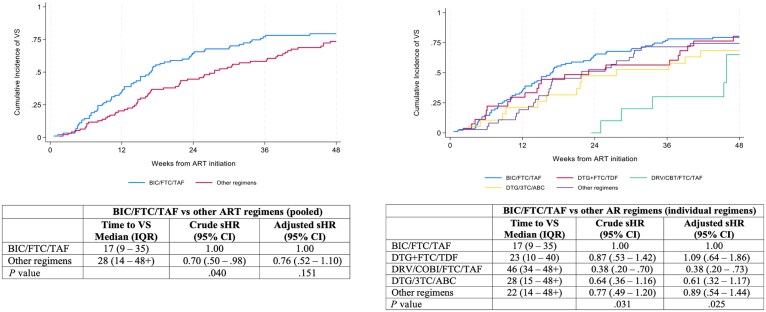
Results: We analyzed 90 individuals initiating ART with BIC/FTC/TAF and 94 with other regimens, with similar baseline characteristics. At week 24, BIC/FTC/TAF was associated with a higher proportion of VS (75.6% vs 56.5%; adjusted odds ratio [aOR], 2.78 [95% confidence interval {CI}, 1.28-6.25]) and with a lower proportion of IR (47.7% vs 61.9%; aOR, 0.49 [95% CI, .25-.99]). These differences disappeared by week 48. The proportion of treatment discontinuations was significantly lower with BIC/FTC/TAF than with other regimens (week 24: 4.4% vs 20.2%; week 48: 10% vs 36.2%). At week 48, the main reasons for discontinuations were adverse events (3.3% vs 8.5%), toxicity prevention (1.1% vs 8.5%), ART simplification (0% vs 10.6%), and treatment failure (2.2% vs 4.3%).
Conclusions: In light of our results, BIC/FTC/TAF is an effective and well-tolerated option for starting ART in people with AIDS.
背景:BIC/FTC/TAF在开始治疗的艾滋病PWH患者中的相对有效性和耐受性尚未得到充分的评估。方法:本研究的目的是比较BIC/FTC/TAF与其他一线抗逆转录病毒疗法在CoRIS队列中开始ART治疗艾滋病的treatment-naïve成年人中的有效性和耐受性。使用逻辑回归模型来估计初始方案与病毒抑制(VS)之间的相关比值比(ORs),定义为HIV RNA 200细胞/mm3。评估并比较两组达到VS的时间和停药比例;所有分析均在抗逆转录病毒治疗开始后第24周和第48周进行。结果:我们分析了90名接受BIC/FTC/TAF治疗的患者和94名接受其他治疗方案的患者,他们的基线特征相似。在第24周,BIC/FTC/TAF与更高比例的VS相关(75.6% VS . 56.5%) (or:2.78;95%CI:1.28-6.25), IR比例较低(47.7%对61.9%,aOR:0.49;95%置信区间:0.25—-0.99)。这些差异在第48周消失。BIC/FTC/TAF的停药比例明显低于其他方案(周数24:4.4% vs. 20.2%)。第48周:10% vs 36.2%)。在第48周,停药的主要原因是不良事件(3.3%对8.5%)、毒性预防(1.1%对8.5%)、ART简化(0%对10.6%)和治疗失败(2.2%对4.3%)。结论:根据我们的研究结果,BIC/FTC/TAF是艾滋病患者开始抗逆转录病毒治疗的有效且耐受性良好的选择。
期刊介绍:
Clinical Infectious Diseases (CID) is dedicated to publishing original research, reviews, guidelines, and perspectives with the potential to reshape clinical practice, providing clinicians with valuable insights for patient care. CID comprehensively addresses the clinical presentation, diagnosis, treatment, and prevention of a wide spectrum of infectious diseases. The journal places a high priority on the assessment of current and innovative treatments, microbiology, immunology, and policies, ensuring relevance to patient care in its commitment to advancing the field of infectious diseases.




 京公网安备 11010802042870号
京ICP备2023020795号-1
京公网安备 11010802042870号
京ICP备2023020795号-1

 分享
分享
 求助内容:
求助内容: 应助结果提醒方式:
 扫码关注我们
