{"title":"Iguratimod, a promising therapeutic agent for COVID-19 that attenuates excessive inflammation in mouse models","authors":"Seiya Oba , Tadashi Hosoya , Daisuke Kawata , Yoji Komiya , Hideyuki Iwai , Ryuji Koike , Sho Miyamoto , Takayuki Kanno , Akira Ainai , Tadaki Suzuki , Hideki Hasegawa , Shinsuke Yasuda","doi":"10.1016/j.ejphar.2025.177537","DOIUrl":null,"url":null,"abstract":"<div><div>In severe COVID-19 patients, excessive inflammation can lead to multiorgan dysfunction. Current anti-inflammatory treatments like glucocorticoids partially improve the outcomes, while immune systems are compromised. We have identified that SARS-CoV-2-infected obese mice were a good model of the cytokine storm seen in COVID-19. Here, we revealed that iguratimod (IGU), an approved agent for rheumatoid arthritis, improved survival by attenuating inflammation with minimal immune suppression.</div><div>In this study, C57BL/6 mice were fed a high-fat diet (HFD) or a normal-fat diet (NFD) for ten weeks before being infected with a mouse-adapted SARS-CoV-2. IGU significantly improved survival rates and reduced lung inflammation in HFD-fed mice, with minimal impact on interferon-induced genes and viral load. Meanwhile, dexamethasone (DEX) did not improve survival, while it suppressed various immune reactions with different mechanisms to IGU. Interestingly, IGU-treated mice had fewer SARS-CoV-2 positive cells in the lung, although viral replication was comparable to the control mice. Neither IGU nor DEX inhibited the SARS-CoV-2 infection in Vero-E6 cells, unlike the antiviral agent, remdesivir. Of note, IGU was effective prophylactically and therapeutically in HFD mice, and showed beneficial effects in NFD-fed mice with a lethal dose exposure of SARS-CoV-2.</div><div>We demonstrated that IGU could be a promising treatment for severe COVID-19, especially in obese patients, by fine-tuning inflammation without compromising antiviral immunity. This study supports the possibility of drug repositioning for IGU COVID-19 beyond autoimmune diseases.</div></div>","PeriodicalId":12004,"journal":{"name":"European journal of pharmacology","volume":"996 ","pages":"Article 177537"},"PeriodicalIF":4.7000,"publicationDate":"2025-06-05","publicationTypes":"Journal Article","fieldsOfStudy":null,"isOpenAccess":false,"openAccessPdf":"","citationCount":"0","resultStr":null,"platform":"Semanticscholar","paperid":null,"PeriodicalName":"European journal of pharmacology","FirstCategoryId":"3","ListUrlMain":"https://www.sciencedirect.com/science/article/pii/S0014299925002912","RegionNum":3,"RegionCategory":"医学","ArticlePicture":[],"TitleCN":null,"AbstractTextCN":null,"PMCID":null,"EPubDate":"2025/3/25 0:00:00","PubModel":"Epub","JCR":"Q1","JCRName":"PHARMACOLOGY & PHARMACY","Score":null,"Total":0}
引用次数: 0
Abstract
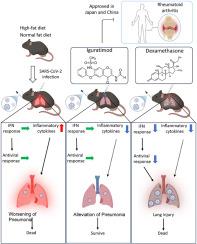
In severe COVID-19 patients, excessive inflammation can lead to multiorgan dysfunction. Current anti-inflammatory treatments like glucocorticoids partially improve the outcomes, while immune systems are compromised. We have identified that SARS-CoV-2-infected obese mice were a good model of the cytokine storm seen in COVID-19. Here, we revealed that iguratimod (IGU), an approved agent for rheumatoid arthritis, improved survival by attenuating inflammation with minimal immune suppression.
In this study, C57BL/6 mice were fed a high-fat diet (HFD) or a normal-fat diet (NFD) for ten weeks before being infected with a mouse-adapted SARS-CoV-2. IGU significantly improved survival rates and reduced lung inflammation in HFD-fed mice, with minimal impact on interferon-induced genes and viral load. Meanwhile, dexamethasone (DEX) did not improve survival, while it suppressed various immune reactions with different mechanisms to IGU. Interestingly, IGU-treated mice had fewer SARS-CoV-2 positive cells in the lung, although viral replication was comparable to the control mice. Neither IGU nor DEX inhibited the SARS-CoV-2 infection in Vero-E6 cells, unlike the antiviral agent, remdesivir. Of note, IGU was effective prophylactically and therapeutically in HFD mice, and showed beneficial effects in NFD-fed mice with a lethal dose exposure of SARS-CoV-2.
We demonstrated that IGU could be a promising treatment for severe COVID-19, especially in obese patients, by fine-tuning inflammation without compromising antiviral immunity. This study supports the possibility of drug repositioning for IGU COVID-19 beyond autoimmune diseases.
期刊介绍:
The European Journal of Pharmacology publishes research papers covering all aspects of experimental pharmacology with focus on the mechanism of action of structurally identified compounds affecting biological systems.
The scope includes:
Behavioural pharmacology
Neuropharmacology and analgesia
Cardiovascular pharmacology
Pulmonary, gastrointestinal and urogenital pharmacology
Endocrine pharmacology
Immunopharmacology and inflammation
Molecular and cellular pharmacology
Regenerative pharmacology
Biologicals and biotherapeutics
Translational pharmacology
Nutriceutical pharmacology.



 京公网安备 11010802042870号
京ICP备2023020795号-1
京公网安备 11010802042870号
京ICP备2023020795号-1

 分享
分享
 求助内容:
求助内容: 应助结果提醒方式:
 扫码关注我们
