Dental pulp stem cells (DPSCs) are essential for pulp regeneration but face low survival rates after transplantation. Genetic modification before transplantation is a promising solution to this issue. We aim to elucidate the biological function and regulatory mechanism of hypoxic lncRNA HRL-SC in DPSCs.
The biological functions of HRL-SC and hypoxia inducible factor-1α (HIF-1α) in DPSCs were evaluated in vitro by cell proliferation, migration and tube formation assays. Subcutaneous transplantation in nude mice was used to evaluate the effect of HRL-SC on DPSC viability in vivo. RNA sequencing and bioinformatics analysis, RNA immunoprecipitation, dual luciferase reporter gene assay, co-immunoprecipitation, RNA fluorescence in situ hybridization, immunofluorescence and RNA and protein stability assays were used to explore the potential mechanism of HRL-SC in DPSCs. Data were analysed by one-way analysis of variance (anova) or Student's t-test, with a p <.05 indicating statistical significance.
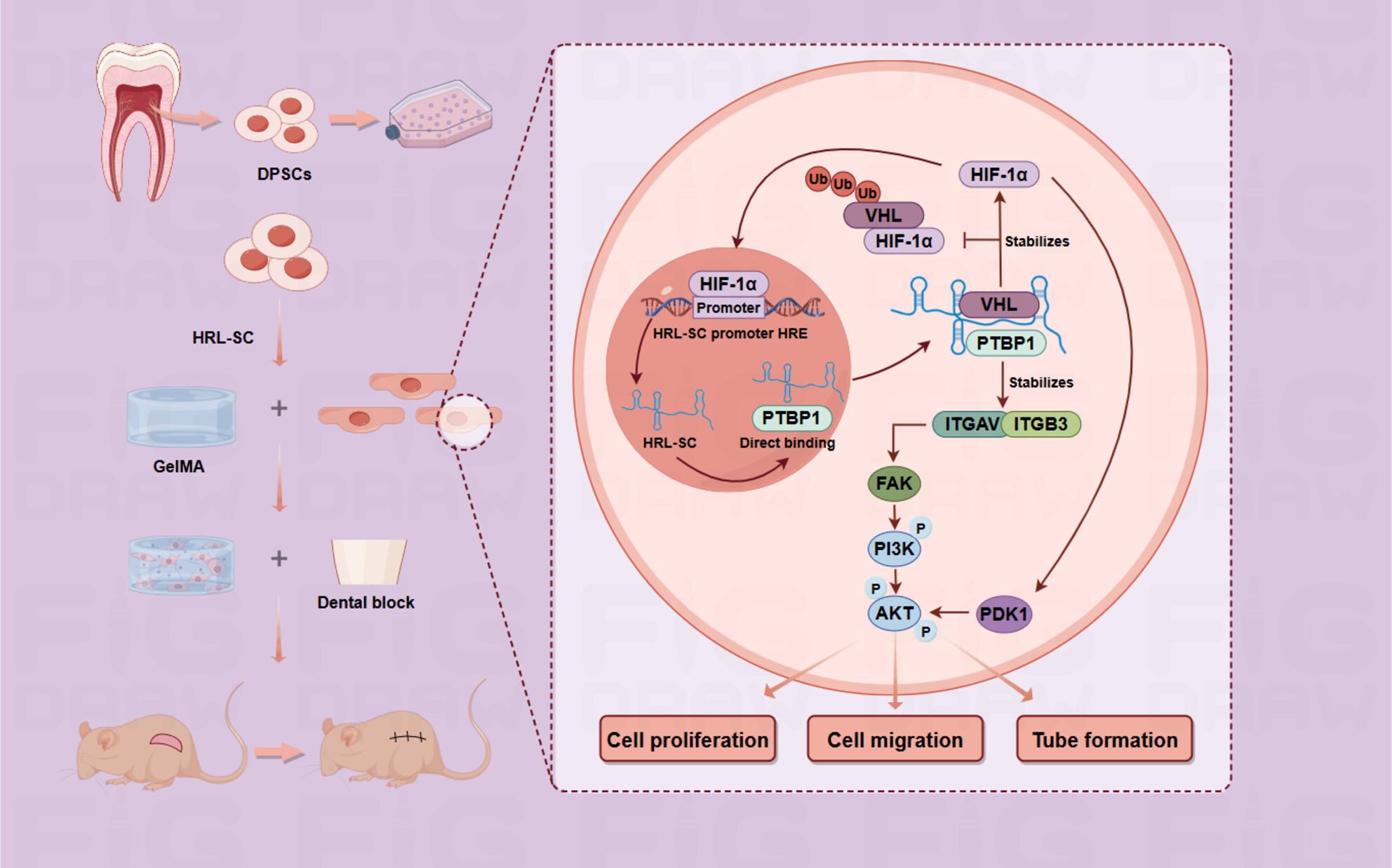
HRL-SC, a hypoxia-responsive lncRNA, enhanced the proliferation, migration and tube formation abilities of DPSCs. Subcutaneous transplantation of dental blocks revealed that HRL-SC-mediated DPSCs exhibited improved cell viability and elevated expression of Ki-67 and CD31, along with the capacity to form vascular-like structures. HIF-1α was observed to induce transcription of HRL-SC. Reciprocally, HRL-SC bound to VHL, thereby inhibiting VHL-mediated HIF-1α ubiquitination, which resulted in a positive feed-forward loop of HRL-SC/HIF-1α. RNA-sequencing and functional analyses revealed that HRL-SC was closely associated with hypoxia, angiogenesis, regeneration, integrin and PI3K/AKT signalling pathways. Furthermore, HRL-SC was shown to stabilize ITGAV and ITGB3 through PTBP1. Finally, it was confirmed that HRL-SC activated the PI3K/AKT signalling pathway via the integrin αvβ3/FAK and HIF-1α/PDK1 axes.
DPSCs modified with HRL-SC demonstrated enhanced cell viability via the PI3K/AKT signaling pathway and exhibited functional characteristics of endothelial cells, which may provide a novel strategy for the application of DPSCs in pulp regeneration.



 京公网安备 11010802042870号
京ICP备2023020795号-1
京公网安备 11010802042870号
京ICP备2023020795号-1

 分享
分享
 求助内容:
求助内容: 应助结果提醒方式:
 扫码关注我们
