Datopotamab Deruxtecan in Advanced or Metastatic Non-Small Cell Lung Cancer With Actionable Genomic Alterations: Results From the Phase II TROPION-Lung05 Study.
Jacob Sands, Myung-Ju Ahn, Aaron Lisberg, Byoung Chul Cho, George Blumenschein, Elaine Shum, Elvire Pons Tostivint, Yasushi Goto, Kiyotaka Yoh, Rebecca Heist, Junichi Shimizu, Jong-Seok Lee, Paul Baas, David Planchard, Maurice Pérol, Enriqueta Felip, Wu-Chou Su, Hong Zebger-Gong, Lan Lan, Chelsea Liu, Paul Howarth, Rachel Chiaverelli, Luis Paz-Ares
{"title":"Datopotamab Deruxtecan in Advanced or Metastatic Non-Small Cell Lung Cancer With Actionable Genomic Alterations: Results From the Phase II TROPION-Lung05 Study.","authors":"Jacob Sands, Myung-Ju Ahn, Aaron Lisberg, Byoung Chul Cho, George Blumenschein, Elaine Shum, Elvire Pons Tostivint, Yasushi Goto, Kiyotaka Yoh, Rebecca Heist, Junichi Shimizu, Jong-Seok Lee, Paul Baas, David Planchard, Maurice Pérol, Enriqueta Felip, Wu-Chou Su, Hong Zebger-Gong, Lan Lan, Chelsea Liu, Paul Howarth, Rachel Chiaverelli, Luis Paz-Ares","doi":"10.1200/JCO-24-01349","DOIUrl":null,"url":null,"abstract":"<p><strong>Purpose: </strong>Datopotamab deruxtecan (Dato-DXd) is a trophoblast cell-surface antigen-2-directed antibody-drug conjugate with a highly potent topoisomerase I inhibitor payload. The TROPION-Lung05 phase II trial (ClinicalTrials.gov identifier: NCT04484142) evaluated the safety and clinical activity of Dato-DXd in patients with advanced/metastatic non-small cell lung cancer (NSCLC) with actionable genomic alterations progressing on or after targeted therapy and platinum-based chemotherapy.</p><p><strong>Patients and methods: </strong>Patients received Dato-DXd 6 mg/kg once every 3 weeks. The primary end point was objective response rate (ORR) by blinded independent central review. Secondary end points included duration of response (DOR), safety, tolerability, and survival.</p><p><strong>Results: </strong>Among 137 patients who received at least 1 dose of Dato-DXd, 71.5% received at least three lines of prior therapies for advanced/metastatic disease. Overall, 56.9% had <i>EGFR</i> mutations and 24.8% had <i>ALK</i> rearrangements. Median treatment duration was 4.4 months (range, 0.7-20.6). The confirmed ORR was 35.8% (95% CI, 27.8 to 44.4) overall, and 43.6% (95% CI, 32.4 to 55.3) and 23.5% (95% CI, 10.7 to 41.2) in those with <i>EGFR</i> mutations and <i>ALK</i> rearrangements, respectively. The median DOR was 7.0 months (95% CI, 4.2 to 9.8), and the overall disease control rate was 78.8% (95% CI, 71.0 to 85.3). Grade ≥3 treatment-related adverse events (TRAEs) occurred in 28.5% of patients. The most common TRAE was stomatitis (preferred term; any grade: 56.2%; grade ≥3: 9.5%). Five (3.6%) patients experienced adjudicated treatment-related interstitial lung disease/pneumonitis, with 1 (0.7%) grade 5 event.</p><p><strong>Conclusion: </strong>Encouraging and durable antitumor activity was observed with Dato-DXd in this heavily pretreated advanced/metastatic NSCLC population with actionable genomic alterations. The rate of treatment-related grade ≥3 toxicities was comparable with previous observations, and no new safety signals were observed.</p>","PeriodicalId":15384,"journal":{"name":"Journal of Clinical Oncology","volume":" ","pages":"1254-1265"},"PeriodicalIF":41.9000,"publicationDate":"2025-04-01","publicationTypes":"Journal Article","fieldsOfStudy":null,"isOpenAccess":false,"openAccessPdf":"https://www.ncbi.nlm.nih.gov/pmc/articles/PMC11949215/pdf/","citationCount":"0","resultStr":null,"platform":"Semanticscholar","paperid":null,"PeriodicalName":"Journal of Clinical Oncology","FirstCategoryId":"3","ListUrlMain":"https://doi.org/10.1200/JCO-24-01349","RegionNum":1,"RegionCategory":"医学","ArticlePicture":[],"TitleCN":null,"AbstractTextCN":null,"PMCID":null,"EPubDate":"2025/1/6 0:00:00","PubModel":"Epub","JCR":"Q1","JCRName":"ONCOLOGY","Score":null,"Total":0}
引用次数: 0
Abstract
Purpose: Datopotamab deruxtecan (Dato-DXd) is a trophoblast cell-surface antigen-2-directed antibody-drug conjugate with a highly potent topoisomerase I inhibitor payload. The TROPION-Lung05 phase II trial (ClinicalTrials.gov identifier: NCT04484142) evaluated the safety and clinical activity of Dato-DXd in patients with advanced/metastatic non-small cell lung cancer (NSCLC) with actionable genomic alterations progressing on or after targeted therapy and platinum-based chemotherapy.
Patients and methods: Patients received Dato-DXd 6 mg/kg once every 3 weeks. The primary end point was objective response rate (ORR) by blinded independent central review. Secondary end points included duration of response (DOR), safety, tolerability, and survival.
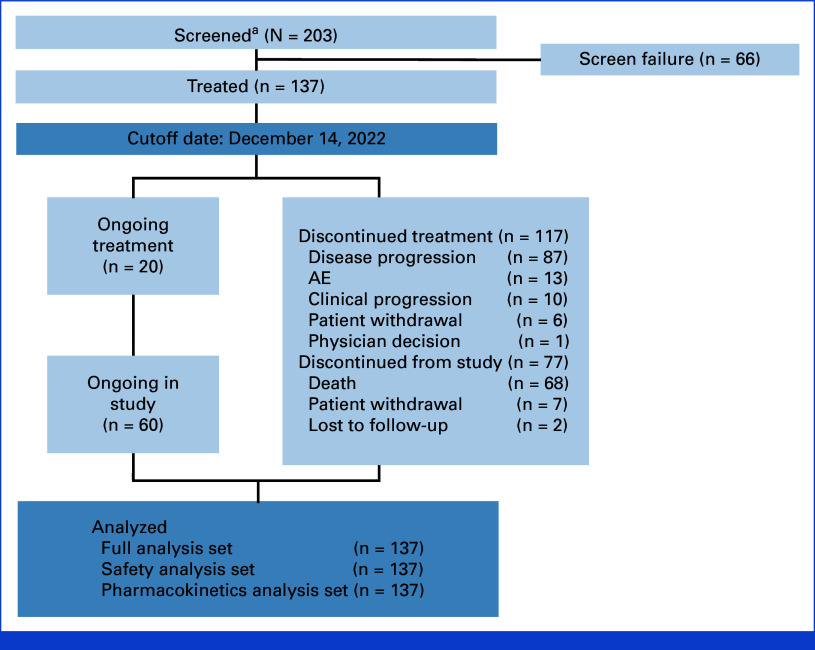
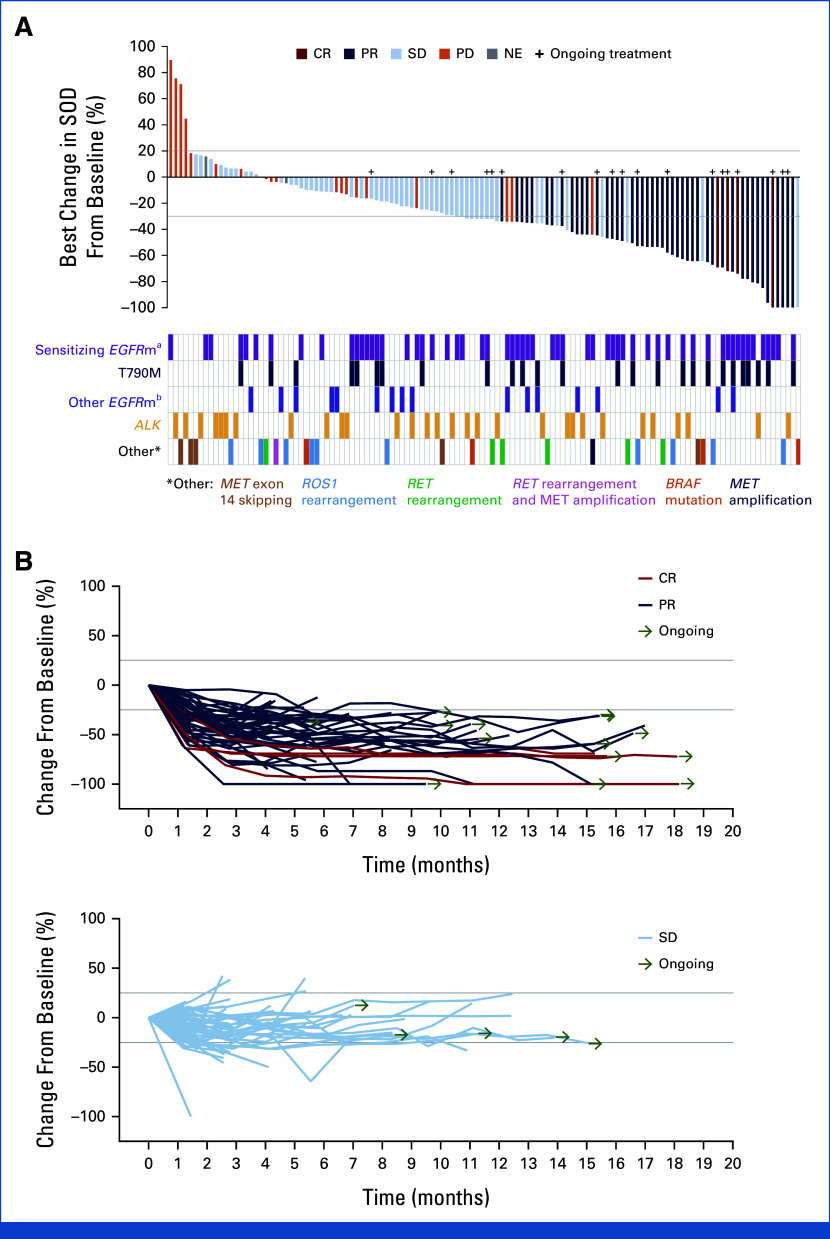
Results: Among 137 patients who received at least 1 dose of Dato-DXd, 71.5% received at least three lines of prior therapies for advanced/metastatic disease. Overall, 56.9% had EGFR mutations and 24.8% had ALK rearrangements. Median treatment duration was 4.4 months (range, 0.7-20.6). The confirmed ORR was 35.8% (95% CI, 27.8 to 44.4) overall, and 43.6% (95% CI, 32.4 to 55.3) and 23.5% (95% CI, 10.7 to 41.2) in those with EGFR mutations and ALK rearrangements, respectively. The median DOR was 7.0 months (95% CI, 4.2 to 9.8), and the overall disease control rate was 78.8% (95% CI, 71.0 to 85.3). Grade ≥3 treatment-related adverse events (TRAEs) occurred in 28.5% of patients. The most common TRAE was stomatitis (preferred term; any grade: 56.2%; grade ≥3: 9.5%). Five (3.6%) patients experienced adjudicated treatment-related interstitial lung disease/pneumonitis, with 1 (0.7%) grade 5 event.
Conclusion: Encouraging and durable antitumor activity was observed with Dato-DXd in this heavily pretreated advanced/metastatic NSCLC population with actionable genomic alterations. The rate of treatment-related grade ≥3 toxicities was comparable with previous observations, and no new safety signals were observed.
期刊介绍:
The Journal of Clinical Oncology serves its readers as the single most credible, authoritative resource for disseminating significant clinical oncology research. In print and in electronic format, JCO strives to publish the highest quality articles dedicated to clinical research. Original Reports remain the focus of JCO, but this scientific communication is enhanced by appropriately selected Editorials, Commentaries, Reviews, and other work that relate to the care of patients with cancer.




 京公网安备 11010802042870号
京ICP备2023020795号-1
京公网安备 11010802042870号
京ICP备2023020795号-1

 分享
分享
 求助内容:
求助内容: 应助结果提醒方式:
 扫码关注我们
