Aaron Naatz, Kelsey S Bohl, Rachel A Jones Lipinski, Joshua A Nord, Alyssa L Gehant, Polly A Hansen, Brian C Smith, John A Corbett
{"title":"Role of SIRT3 in the regulation of Gadd45α expression and DNA repair in β-cells.","authors":"Aaron Naatz, Kelsey S Bohl, Rachel A Jones Lipinski, Joshua A Nord, Alyssa L Gehant, Polly A Hansen, Brian C Smith, John A Corbett","doi":"10.1016/j.jbc.2025.108451","DOIUrl":null,"url":null,"abstract":"<p><p>In previous studies, we have shown that growth arrest and DNA damage (Gadd) 45α is required for the repair of nitric oxide-mediated DNA damage in β-cells. Gadd45α expression is stimulated by nitric oxide and requires forkhead box protein (Fox) O1 and NAD<sup>+</sup>-dependent deacetylase activity. Based on inhibitor studies, we attributed this activity to Sirtuin (SIRT)1; however, the inhibitors used in this previous study also attenuate the deacetylase activity of SIRT2, 3, and 6. We now provide experimental evidence that SIRT1 is dispensable for β-cell expression of Gadd45α and that the mitochondrial localized isoform SIRT3, is required for DNA repair in β-cells. We show that siRNA knockdown of Sirt3 attenuates nitric oxide-stimulated Gadd45α mRNA accumulation in both wildtype and Sirt1<sup>-/-</sup> INS 832/13 cells as well as isolated rat islets and that SIRT3 inhibition increases FoxO1 acetylation and attenuates DNA repair in response to nitric oxide. While SIRT3 is predominantly localized to mitochondria, a small fraction is localized in the nucleus of insulin-containing cells and functions to participate in the regulation of FoxO1-dependent, nitric oxide-stimulated DNA repair.</p>","PeriodicalId":15140,"journal":{"name":"Journal of Biological Chemistry","volume":" ","pages":"108451"},"PeriodicalIF":4.0000,"publicationDate":"2025-05-01","publicationTypes":"Journal Article","fieldsOfStudy":null,"isOpenAccess":false,"openAccessPdf":"https://www.ncbi.nlm.nih.gov/pmc/articles/PMC12051128/pdf/","citationCount":"0","resultStr":null,"platform":"Semanticscholar","paperid":null,"PeriodicalName":"Journal of Biological Chemistry","FirstCategoryId":"99","ListUrlMain":"https://doi.org/10.1016/j.jbc.2025.108451","RegionNum":2,"RegionCategory":"生物学","ArticlePicture":[],"TitleCN":null,"AbstractTextCN":null,"PMCID":null,"EPubDate":"2025/3/25 0:00:00","PubModel":"Epub","JCR":"Q2","JCRName":"BIOCHEMISTRY & MOLECULAR BIOLOGY","Score":null,"Total":0}
引用次数: 0
Abstract
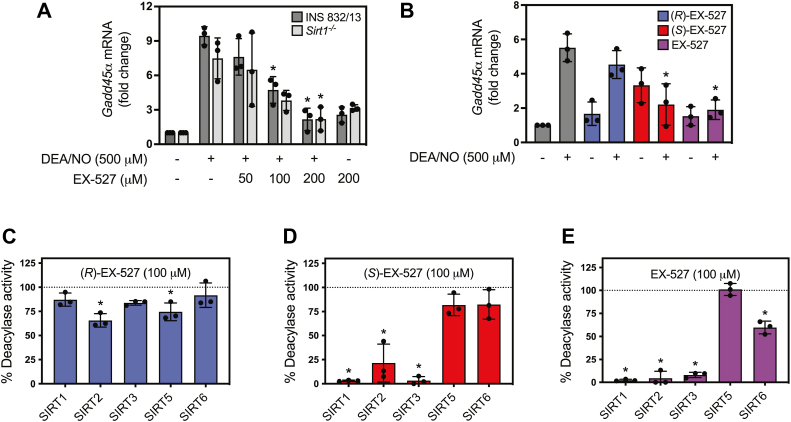
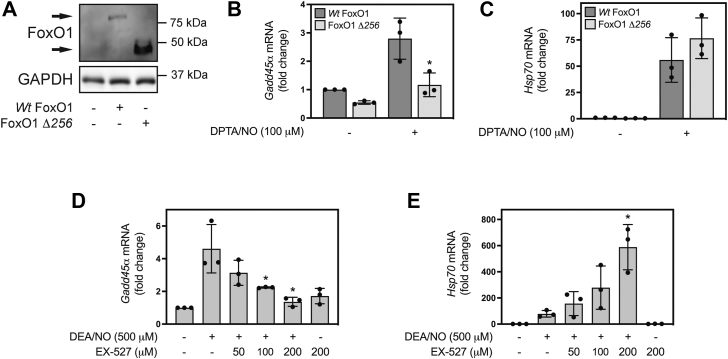
In previous studies, we have shown that growth arrest and DNA damage (Gadd) 45α is required for the repair of nitric oxide-mediated DNA damage in β-cells. Gadd45α expression is stimulated by nitric oxide and requires forkhead box protein (Fox) O1 and NAD+-dependent deacetylase activity. Based on inhibitor studies, we attributed this activity to Sirtuin (SIRT)1; however, the inhibitors used in this previous study also attenuate the deacetylase activity of SIRT2, 3, and 6. We now provide experimental evidence that SIRT1 is dispensable for β-cell expression of Gadd45α and that the mitochondrial localized isoform SIRT3, is required for DNA repair in β-cells. We show that siRNA knockdown of Sirt3 attenuates nitric oxide-stimulated Gadd45α mRNA accumulation in both wildtype and Sirt1-/- INS 832/13 cells as well as isolated rat islets and that SIRT3 inhibition increases FoxO1 acetylation and attenuates DNA repair in response to nitric oxide. While SIRT3 is predominantly localized to mitochondria, a small fraction is localized in the nucleus of insulin-containing cells and functions to participate in the regulation of FoxO1-dependent, nitric oxide-stimulated DNA repair.
期刊介绍:
The Journal of Biological Chemistry welcomes high-quality science that seeks to elucidate the molecular and cellular basis of biological processes. Papers published in JBC can therefore fall under the umbrellas of not only biological chemistry, chemical biology, or biochemistry, but also allied disciplines such as biophysics, systems biology, RNA biology, immunology, microbiology, neurobiology, epigenetics, computational biology, ’omics, and many more. The outcome of our focus on papers that contribute novel and important mechanistic insights, rather than on a particular topic area, is that JBC is truly a melting pot for scientists across disciplines. In addition, JBC welcomes papers that describe methods that will help scientists push their biochemical inquiries forward and resources that will be of use to the research community.




 京公网安备 11010802042870号
京ICP备2023020795号-1
京公网安备 11010802042870号
京ICP备2023020795号-1

 分享
分享
 求助内容:
求助内容: 应助结果提醒方式:
 扫码关注我们
