Dory E DeWeese, Michael P Everett, Jeffrey T Babicz, Anahita Daruwalla, Edward I Solomon, Philip D Kiser
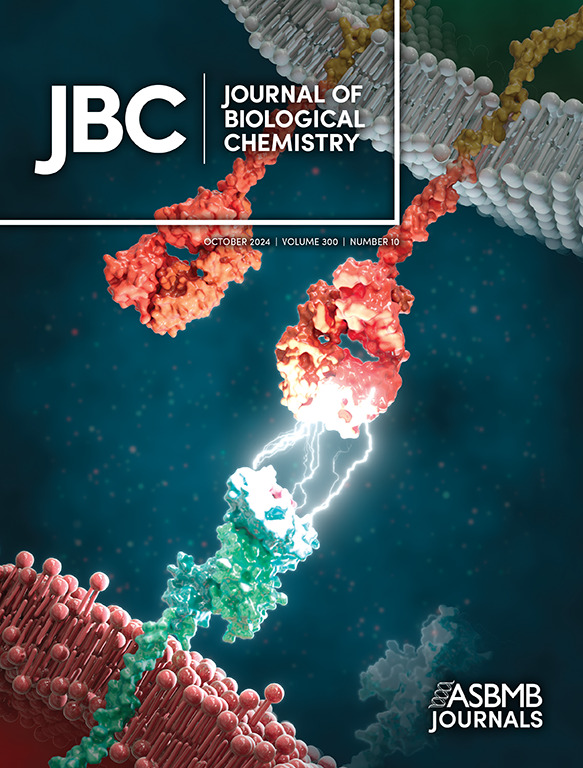
{"title":"Spectroscopy and crystallography define carotenoid oxygenases as a new subclass of mononuclear non-heme Fe<sup>II</sup> enzymes.","authors":"Dory E DeWeese, Michael P Everett, Jeffrey T Babicz, Anahita Daruwalla, Edward I Solomon, Philip D Kiser","doi":"10.1016/j.jbc.2025.108444","DOIUrl":null,"url":null,"abstract":"<p><p>Carotenoid cleavage dioxygenases (CCDs) are non-heme Fe<sup>II</sup> enzymes that catalyze the oxidative cleavage of alkene bonds in carotenoids, stilbenoids, and related compounds. How these enzymes control the reaction of dioxygen (O<sub>2</sub>) with their alkene substrates is unclear. Here, we apply spectroscopy in conjunction with X-ray crystallography to define the iron coordination geometry of a model CCD, CAO1 (Neurospora crassa carotenoid oxygenase 1), in its resting state and following substrate binding and coordination sphere substitutions. Resting CAO1 exhibits a five-coordinate (5C), square pyramidal Fe<sup>II</sup> center that undergoes steric distortion toward a trigonal bipyramidal geometry in the presence of piceatannol. Titrations with the O<sub>2</sub>-analog, nitric oxide, show a >100-fold increase in iron-nitric oxide affinity upon substrate binding, defining a crucial role for the substrate in activating the Fe<sup>II</sup> site for O<sub>2</sub> reactivity. The importance of the 5C Fe<sup>II</sup> structure for reactivity was probed through mutagenesis of the second-sphere Thr151 residue of CAO1, which occludes ligand binding at the sixth coordination position. A T151G substitution resulted in the conversion of the iron center to a six-coordinate state and a 135-fold reduction in apparent catalytic efficiency toward piceatannol compared with the wildtype enzyme. Substrate complexation resulted in partial six-coordinate to 5C conversion, indicating solvent dissociation from the iron center. Additional substitutions at this site demonstrated a general functional importance of the occluding residue within the CCD superfamily. Taken together, these data suggest an ordered mechanism of CCD catalysis occurring via substrate-promoted solvent replacement by O<sub>2</sub>. CCDs thus represent a new class of mononuclear non-heme Fe<sup>II</sup> enzymes.</p>","PeriodicalId":15140,"journal":{"name":"Journal of Biological Chemistry","volume":" ","pages":"108444"},"PeriodicalIF":4.0000,"publicationDate":"2025-05-01","publicationTypes":"Journal Article","fieldsOfStudy":null,"isOpenAccess":false,"openAccessPdf":"https://www.ncbi.nlm.nih.gov/pmc/articles/PMC12051055/pdf/","citationCount":"0","resultStr":null,"platform":"Semanticscholar","paperid":null,"PeriodicalName":"Journal of Biological Chemistry","FirstCategoryId":"99","ListUrlMain":"https://doi.org/10.1016/j.jbc.2025.108444","RegionNum":2,"RegionCategory":"生物学","ArticlePicture":[],"TitleCN":null,"AbstractTextCN":null,"PMCID":null,"EPubDate":"2025/3/25 0:00:00","PubModel":"Epub","JCR":"Q2","JCRName":"BIOCHEMISTRY & MOLECULAR BIOLOGY","Score":null,"Total":0}
引用次数: 0
Abstract
Carotenoid cleavage dioxygenases (CCDs) are non-heme FeII enzymes that catalyze the oxidative cleavage of alkene bonds in carotenoids, stilbenoids, and related compounds. How these enzymes control the reaction of dioxygen (O2) with their alkene substrates is unclear. Here, we apply spectroscopy in conjunction with X-ray crystallography to define the iron coordination geometry of a model CCD, CAO1 (Neurospora crassa carotenoid oxygenase 1), in its resting state and following substrate binding and coordination sphere substitutions. Resting CAO1 exhibits a five-coordinate (5C), square pyramidal FeII center that undergoes steric distortion toward a trigonal bipyramidal geometry in the presence of piceatannol. Titrations with the O2-analog, nitric oxide, show a >100-fold increase in iron-nitric oxide affinity upon substrate binding, defining a crucial role for the substrate in activating the FeII site for O2 reactivity. The importance of the 5C FeII structure for reactivity was probed through mutagenesis of the second-sphere Thr151 residue of CAO1, which occludes ligand binding at the sixth coordination position. A T151G substitution resulted in the conversion of the iron center to a six-coordinate state and a 135-fold reduction in apparent catalytic efficiency toward piceatannol compared with the wildtype enzyme. Substrate complexation resulted in partial six-coordinate to 5C conversion, indicating solvent dissociation from the iron center. Additional substitutions at this site demonstrated a general functional importance of the occluding residue within the CCD superfamily. Taken together, these data suggest an ordered mechanism of CCD catalysis occurring via substrate-promoted solvent replacement by O2. CCDs thus represent a new class of mononuclear non-heme FeII enzymes.
期刊介绍:
The Journal of Biological Chemistry welcomes high-quality science that seeks to elucidate the molecular and cellular basis of biological processes. Papers published in JBC can therefore fall under the umbrellas of not only biological chemistry, chemical biology, or biochemistry, but also allied disciplines such as biophysics, systems biology, RNA biology, immunology, microbiology, neurobiology, epigenetics, computational biology, ’omics, and many more. The outcome of our focus on papers that contribute novel and important mechanistic insights, rather than on a particular topic area, is that JBC is truly a melting pot for scientists across disciplines. In addition, JBC welcomes papers that describe methods that will help scientists push their biochemical inquiries forward and resources that will be of use to the research community.



 京公网安备 11010802042870号
京ICP备2023020795号-1
京公网安备 11010802042870号
京ICP备2023020795号-1

 分享
分享
 求助内容:
求助内容: 应助结果提醒方式:
 扫码关注我们
