Exploring the bidirectional associations of ADHD symptomatology, nutritional status, and body composition in childhood: evidence from a Brazilian Birth Cohort Study
Bárbara Peter Gonçalves, Thais Martins-Silva, Isabel Bierhals, Joseph Murray, Marlos R. Domingues, Pedro C. Hallal, Luciana Tovo-Rodrigues, Andréa Dâmaso Bertoldi
{"title":"Exploring the bidirectional associations of ADHD symptomatology, nutritional status, and body composition in childhood: evidence from a Brazilian Birth Cohort Study","authors":"Bárbara Peter Gonçalves, Thais Martins-Silva, Isabel Bierhals, Joseph Murray, Marlos R. Domingues, Pedro C. Hallal, Luciana Tovo-Rodrigues, Andréa Dâmaso Bertoldi","doi":"10.1038/s41366-025-01745-1","DOIUrl":null,"url":null,"abstract":"Attention deficit hyperactivity disorder (ADHD) has been linked to excessive weight; however, the underlying mechanisms of this association are not well understood. To date, the bidirectional associations between ADHD and nutritional status in childhood have been explored in a limited number of studies, with particularly few of those incorporating body composition data. This study aims to evaluate the associations of ADHD symptoms, nutritional status, and body composition in childhood. We analyzed data from 3940 children from the 2015 Pelotas (Brazil) Birth Cohort at 4 and 6–7 years of age. Linear regression was performed to evaluate the association between ADHD symptoms and nutritional status (weight, height, and body mass index [BMI]) at ages 4 and 6–7, as well as body composition, specifically fat mass (FF) and fat-free mass (FFM) at ages 6–7. Moreover, a cross-lagged panel model (CLPM) analysis between ADHD symptoms and BMI was performed to explore the bidirectional associations. ADHD symptoms were associated with increased height (β 0.01, 95%CI 0.001, 0.026) and FFM (β 0.02, 95%CI 0.008–0.035) at age 4, and increased BMI (β0.02, 95%IC 0.002, 0.038), weight (β 0. 02, 95%CI 0.005, 0.039), height (β 0.01, 95%CI 0.000, 0.024), and FFM (β 0.02, 95%CI 0.012, 0.040) at ages 6–7. Although the CLPM indicated a small effect suggesting a bidirectional relationship between ADHD symptoms and BMI, the observed associations were not statistically significant: ADHD scores at age 4 predicting BMI z-scores at ages 6–7 (β 0.003; 95% CI: –0.026, 0.020), and BMI z-scores at age 4 predicting ADHD scores at ages 6–7 (β 0.013; 95% CI: –0.018, 0.044). Children with higher ADHD symptoms showed increased growth in weight, height, and BMI. The observed increase in weight and BMI was attributed to greater FFM in these children.","PeriodicalId":14183,"journal":{"name":"International Journal of Obesity","volume":"49 5","pages":"965-972"},"PeriodicalIF":5.4000,"publicationDate":"2025-03-27","publicationTypes":"Journal Article","fieldsOfStudy":null,"isOpenAccess":false,"openAccessPdf":"","citationCount":"0","resultStr":null,"platform":"Semanticscholar","paperid":null,"PeriodicalName":"International Journal of Obesity","FirstCategoryId":"3","ListUrlMain":"https://www.nature.com/articles/s41366-025-01745-1","RegionNum":2,"RegionCategory":"医学","ArticlePicture":[],"TitleCN":null,"AbstractTextCN":null,"PMCID":null,"EPubDate":"","PubModel":"","JCR":"Q1","JCRName":"ENDOCRINOLOGY & METABOLISM","Score":null,"Total":0}
引用次数: 0
Abstract
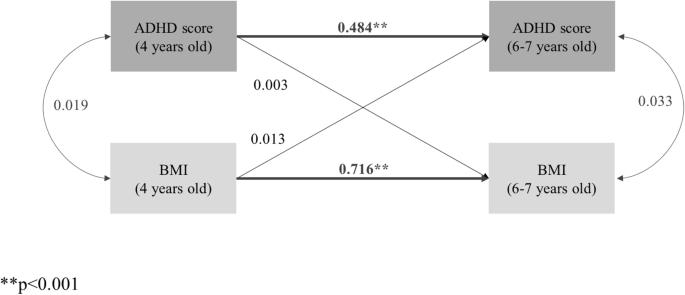
Attention deficit hyperactivity disorder (ADHD) has been linked to excessive weight; however, the underlying mechanisms of this association are not well understood. To date, the bidirectional associations between ADHD and nutritional status in childhood have been explored in a limited number of studies, with particularly few of those incorporating body composition data. This study aims to evaluate the associations of ADHD symptoms, nutritional status, and body composition in childhood. We analyzed data from 3940 children from the 2015 Pelotas (Brazil) Birth Cohort at 4 and 6–7 years of age. Linear regression was performed to evaluate the association between ADHD symptoms and nutritional status (weight, height, and body mass index [BMI]) at ages 4 and 6–7, as well as body composition, specifically fat mass (FF) and fat-free mass (FFM) at ages 6–7. Moreover, a cross-lagged panel model (CLPM) analysis between ADHD symptoms and BMI was performed to explore the bidirectional associations. ADHD symptoms were associated with increased height (β 0.01, 95%CI 0.001, 0.026) and FFM (β 0.02, 95%CI 0.008–0.035) at age 4, and increased BMI (β0.02, 95%IC 0.002, 0.038), weight (β 0. 02, 95%CI 0.005, 0.039), height (β 0.01, 95%CI 0.000, 0.024), and FFM (β 0.02, 95%CI 0.012, 0.040) at ages 6–7. Although the CLPM indicated a small effect suggesting a bidirectional relationship between ADHD symptoms and BMI, the observed associations were not statistically significant: ADHD scores at age 4 predicting BMI z-scores at ages 6–7 (β 0.003; 95% CI: –0.026, 0.020), and BMI z-scores at age 4 predicting ADHD scores at ages 6–7 (β 0.013; 95% CI: –0.018, 0.044). Children with higher ADHD symptoms showed increased growth in weight, height, and BMI. The observed increase in weight and BMI was attributed to greater FFM in these children.
期刊介绍:
The International Journal of Obesity is a multi-disciplinary forum for research describing basic, clinical and applied studies in biochemistry, physiology, genetics and nutrition, molecular, metabolic, psychological and epidemiological aspects of obesity and related disorders.
We publish a range of content types including original research articles, technical reports, reviews, correspondence and brief communications that elaborate on significant advances in the field and cover topical issues.




 京公网安备 11010802042870号
京ICP备2023020795号-1
京公网安备 11010802042870号
京ICP备2023020795号-1

 分享
分享
 求助内容:
求助内容: 应助结果提醒方式:
 扫码关注我们
