Andreas Rathke, Frank Pfefferkorn, Michael Kent McGuire, Rick H. Heard, Mikael Åström, Rainer Seemann
{"title":"Three-Year Practice-Based Clinical Trial on the Performance of a Self-Adhesive Resin-Based Bulk-Fill Restorative","authors":"Andreas Rathke, Frank Pfefferkorn, Michael Kent McGuire, Rick H. Heard, Mikael Åström, Rainer Seemann","doi":"10.1111/jerd.13468","DOIUrl":null,"url":null,"abstract":"<div>\n \n \n <section>\n \n <h3> Objective</h3>\n \n <p>The prospective clinical study followed up on self-adhesive resin-based bulk-fill restorations.</p>\n </section>\n \n <section>\n \n <h3> Materials and Methods</h3>\n \n <p>Seven general dental practitioners from a practice-based research network filled 60 cavities (20 Class I, 19 Class II, 21 Class V) in permanent vital teeth of 41 subjects with a self-adhesive, dual-curing composite hybrid (Surefil one). Modified USPHS criteria were evaluated at baseline and annually. Replacement or repair of the restoration was defined as failure. Data were analyzed using the Kaplan–Meier method and non-parametrically (<i>p</i> < 0.05).</p>\n </section>\n \n <section>\n \n <h3> Results</h3>\n \n <p>After 3 years (1118 ± 39 days), all 29 recalled teeth were rated as vital with no hypersensitivity. One tooth showed signs of cracking. One Class I and one Class II restoration failed due to a combined marginal gap and chipping. Two restorations showed a color mismatch. The remaining restorations were found to be in clinically acceptable condition and all Class II restorations in proximal contact maintained proper contact. With one restoration failure reported after 1 year, the total of three failures resulted in an annual failure rate of 3.94%.</p>\n </section>\n \n <section>\n \n <h3> Conclusions</h3>\n \n <p>The self-adhesive composite hybrid placed during daily routine showed acceptable results out to 3 years in load-bearing Classes I and II as well as non-retentive Class V cavities.</p>\n </section>\n \n <section>\n \n <h3> Clinical Significance</h3>\n \n <p>Three-year data confirmed the suitability of the novel self-adhesive restorative material for stress-bearing posterior restorations.</p>\n </section>\n </div>","PeriodicalId":15988,"journal":{"name":"Journal of Esthetic and Restorative Dentistry","volume":"37 7","pages":"1891-1899"},"PeriodicalIF":4.1000,"publicationDate":"2025-03-28","publicationTypes":"Journal Article","fieldsOfStudy":null,"isOpenAccess":false,"openAccessPdf":"https://onlinelibrary.wiley.com/doi/epdf/10.1111/jerd.13468","citationCount":"0","resultStr":null,"platform":"Semanticscholar","paperid":null,"PeriodicalName":"Journal of Esthetic and Restorative Dentistry","FirstCategoryId":"3","ListUrlMain":"https://onlinelibrary.wiley.com/doi/10.1111/jerd.13468","RegionNum":3,"RegionCategory":"医学","ArticlePicture":[],"TitleCN":null,"AbstractTextCN":null,"PMCID":null,"EPubDate":"","PubModel":"","JCR":"Q1","JCRName":"DENTISTRY, ORAL SURGERY & MEDICINE","Score":null,"Total":0}
引用次数: 0
Abstract
Objective
The prospective clinical study followed up on self-adhesive resin-based bulk-fill restorations.
Materials and Methods
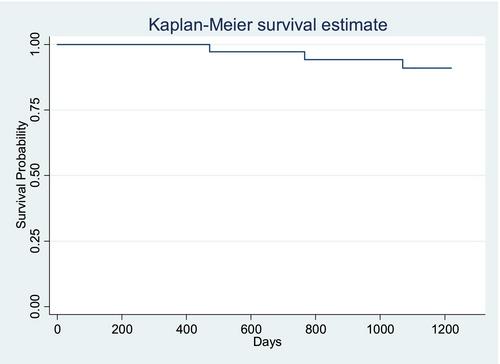
Seven general dental practitioners from a practice-based research network filled 60 cavities (20 Class I, 19 Class II, 21 Class V) in permanent vital teeth of 41 subjects with a self-adhesive, dual-curing composite hybrid (Surefil one). Modified USPHS criteria were evaluated at baseline and annually. Replacement or repair of the restoration was defined as failure. Data were analyzed using the Kaplan–Meier method and non-parametrically (p < 0.05).
Results
After 3 years (1118 ± 39 days), all 29 recalled teeth were rated as vital with no hypersensitivity. One tooth showed signs of cracking. One Class I and one Class II restoration failed due to a combined marginal gap and chipping. Two restorations showed a color mismatch. The remaining restorations were found to be in clinically acceptable condition and all Class II restorations in proximal contact maintained proper contact. With one restoration failure reported after 1 year, the total of three failures resulted in an annual failure rate of 3.94%.
Conclusions
The self-adhesive composite hybrid placed during daily routine showed acceptable results out to 3 years in load-bearing Classes I and II as well as non-retentive Class V cavities.
Clinical Significance
Three-year data confirmed the suitability of the novel self-adhesive restorative material for stress-bearing posterior restorations.
期刊介绍:
The Journal of Esthetic and Restorative Dentistry (JERD) is the longest standing peer-reviewed journal devoted solely to advancing the knowledge and practice of esthetic dentistry. Its goal is to provide the very latest evidence-based information in the realm of contemporary interdisciplinary esthetic dentistry through high quality clinical papers, sound research reports and educational features.
The range of topics covered in the journal includes:
- Interdisciplinary esthetic concepts
- Implants
- Conservative adhesive restorations
- Tooth Whitening
- Prosthodontic materials and techniques
- Dental materials
- Orthodontic, periodontal and endodontic esthetics
- Esthetics related research
- Innovations in esthetics



 京公网安备 11010802042870号
京ICP备2023020795号-1
京公网安备 11010802042870号
京ICP备2023020795号-1

 分享
分享
 求助内容:
求助内容: 应助结果提醒方式:
 扫码关注我们
