Hye-Min Yi, Seok Won, Juhan Pak, Seong-Eun Park, Mi-Ri Kim, Ji-Hyun Kim, Eun-Young Park, Sun-Young Hwang, Mee-Hyun Lee, Hong-Seok Son, Suryang Kwak
{"title":"Fecal Microbiome and Urine Metabolome Profiling of Type 2 Diabetes.","authors":"Hye-Min Yi, Seok Won, Juhan Pak, Seong-Eun Park, Mi-Ri Kim, Ji-Hyun Kim, Eun-Young Park, Sun-Young Hwang, Mee-Hyun Lee, Hong-Seok Son, Suryang Kwak","doi":"10.4014/jmb.2411.11071","DOIUrl":null,"url":null,"abstract":"<p><p>Type 2 diabetes is a prevalent metabolic disorder with serious health consequences, necessitating both enhanced diagnostic methodologies and comprehensive elucidation of its pathophysiological mechanisms. We compared fecal microbiome and urine metabolome profiles in type 2 diabetes patients versus healthy controls to evaluate their respective diagnostic potential. Using a cohort of 94 subjects (48 diabetics, 46 controls), this study employed 16S rRNA amplicon sequencing for fecal microbiome analysis and GC-MS for urinary metabolomics. While fecal microbiome alpha diversity showed no significant differences between groups, urinary metabolomics demonstrated distinct structural patterns and higher evenness in type 2 diabetes patients. The study identified several diabetes-associated urinary metabolites, including elevated levels of glucose and inositol, along with decreased levels of 6 urine metabolites including glycolic acid, hippurate, and 2-aminoethanol. In the fecal microbiome, genera such as <i>Escherichia</i>-<i>Shigella</i> showed positive correlation with type 2 diabetes, while <i>Lacticaseibacillus</i> demonstrated negative correlation. Receiver operating characteristic curve analyses revealed that urinary metabolites exhibited superior diagnostic potential compared to fecal microbiome features, with an area under the curve of 0.90 for the combined metabolite model versus 0.82 for the integrated bacterial taxa model. These findings suggest that urinary metabolomics may offer a more reliable approach for type 2 diabetes diagnosis compared to fecal 16S metabarcoding, while highlighting the potential of multi-marker panels for enhanced diagnostic accuracy.</p>","PeriodicalId":16481,"journal":{"name":"Journal of microbiology and biotechnology","volume":"35 ","pages":"e2411071"},"PeriodicalIF":3.4000,"publicationDate":"2025-03-11","publicationTypes":"Journal Article","fieldsOfStudy":null,"isOpenAccess":false,"openAccessPdf":"https://www.ncbi.nlm.nih.gov/pmc/articles/PMC11985407/pdf/","citationCount":"0","resultStr":null,"platform":"Semanticscholar","paperid":null,"PeriodicalName":"Journal of microbiology and biotechnology","FirstCategoryId":"5","ListUrlMain":"https://doi.org/10.4014/jmb.2411.11071","RegionNum":4,"RegionCategory":"生物学","ArticlePicture":[],"TitleCN":null,"AbstractTextCN":null,"PMCID":null,"EPubDate":"","PubModel":"","JCR":"Q3","JCRName":"BIOTECHNOLOGY & APPLIED MICROBIOLOGY","Score":null,"Total":0}
引用次数: 0
Abstract
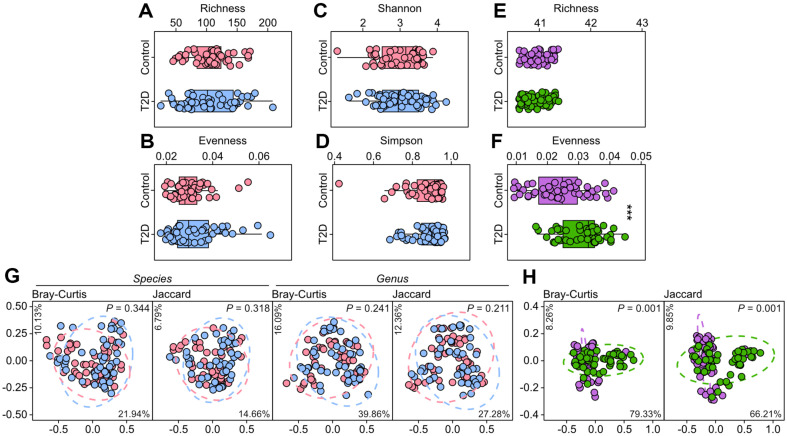
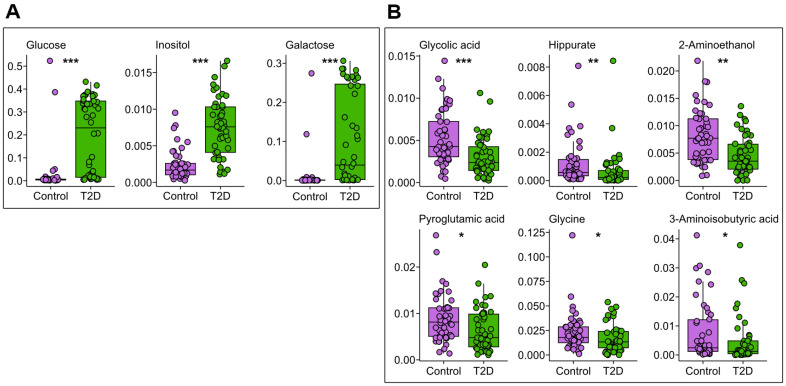
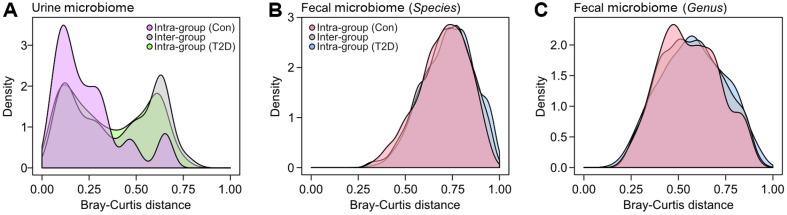
Type 2 diabetes is a prevalent metabolic disorder with serious health consequences, necessitating both enhanced diagnostic methodologies and comprehensive elucidation of its pathophysiological mechanisms. We compared fecal microbiome and urine metabolome profiles in type 2 diabetes patients versus healthy controls to evaluate their respective diagnostic potential. Using a cohort of 94 subjects (48 diabetics, 46 controls), this study employed 16S rRNA amplicon sequencing for fecal microbiome analysis and GC-MS for urinary metabolomics. While fecal microbiome alpha diversity showed no significant differences between groups, urinary metabolomics demonstrated distinct structural patterns and higher evenness in type 2 diabetes patients. The study identified several diabetes-associated urinary metabolites, including elevated levels of glucose and inositol, along with decreased levels of 6 urine metabolites including glycolic acid, hippurate, and 2-aminoethanol. In the fecal microbiome, genera such as Escherichia-Shigella showed positive correlation with type 2 diabetes, while Lacticaseibacillus demonstrated negative correlation. Receiver operating characteristic curve analyses revealed that urinary metabolites exhibited superior diagnostic potential compared to fecal microbiome features, with an area under the curve of 0.90 for the combined metabolite model versus 0.82 for the integrated bacterial taxa model. These findings suggest that urinary metabolomics may offer a more reliable approach for type 2 diabetes diagnosis compared to fecal 16S metabarcoding, while highlighting the potential of multi-marker panels for enhanced diagnostic accuracy.
期刊介绍:
The Journal of Microbiology and Biotechnology (JMB) is a monthly international journal devoted to the advancement and dissemination of scientific knowledge pertaining to microbiology, biotechnology, and related academic disciplines. It covers various scientific and technological aspects of Molecular and Cellular Microbiology, Environmental Microbiology and Biotechnology, Food Biotechnology, and Biotechnology and Bioengineering (subcategories are listed below). Launched in March 1991, the JMB is published by the Korean Society for Microbiology and Biotechnology (KMB) and distributed worldwide.




 京公网安备 11010802042870号
京ICP备2023020795号-1
京公网安备 11010802042870号
京ICP备2023020795号-1

 分享
分享
 求助内容:
求助内容: 应助结果提醒方式:
 扫码关注我们
