M.S.B.W.T.M. Nipuna Sudaraka Tennakoon , Jae-Yeon Park , Hye-Mi Lee , Ji-Hoon Ryu , Hyun-Jin Shin
{"title":"Ferritin nanoparticle complex with porcine epidemic diarrhea virus spike protein induces neutralizing antibody response against PEDV in mouse models","authors":"M.S.B.W.T.M. Nipuna Sudaraka Tennakoon , Jae-Yeon Park , Hye-Mi Lee , Ji-Hoon Ryu , Hyun-Jin Shin","doi":"10.1016/j.micpath.2025.107509","DOIUrl":null,"url":null,"abstract":"<div><div>As the spike protein is the major antigen that contains various neutralizing epitopes against porcine epidemic diarrhea virus (PEDV), numerous vaccine trials employing the spike protein have been established. In this study, we developed a ferritin-based nanoparticle vaccine for PEDV by combining gene delivery functions of recombinant adenoviruses. To generate nanoparticles, the S1 subunit of the spike protein was genetically linked to the N-terminus of the human ferritin heavy chain (hFTHC), and recombinant adenoviruses were generated to deliver the genetic material. The efficacy of S1 conjugated human ferritin heavy chain (S1-hFTHC) adenoviruses against S1 adenoviruses was evaluated in BALB/c mice immunized intramuscularly without adjuvant. Two weeks after the final boost, we observed a significantly higher IgG response in S1-hFTHC immunized mice compared with the S1 immunized mice, and results from the virus neutralization assay revealed robust virus neutralization activity in the S1-hFTHC immunized group compared to the S1 immunized group. Furthermore, analysis of the serum based on IgG and neutralizing titers 40 days after the last vaccination revealed the significance and longevity of the immune response induced by S1-hFTCH compared to S1 only. This strategy elucidates the efficacy of combined vaccine strategies for developing promising vaccine candidates against PEDV.</div></div>","PeriodicalId":18599,"journal":{"name":"Microbial pathogenesis","volume":"203 ","pages":"Article 107509"},"PeriodicalIF":3.9000,"publicationDate":"2025-06-01","publicationTypes":"Journal Article","fieldsOfStudy":null,"isOpenAccess":false,"openAccessPdf":"","citationCount":"0","resultStr":null,"platform":"Semanticscholar","paperid":null,"PeriodicalName":"Microbial pathogenesis","FirstCategoryId":"3","ListUrlMain":"https://www.sciencedirect.com/science/article/pii/S0882401025002347","RegionNum":3,"RegionCategory":"医学","ArticlePicture":[],"TitleCN":null,"AbstractTextCN":null,"PMCID":null,"EPubDate":"2025/3/25 0:00:00","PubModel":"Epub","JCR":"Q3","JCRName":"IMMUNOLOGY","Score":null,"Total":0}
引用次数: 0
Abstract
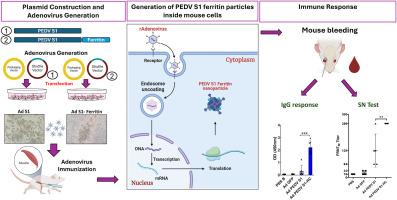
As the spike protein is the major antigen that contains various neutralizing epitopes against porcine epidemic diarrhea virus (PEDV), numerous vaccine trials employing the spike protein have been established. In this study, we developed a ferritin-based nanoparticle vaccine for PEDV by combining gene delivery functions of recombinant adenoviruses. To generate nanoparticles, the S1 subunit of the spike protein was genetically linked to the N-terminus of the human ferritin heavy chain (hFTHC), and recombinant adenoviruses were generated to deliver the genetic material. The efficacy of S1 conjugated human ferritin heavy chain (S1-hFTHC) adenoviruses against S1 adenoviruses was evaluated in BALB/c mice immunized intramuscularly without adjuvant. Two weeks after the final boost, we observed a significantly higher IgG response in S1-hFTHC immunized mice compared with the S1 immunized mice, and results from the virus neutralization assay revealed robust virus neutralization activity in the S1-hFTHC immunized group compared to the S1 immunized group. Furthermore, analysis of the serum based on IgG and neutralizing titers 40 days after the last vaccination revealed the significance and longevity of the immune response induced by S1-hFTCH compared to S1 only. This strategy elucidates the efficacy of combined vaccine strategies for developing promising vaccine candidates against PEDV.
期刊介绍:
Microbial Pathogenesis publishes original contributions and reviews about the molecular and cellular mechanisms of infectious diseases. It covers microbiology, host-pathogen interaction and immunology related to infectious agents, including bacteria, fungi, viruses and protozoa. It also accepts papers in the field of clinical microbiology, with the exception of case reports.
Research Areas Include:
-Pathogenesis
-Virulence factors
-Host susceptibility or resistance
-Immune mechanisms
-Identification, cloning and sequencing of relevant genes
-Genetic studies
-Viruses, prokaryotic organisms and protozoa
-Microbiota
-Systems biology related to infectious diseases
-Targets for vaccine design (pre-clinical studies)




 京公网安备 11010802042870号
京ICP备2023020795号-1
京公网安备 11010802042870号
京ICP备2023020795号-1

 分享
分享
 求助内容:
求助内容: 应助结果提醒方式:
 扫码关注我们
