Agni-Maria Konitsioti, Sarah Laurent, David Ellenberger, Alexander Stahmann, Paulus Rommer, Judith Haas, Clemens Warnke
{"title":"MS treatment trends before, during, and after the COVID-19 pandemic: insights from the German MS Register.","authors":"Agni-Maria Konitsioti, Sarah Laurent, David Ellenberger, Alexander Stahmann, Paulus Rommer, Judith Haas, Clemens Warnke","doi":"10.1007/s00415-025-13010-6","DOIUrl":null,"url":null,"abstract":"<p><strong>Background: </strong>The COVID-19 pandemic affected healthcare management for people with multiple sclerosis (PwMS), leading to alterations in disease-modifying therapies (DMTs) due to concerns about COVID-19 outcomes and vaccine efficacy.</p><p><strong>Objectives: </strong>To compare DMT prescription patterns in PwMS before, during, and after the COVID-19 pandemic.</p><p><strong>Methods: </strong>PwMS from the German MS Register, between 2019 and 2024, either newly diagnosed (Cohort A) or who discontinued or switched DMT (Cohort B), were analyzed over a follow-up period of 3 months. Data from the pre-pandemic period were compared to early-, late-, and post-pandemic periods. DMTs were categorized as medium efficacy (meDMT) or high efficacy (heDMT).</p><p><strong>Results: </strong>In Cohort A (n = 1810), pre-pandemic 46% had no DMT within 3 months of diagnosis, 39% received meDMT, and 15% heDMT (7.5% B cell-depleting therapies (BCD)). heDMT use increased during later periods (\"early\" 19%, \"late\" 29%, \"post\" 41%), with a shift toward BCD. In cohort B (n = 4246), pre-pandemic 47% paused DMT, 19% switched to meDMT, and 34% to heDMT (17% BCD). heDMT use also rose during the pandemic (\"early\" 37%, \"late\" 47%, \"post\" 48%), with increased BCD use.</p><p><strong>Conclusions: </strong>There were no delays in DMT initiation or resumption during the pandemic with a notable increase in heDMT and BCD use, reflecting growing confidence in these treatment options.</p>","PeriodicalId":16558,"journal":{"name":"Journal of Neurology","volume":"272 4","pages":"294"},"PeriodicalIF":5.4000,"publicationDate":"2025-03-26","publicationTypes":"Journal Article","fieldsOfStudy":null,"isOpenAccess":false,"openAccessPdf":"https://www.ncbi.nlm.nih.gov/pmc/articles/PMC11947008/pdf/","citationCount":"0","resultStr":null,"platform":"Semanticscholar","paperid":null,"PeriodicalName":"Journal of Neurology","FirstCategoryId":"3","ListUrlMain":"https://doi.org/10.1007/s00415-025-13010-6","RegionNum":2,"RegionCategory":"医学","ArticlePicture":[],"TitleCN":null,"AbstractTextCN":null,"PMCID":null,"EPubDate":"","PubModel":"","JCR":"Q1","JCRName":"CLINICAL NEUROLOGY","Score":null,"Total":0}
引用次数: 0
Abstract
Background: The COVID-19 pandemic affected healthcare management for people with multiple sclerosis (PwMS), leading to alterations in disease-modifying therapies (DMTs) due to concerns about COVID-19 outcomes and vaccine efficacy.
Objectives: To compare DMT prescription patterns in PwMS before, during, and after the COVID-19 pandemic.
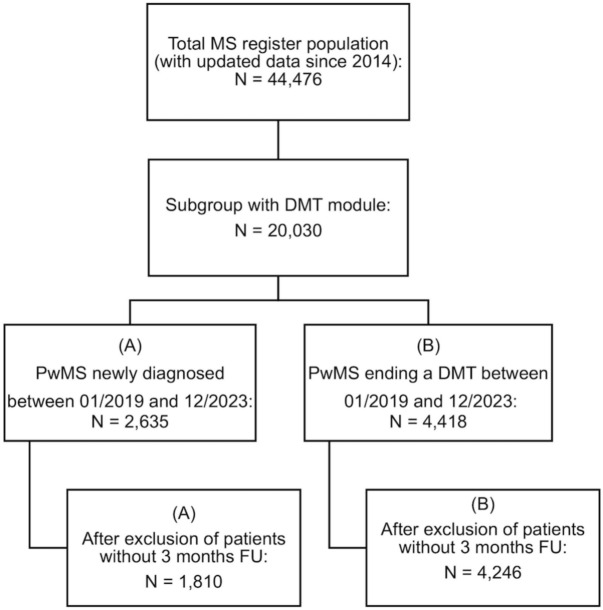
Methods: PwMS from the German MS Register, between 2019 and 2024, either newly diagnosed (Cohort A) or who discontinued or switched DMT (Cohort B), were analyzed over a follow-up period of 3 months. Data from the pre-pandemic period were compared to early-, late-, and post-pandemic periods. DMTs were categorized as medium efficacy (meDMT) or high efficacy (heDMT).
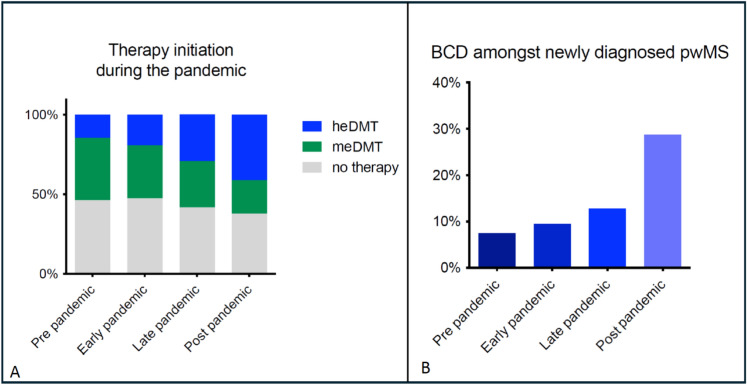
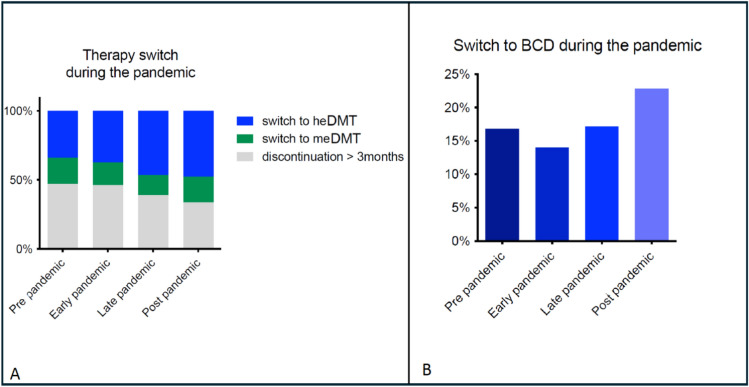
Results: In Cohort A (n = 1810), pre-pandemic 46% had no DMT within 3 months of diagnosis, 39% received meDMT, and 15% heDMT (7.5% B cell-depleting therapies (BCD)). heDMT use increased during later periods ("early" 19%, "late" 29%, "post" 41%), with a shift toward BCD. In cohort B (n = 4246), pre-pandemic 47% paused DMT, 19% switched to meDMT, and 34% to heDMT (17% BCD). heDMT use also rose during the pandemic ("early" 37%, "late" 47%, "post" 48%), with increased BCD use.
Conclusions: There were no delays in DMT initiation or resumption during the pandemic with a notable increase in heDMT and BCD use, reflecting growing confidence in these treatment options.
期刊介绍:
The Journal of Neurology is an international peer-reviewed journal which provides a source for publishing original communications and reviews on clinical neurology covering the whole field.
In addition, Letters to the Editors serve as a forum for clinical cases and the exchange of ideas which highlight important new findings. A section on Neurological progress serves to summarise the major findings in certain fields of neurology. Commentaries on new developments in clinical neuroscience, which may be commissioned or submitted, are published as editorials.
Every neurologist interested in the current diagnosis and treatment of neurological disorders needs access to the information contained in this valuable journal.




 京公网安备 11010802042870号
京ICP备2023020795号-1
京公网安备 11010802042870号
京ICP备2023020795号-1

 分享
分享
 求助内容:
求助内容: 应助结果提醒方式:
 扫码关注我们
