Jennifer Kawi, Chao Hsing Yeh, Nada Lukkahatai, Hulin Wu, Natalia E Morone, Ronald Glick, Elizabeth A Schlenk, Claudia Campbell, Johannes Thrul, Xinran Huang, Hongyu Wang, Hejingzi Monica Jia, Paul Christo, Constance Johnson
{"title":"Auricular point acupressure for older adults with chronic low back pain: a randomized controlled trial.","authors":"Jennifer Kawi, Chao Hsing Yeh, Nada Lukkahatai, Hulin Wu, Natalia E Morone, Ronald Glick, Elizabeth A Schlenk, Claudia Campbell, Johannes Thrul, Xinran Huang, Hongyu Wang, Hejingzi Monica Jia, Paul Christo, Constance Johnson","doi":"10.1093/pm/pnaf035","DOIUrl":null,"url":null,"abstract":"<p><strong>Objective: </strong>Efficacious modalities are limited in chronic low back pain (cLBP). We determined the efficacy of auricular point acupressure (APA) in older adults with cLBP.</p><p><strong>Design: </strong>3-arm randomized controlled trial.</p><p><strong>Setting: </strong>Baltimore, Maryland.</p><p><strong>Participants: </strong>Participants, ≥60 years with cLBP, were randomized (1:1:1) to APA with ear points targeted to cLBP (T-APA, n = 92), points nontargeted to cLBP (NT-APA, n = 91), or waitlist education control (n = 89), and followed up to 6 months (6M). Participants in the APA groups received 4 weekly APA sessions; the education control group received 4 weekly educational sessions.</p><p><strong>Intervention: </strong>APA.</p><p><strong>Main outcomes and measures: </strong>Primary outcomes were pain (Numerical Rating Scale) and function (Roland-Morris Disability Questionnaire).</p><p><strong>Results: </strong>There were 272 participants (174 women [64%]; mean [SD] age 70.0 [6.95] years; 62% non-White). Compared to control, the T-APA group had significant improvement on pain from baseline to postintervention and 1-month (1M) follow-up by 1.73 and 1.26 points (P ≤ .001) respectively. The NT-APA group achieved similar improvements in pain. The improvement in function by T-APA and NT-APA was significant at postintervention by 1.89 and 2.68 points (P = .04 and .004) respectively, minimal at 1M follow-up, but significant at 6M in both APA groups. There were no statistically significant differences in treatment responses between the APA groups. Both APA groups had higher responder rates in pain and function at postintervention and 1M follow-up compared to the control group (odds ratio ranged from 2.11 to 6.32). The APA effects were sustained at 6M follow-up.</p><p><strong>Conclusions: </strong>APA treatments significantly improved pain and function compared to control; effects were sustained at 6M. APA should be recommended as a nonpharmacologic therapy for older adults with cLBP.</p><p><strong>Clinical trial registration number: </strong>Trial registry: Clinicaltrials.gov; Trial ID: NCT03589703; URL: https://clinicaltrials.gov/ct2/show/record/NCT03589703.</p>","PeriodicalId":19744,"journal":{"name":"Pain Medicine","volume":" ","pages":"515-526"},"PeriodicalIF":3.0000,"publicationDate":"2025-09-01","publicationTypes":"Journal Article","fieldsOfStudy":null,"isOpenAccess":false,"openAccessPdf":"https://www.ncbi.nlm.nih.gov/pmc/articles/PMC12405757/pdf/","citationCount":"0","resultStr":null,"platform":"Semanticscholar","paperid":null,"PeriodicalName":"Pain Medicine","FirstCategoryId":"3","ListUrlMain":"https://doi.org/10.1093/pm/pnaf035","RegionNum":3,"RegionCategory":"医学","ArticlePicture":[],"TitleCN":null,"AbstractTextCN":null,"PMCID":null,"EPubDate":"","PubModel":"","JCR":"Q1","JCRName":"ANESTHESIOLOGY","Score":null,"Total":0}
引用次数: 0
Abstract
Objective: Efficacious modalities are limited in chronic low back pain (cLBP). We determined the efficacy of auricular point acupressure (APA) in older adults with cLBP.
Design: 3-arm randomized controlled trial.
Setting: Baltimore, Maryland.
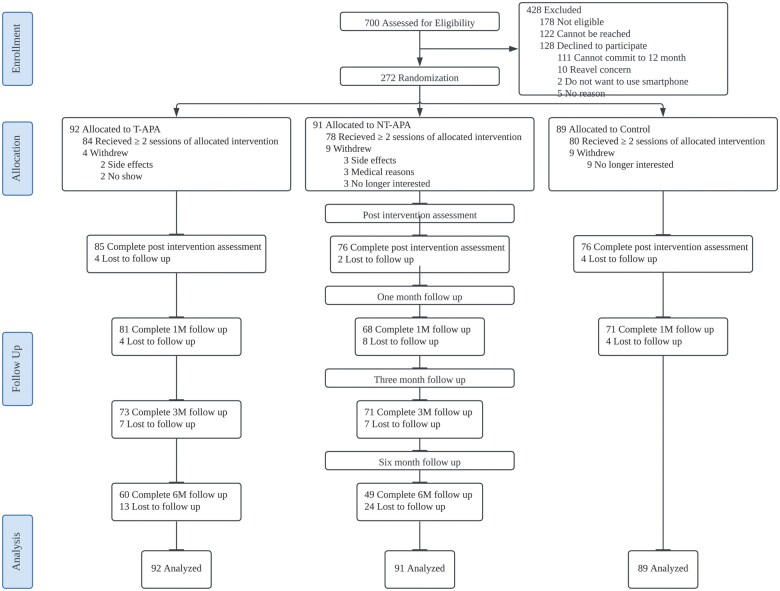
Participants: Participants, ≥60 years with cLBP, were randomized (1:1:1) to APA with ear points targeted to cLBP (T-APA, n = 92), points nontargeted to cLBP (NT-APA, n = 91), or waitlist education control (n = 89), and followed up to 6 months (6M). Participants in the APA groups received 4 weekly APA sessions; the education control group received 4 weekly educational sessions.
Intervention: APA.
Main outcomes and measures: Primary outcomes were pain (Numerical Rating Scale) and function (Roland-Morris Disability Questionnaire).
Results: There were 272 participants (174 women [64%]; mean [SD] age 70.0 [6.95] years; 62% non-White). Compared to control, the T-APA group had significant improvement on pain from baseline to postintervention and 1-month (1M) follow-up by 1.73 and 1.26 points (P ≤ .001) respectively. The NT-APA group achieved similar improvements in pain. The improvement in function by T-APA and NT-APA was significant at postintervention by 1.89 and 2.68 points (P = .04 and .004) respectively, minimal at 1M follow-up, but significant at 6M in both APA groups. There were no statistically significant differences in treatment responses between the APA groups. Both APA groups had higher responder rates in pain and function at postintervention and 1M follow-up compared to the control group (odds ratio ranged from 2.11 to 6.32). The APA effects were sustained at 6M follow-up.
Conclusions: APA treatments significantly improved pain and function compared to control; effects were sustained at 6M. APA should be recommended as a nonpharmacologic therapy for older adults with cLBP.
期刊介绍:
Pain Medicine is a multi-disciplinary journal dedicated to pain clinicians, educators and researchers with an interest in pain from various medical specialties such as pain medicine, anaesthesiology, family practice, internal medicine, neurology, neurological surgery, orthopaedic spine surgery, psychiatry, and rehabilitation medicine as well as related health disciplines such as psychology, neuroscience, nursing, nurse practitioner, physical therapy, and integrative health.



 京公网安备 11010802042870号
京ICP备2023020795号-1
京公网安备 11010802042870号
京ICP备2023020795号-1

 分享
分享
 求助内容:
求助内容: 应助结果提醒方式:
 扫码关注我们
