Seongmoon Jo , Sang Hee Im , Sung Hoon Kim , Dawoon Baek , Jin-Kyoung Shim , Seok-Gu Kang , Jong Hee Chang , Geneva Rose Notario , Do-Won Lee , Ahreum Baek , Sung-Rae Cho
{"title":"Tumor suppressive effect of low-frequency repetitive transcranial magnetic stimulation on glioblastoma progression","authors":"Seongmoon Jo , Sang Hee Im , Sung Hoon Kim , Dawoon Baek , Jin-Kyoung Shim , Seok-Gu Kang , Jong Hee Chang , Geneva Rose Notario , Do-Won Lee , Ahreum Baek , Sung-Rae Cho","doi":"10.1016/j.neurot.2025.e00569","DOIUrl":null,"url":null,"abstract":"<div><div>Repetitive transcranial magnetic stimulation (rTMS) is used as a non-invasive treatment for various diseases, and its potential application in cancer treatment has been proposed by researchers. However, the precise mechanisms and effects of rTMS on many types of cancer, including glioblastoma (GBM), remain largely unknown. This study aimed to investigate the effects of low-frequency rTMS on <em>in vitro</em> and <em>in vivo</em> GBM models and to elucidate an underlying biological mechanism of rTMS on GBM. <em>In vitro</em> and <em>in vivo</em> GBM models were treated with low-frequency rTMS (0.5 Hz, 10 min per day), and the effects of rTMS were assessed using various assays, including CCK-8 assay, sphere formation assay, 3D invasion assay, RT-qPCR, Western blot, immunohistochemistry, TUNEL assay, MRI, and IVIS. The results showed that treatment of GBM models <em>in vitro</em> with low-frequency rTMS significantly inhibited cell proliferation. Transcriptome array analysis revealed a substantial downregulation of FLNA and FLNC expression after low-frequency rTMS treatment. Moreover, in an <em>in vitro</em> GBM tumor sphere model, low-frequency rTMS suppressed the activation of EGFR and EphA2, inhibited ERK/JNK/p38 and PI3K/AKT/mTOR pathways, and induced apoptosis. Low-frequency rTMS also suppressed the invasion of GBM by downregulating MMP2 and MMP9 expression. Additionally, in an <em>in vivo</em> GBM model, low-frequency rTMS suppressed GBM progression by downregulating FLNA and FLNC expression. The results demonstrated that low-frequency rTMS could be a potential treatment for GBM, achieved by downregulating FLNA and FLNC expression. This study sheds light on the potential for rTMS as a therapeutic strategy for glioblastoma as well as other types of cancers.</div></div>","PeriodicalId":19159,"journal":{"name":"Neurotherapeutics","volume":"22 4","pages":"Article e00569"},"PeriodicalIF":6.9000,"publicationDate":"2025-07-01","publicationTypes":"Journal Article","fieldsOfStudy":null,"isOpenAccess":false,"openAccessPdf":"","citationCount":"0","resultStr":null,"platform":"Semanticscholar","paperid":null,"PeriodicalName":"Neurotherapeutics","FirstCategoryId":"3","ListUrlMain":"https://www.sciencedirect.com/science/article/pii/S1878747925000479","RegionNum":2,"RegionCategory":"医学","ArticlePicture":[],"TitleCN":null,"AbstractTextCN":null,"PMCID":null,"EPubDate":"2025/3/27 0:00:00","PubModel":"Epub","JCR":"Q1","JCRName":"CLINICAL NEUROLOGY","Score":null,"Total":0}
引用次数: 0
Abstract
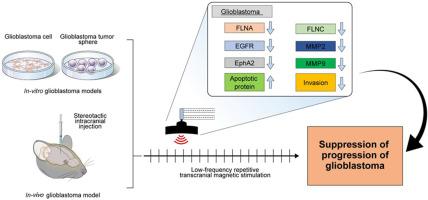
Repetitive transcranial magnetic stimulation (rTMS) is used as a non-invasive treatment for various diseases, and its potential application in cancer treatment has been proposed by researchers. However, the precise mechanisms and effects of rTMS on many types of cancer, including glioblastoma (GBM), remain largely unknown. This study aimed to investigate the effects of low-frequency rTMS on in vitro and in vivo GBM models and to elucidate an underlying biological mechanism of rTMS on GBM. In vitro and in vivo GBM models were treated with low-frequency rTMS (0.5 Hz, 10 min per day), and the effects of rTMS were assessed using various assays, including CCK-8 assay, sphere formation assay, 3D invasion assay, RT-qPCR, Western blot, immunohistochemistry, TUNEL assay, MRI, and IVIS. The results showed that treatment of GBM models in vitro with low-frequency rTMS significantly inhibited cell proliferation. Transcriptome array analysis revealed a substantial downregulation of FLNA and FLNC expression after low-frequency rTMS treatment. Moreover, in an in vitro GBM tumor sphere model, low-frequency rTMS suppressed the activation of EGFR and EphA2, inhibited ERK/JNK/p38 and PI3K/AKT/mTOR pathways, and induced apoptosis. Low-frequency rTMS also suppressed the invasion of GBM by downregulating MMP2 and MMP9 expression. Additionally, in an in vivo GBM model, low-frequency rTMS suppressed GBM progression by downregulating FLNA and FLNC expression. The results demonstrated that low-frequency rTMS could be a potential treatment for GBM, achieved by downregulating FLNA and FLNC expression. This study sheds light on the potential for rTMS as a therapeutic strategy for glioblastoma as well as other types of cancers.
期刊介绍:
Neurotherapeutics® is the journal of the American Society for Experimental Neurotherapeutics (ASENT). Each issue provides critical reviews of an important topic relating to the treatment of neurological disorders written by international authorities.
The Journal also publishes original research articles in translational neuroscience including descriptions of cutting edge therapies that cross disciplinary lines and represent important contributions to neurotherapeutics for medical practitioners and other researchers in the field.
Neurotherapeutics ® delivers a multidisciplinary perspective on the frontiers of translational neuroscience, provides perspectives on current research and practice, and covers social and ethical as well as scientific issues.




 京公网安备 11010802042870号
京ICP备2023020795号-1
京公网安备 11010802042870号
京ICP备2023020795号-1

 分享
分享
 求助内容:
求助内容: 应助结果提醒方式:
 扫码关注我们
