Ioannis Foukarakis, Stefanos N Sampatakakis, Eirini Mamalaki, Andreas Kyrozis, Eva Ntanasi, Angeliki Tsapanou, Mary Yannakoulia, Konstantinos Rouskas, Nikolaos Scarmeas
{"title":"Sleep architecture in Alzheimer's disease continuum: The deep sleep question.","authors":"Ioannis Foukarakis, Stefanos N Sampatakakis, Eirini Mamalaki, Andreas Kyrozis, Eva Ntanasi, Angeliki Tsapanou, Mary Yannakoulia, Konstantinos Rouskas, Nikolaos Scarmeas","doi":"10.1515/biol-2025-1077","DOIUrl":null,"url":null,"abstract":"<p><p>As sleep appears to be closely related to cognitive status, we aimed to explore the association between the percentage of deep sleep, cognitive state, and the cerebrospinal fluid (CSF) biomarker amyloid-beta 42 in non-demented individuals. In this cross-sectional study, 90 non-demented participants from the Aiginition Longitudinal Biomarker Investigation of Neurodegeneration cohort underwent a one-night WatchPAT sleep evaluation. Participants were categorized by cognitive status (patients with mild cognitive impairment [MCI] or cognitively normal [CN] individuals) and CSF Aβ42 status (Aβ42 ≤ 1,030 pg/mL [A+] or Ab42 > 1,030 pg/mL [A-]). After controlling for age, sex, and years of education, a significant inverse association was found between the percentage of deep sleep and the odds of being classified as MCI compared to CN (OR = 0.86, 95% CI [0.76-0.97], <i>p</i> = 0.012). However, a non-significant trend for an inverse association between the percentage of deep sleep and the odds of being classified as A+ was observed (OR = 0.92, 95% CI [0.84-1.01], <i>p</i> = 0.092). This study demonstrates a significant link between deep sleep and MCI. Although more longitudinal studies are needed, deep sleep could potentially serve as a novel biomarker of cognitive decline and an intervention target for dementia prevention.</p>","PeriodicalId":19605,"journal":{"name":"Open Life Sciences","volume":"20 1","pages":"20251077"},"PeriodicalIF":2.3000,"publicationDate":"2025-03-25","publicationTypes":"Journal Article","fieldsOfStudy":null,"isOpenAccess":false,"openAccessPdf":"https://www.ncbi.nlm.nih.gov/pmc/articles/PMC11947663/pdf/","citationCount":"0","resultStr":null,"platform":"Semanticscholar","paperid":null,"PeriodicalName":"Open Life Sciences","FirstCategoryId":"99","ListUrlMain":"https://doi.org/10.1515/biol-2025-1077","RegionNum":4,"RegionCategory":"生物学","ArticlePicture":[],"TitleCN":null,"AbstractTextCN":null,"PMCID":null,"EPubDate":"2025/1/1 0:00:00","PubModel":"eCollection","JCR":"Q3","JCRName":"BIOLOGY","Score":null,"Total":0}
引用次数: 0
Abstract
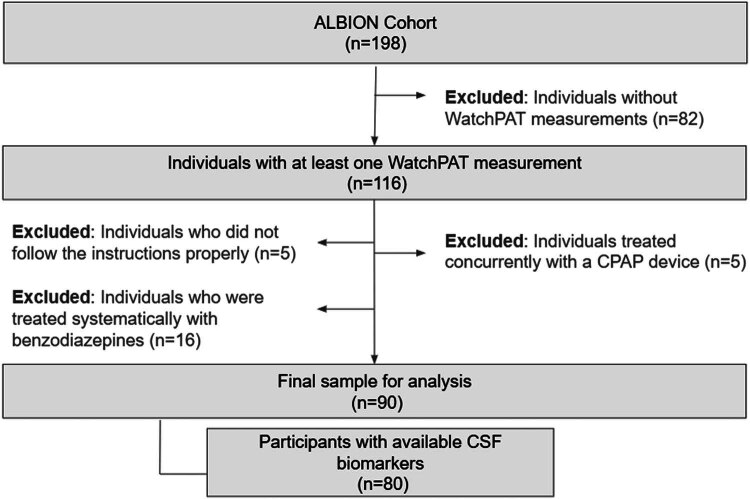
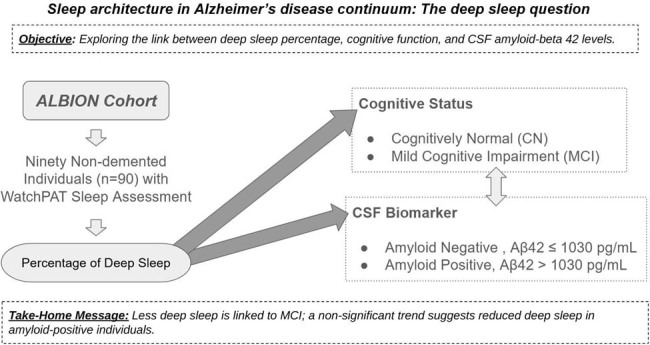
As sleep appears to be closely related to cognitive status, we aimed to explore the association between the percentage of deep sleep, cognitive state, and the cerebrospinal fluid (CSF) biomarker amyloid-beta 42 in non-demented individuals. In this cross-sectional study, 90 non-demented participants from the Aiginition Longitudinal Biomarker Investigation of Neurodegeneration cohort underwent a one-night WatchPAT sleep evaluation. Participants were categorized by cognitive status (patients with mild cognitive impairment [MCI] or cognitively normal [CN] individuals) and CSF Aβ42 status (Aβ42 ≤ 1,030 pg/mL [A+] or Ab42 > 1,030 pg/mL [A-]). After controlling for age, sex, and years of education, a significant inverse association was found between the percentage of deep sleep and the odds of being classified as MCI compared to CN (OR = 0.86, 95% CI [0.76-0.97], p = 0.012). However, a non-significant trend for an inverse association between the percentage of deep sleep and the odds of being classified as A+ was observed (OR = 0.92, 95% CI [0.84-1.01], p = 0.092). This study demonstrates a significant link between deep sleep and MCI. Although more longitudinal studies are needed, deep sleep could potentially serve as a novel biomarker of cognitive decline and an intervention target for dementia prevention.
期刊介绍:
Open Life Sciences (previously Central European Journal of Biology) is a fast growing peer-reviewed journal, devoted to scholarly research in all areas of life sciences, such as molecular biology, plant science, biotechnology, cell biology, biochemistry, biophysics, microbiology and virology, ecology, differentiation and development, genetics and many others. Open Life Sciences assures top quality of published data through critical peer review and editorial involvement throughout the whole publication process. Thanks to the Open Access model of publishing, it also offers unrestricted access to published articles for all users.




 京公网安备 11010802042870号
京ICP备2023020795号-1
京公网安备 11010802042870号
京ICP备2023020795号-1

 分享
分享
 求助内容:
求助内容: 应助结果提醒方式:
 扫码关注我们
