{"title":"Proteomics of Extracellular Vesicles: Recent Updates, Challenges and Limitations.","authors":"Mohini Singh, Prashant Kumar Tiwari, Vivek Kashyap, Sanjay Kumar","doi":"10.3390/proteomes13010012","DOIUrl":null,"url":null,"abstract":"<p><p>Extracellular vesicles (EVs) are lipid-bound vesicles secreted by cells, including exosomes, microvesicles, and apoptotic bodies. Proteomic analyses of EVs, particularly in relation to cancer, reveal specific biomarkers crucial for diagnosis and therapy. However, isolation techniques such as ultracentrifugation, size-exclusion chromatography, and ultrafiltration face challenges regarding purity, contamination, and yield. Contamination from other proteins complicates downstream processing, leading to difficulties in identifying biomarkers and interpreting results. Future research will focus on refining EV characterization for diagnostic and therapeutic applications, improving proteomics tools for greater accuracy, and exploring the use of EVs in drug delivery and regenerative medicine. In this review, we provide a bird's eye view of various challenges, starting with EV isolation methods, yield, purity, and limitations in the proteome analysis of EVs for identifying protein targets.</p>","PeriodicalId":20877,"journal":{"name":"Proteomes","volume":"13 1","pages":""},"PeriodicalIF":3.6000,"publicationDate":"2025-03-04","publicationTypes":"Journal Article","fieldsOfStudy":null,"isOpenAccess":false,"openAccessPdf":"https://www.ncbi.nlm.nih.gov/pmc/articles/PMC11944546/pdf/","citationCount":"0","resultStr":null,"platform":"Semanticscholar","paperid":null,"PeriodicalName":"Proteomes","FirstCategoryId":"1085","ListUrlMain":"https://doi.org/10.3390/proteomes13010012","RegionNum":0,"RegionCategory":null,"ArticlePicture":[],"TitleCN":null,"AbstractTextCN":null,"PMCID":null,"EPubDate":"","PubModel":"","JCR":"Q2","JCRName":"BIOCHEMISTRY & MOLECULAR BIOLOGY","Score":null,"Total":0}
引用次数: 0
Abstract
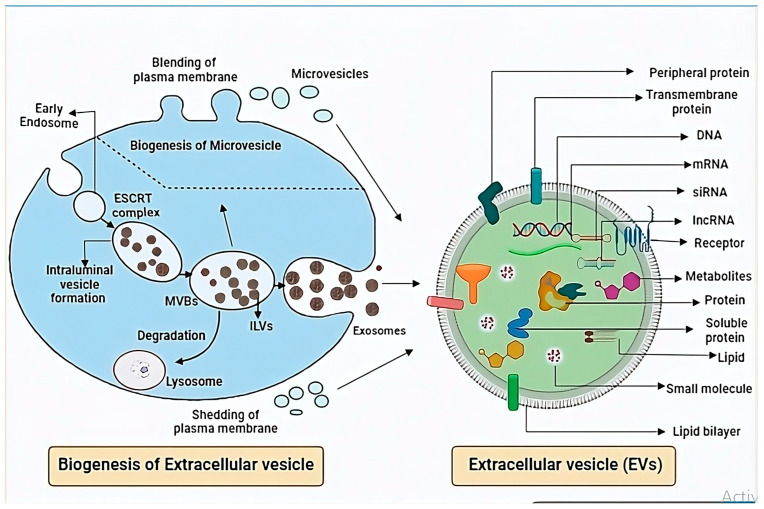
Extracellular vesicles (EVs) are lipid-bound vesicles secreted by cells, including exosomes, microvesicles, and apoptotic bodies. Proteomic analyses of EVs, particularly in relation to cancer, reveal specific biomarkers crucial for diagnosis and therapy. However, isolation techniques such as ultracentrifugation, size-exclusion chromatography, and ultrafiltration face challenges regarding purity, contamination, and yield. Contamination from other proteins complicates downstream processing, leading to difficulties in identifying biomarkers and interpreting results. Future research will focus on refining EV characterization for diagnostic and therapeutic applications, improving proteomics tools for greater accuracy, and exploring the use of EVs in drug delivery and regenerative medicine. In this review, we provide a bird's eye view of various challenges, starting with EV isolation methods, yield, purity, and limitations in the proteome analysis of EVs for identifying protein targets.
ProteomesBiochemistry, Genetics and Molecular Biology-Clinical Biochemistry
CiteScore
6.50
自引率
3.00%
发文量
37
审稿时长
11 weeks
期刊介绍:
Proteomes (ISSN 2227-7382) is an open access, peer reviewed journal on all aspects of proteome science. Proteomes covers the multi-disciplinary topics of structural and functional biology, protein chemistry, cell biology, methodology used for protein analysis, including mass spectrometry, protein arrays, bioinformatics, HTS assays, etc. Our aim is to encourage scientists to publish their experimental and theoretical results in as much detail as possible. Therefore, there is no restriction on the length of papers. Scope: -whole proteome analysis of any organism -disease/pharmaceutical studies -comparative proteomics -protein-ligand/protein interactions -structure/functional proteomics -gene expression -methodology -bioinformatics -applications of proteomics




 京公网安备 11010802042870号
京ICP备2023020795号-1
京公网安备 11010802042870号
京ICP备2023020795号-1

 分享
分享
 求助内容:
求助内容: 应助结果提醒方式:
 扫码关注我们
