Corinne Pettigrew, Anja Soldan, Jiangxia Wang, Timothy Hohman, Logan Dumitrescu, Marilyn Albert, Kaj Blennow, Tobias Bittner, Abhay Moghekar
{"title":"Plasma biomarker trajectories: Impact of AD genetic risk and clinical progression.","authors":"Corinne Pettigrew, Anja Soldan, Jiangxia Wang, Timothy Hohman, Logan Dumitrescu, Marilyn Albert, Kaj Blennow, Tobias Bittner, Abhay Moghekar","doi":"10.1002/dad2.70081","DOIUrl":null,"url":null,"abstract":"<p><strong>Introduction: </strong>We examined long-term plasma biomarker trajectories among participants who were cognitively unimpaired and primarily middle aged at baseline and whether trajectories differed by Alzheimer's disease (AD) genetic risk and among those who developed cognitive impairment.</p><p><strong>Methods: </strong>Plasma amyloid beta (Aβ)<sub>42</sub>/Aβ<sub>40</sub>, phosphorylated tau (p-tau)<sub>181</sub>, neurofilament light chain (NfL), glial fibrillary acidic protein (GFAP), soluble triggering receptor expressed on myeloid cells, and chitinase 3-like protein 1 were measured longitudinally in 177 BIOCARD participants (<i>M</i> baseline age = 57.7 years; <i>M</i> follow-up = 15.8 years), including 57 who developed cognitive impairment. Measures of AD genetic risk included apolipoprotein E (<i>APOE</i>) ε4 and an AD polygenic risk score (AD-PRS).</p><p><strong>Results: </strong>Compared to non-carriers, <i>APOE</i> ε4 carriers had lower Aβ<sub>42</sub>/Aβ<sub>40</sub> and greater longitudinal increases in p-tau<sub>181</sub> and GFAP; in contrast, the AD-PRS (excluding the <i>APOE</i> region) was associated with greater declines in Aβ<sub>42</sub>/Aβ<sub>40</sub> among <i>APOE</i> ε4 non-carriers. Rates of increase in p-tau<sub>181</sub>, NfL, and GFAP were greater among those who later developed cognitive impairment.</p><p><strong>Discussion: </strong>Monitoring changes in plasma p-tau<sub>181</sub>, NfL, and GFAP may be particularly informative during preclinical AD.</p><p><strong>Highlights: </strong>We examined plasma biomarker changes in cognitively normal individuals over 15.8 years.Apolipoprotein E (<i>APOE</i>) ε4 was related to lower amyloid beta (Aβ)<sub>42</sub>/Aβ<sub>40</sub> and greater increases in phosphorylated tau (p-tau)<sub>181</sub> and glial fibrillary acidic protein (GFAP).In <i>APOE</i> ε4 non-carriers, higher Alzheimer's disease (AD) polygenic risk score was related to greater Aβ<sub>42</sub>/Aβ<sub>40</sub> declines.P-tau<sub>181</sub>, NfL, and GFAP increases were greater among those who progressed to mild cognitive impairment.Results highlight the predictive value of plasma biomarkers during preclinical AD.</p>","PeriodicalId":53226,"journal":{"name":"Alzheimer''s and Dementia: Diagnosis, Assessment and Disease Monitoring","volume":"17 1","pages":"e70081"},"PeriodicalIF":4.4000,"publicationDate":"2025-03-27","publicationTypes":"Journal Article","fieldsOfStudy":null,"isOpenAccess":false,"openAccessPdf":"https://www.ncbi.nlm.nih.gov/pmc/articles/PMC11947672/pdf/","citationCount":"0","resultStr":null,"platform":"Semanticscholar","paperid":null,"PeriodicalName":"Alzheimer''s and Dementia: Diagnosis, Assessment and Disease Monitoring","FirstCategoryId":"1085","ListUrlMain":"https://doi.org/10.1002/dad2.70081","RegionNum":0,"RegionCategory":null,"ArticlePicture":[],"TitleCN":null,"AbstractTextCN":null,"PMCID":null,"EPubDate":"2025/1/1 0:00:00","PubModel":"eCollection","JCR":"Q1","JCRName":"CLINICAL NEUROLOGY","Score":null,"Total":0}
引用次数: 0
Abstract
Introduction: We examined long-term plasma biomarker trajectories among participants who were cognitively unimpaired and primarily middle aged at baseline and whether trajectories differed by Alzheimer's disease (AD) genetic risk and among those who developed cognitive impairment.
Methods: Plasma amyloid beta (Aβ)42/Aβ40, phosphorylated tau (p-tau)181, neurofilament light chain (NfL), glial fibrillary acidic protein (GFAP), soluble triggering receptor expressed on myeloid cells, and chitinase 3-like protein 1 were measured longitudinally in 177 BIOCARD participants (M baseline age = 57.7 years; M follow-up = 15.8 years), including 57 who developed cognitive impairment. Measures of AD genetic risk included apolipoprotein E (APOE) ε4 and an AD polygenic risk score (AD-PRS).
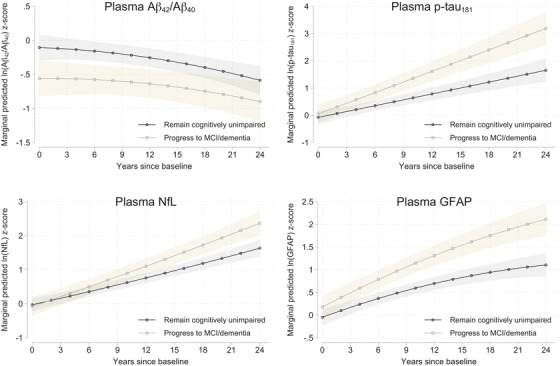
Results: Compared to non-carriers, APOE ε4 carriers had lower Aβ42/Aβ40 and greater longitudinal increases in p-tau181 and GFAP; in contrast, the AD-PRS (excluding the APOE region) was associated with greater declines in Aβ42/Aβ40 among APOE ε4 non-carriers. Rates of increase in p-tau181, NfL, and GFAP were greater among those who later developed cognitive impairment.
Discussion: Monitoring changes in plasma p-tau181, NfL, and GFAP may be particularly informative during preclinical AD.
Highlights: We examined plasma biomarker changes in cognitively normal individuals over 15.8 years.Apolipoprotein E (APOE) ε4 was related to lower amyloid beta (Aβ)42/Aβ40 and greater increases in phosphorylated tau (p-tau)181 and glial fibrillary acidic protein (GFAP).In APOE ε4 non-carriers, higher Alzheimer's disease (AD) polygenic risk score was related to greater Aβ42/Aβ40 declines.P-tau181, NfL, and GFAP increases were greater among those who progressed to mild cognitive impairment.Results highlight the predictive value of plasma biomarkers during preclinical AD.
期刊介绍:
Alzheimer''s & Dementia: Diagnosis, Assessment & Disease Monitoring (DADM) is an open access, peer-reviewed, journal from the Alzheimer''s Association® that will publish new research that reports the discovery, development and validation of instruments, technologies, algorithms, and innovative processes. Papers will cover a range of topics interested in the early and accurate detection of individuals with memory complaints and/or among asymptomatic individuals at elevated risk for various forms of memory disorders. The expectation for published papers will be to translate fundamental knowledge about the neurobiology of the disease into practical reports that describe both the conceptual and methodological aspects of the submitted scientific inquiry. Published topics will explore the development of biomarkers, surrogate markers, and conceptual/methodological challenges. Publication priority will be given to papers that 1) describe putative surrogate markers that accurately track disease progression, 2) biomarkers that fulfill international regulatory requirements, 3) reports from large, well-characterized population-based cohorts that comprise the heterogeneity and diversity of asymptomatic individuals and 4) algorithmic development that considers multi-marker arrays (e.g., integrated-omics, genetics, biofluids, imaging, etc.) and advanced computational analytics and technologies.





 京公网安备 11010802042870号
京ICP备2023020795号-1
京公网安备 11010802042870号
京ICP备2023020795号-1

 分享
分享
 求助内容:
求助内容: 应助结果提醒方式:
 扫码关注我们
