Noara Alhusseini, Jamil Alghanem, Salsabil Haque, Samanta Mohammed Shahin, Mohammad Alsaeed, Wael Kalou, Adel Kalou, Sara Alnasser, Majed Ramadan, Khadijah Ateq
{"title":"Nomophobia and Psychological distress among the Saudi Population.","authors":"Noara Alhusseini, Jamil Alghanem, Salsabil Haque, Samanta Mohammed Shahin, Mohammad Alsaeed, Wael Kalou, Adel Kalou, Sara Alnasser, Majed Ramadan, Khadijah Ateq","doi":"10.1371/journal.pdig.0000779","DOIUrl":null,"url":null,"abstract":"<p><strong>Introduction: </strong>Smartphones have become a defining feature of the 21st century, fundamentally transforming the way we live and interact. However, the pervasive use and growing dependence on these devices have led to increasing concerns about their impact on mental health. The rise of smartphone addiction, often manifesting as anxiety, irritability, and a feeling of melancholy, has contributed to the rapid increase in nomophobia, a term describing the fear of being without a mobile device. This phenomenon is increasingly linked to psychological distress as our reliance on smartphones continues to deepen.</p><p><strong>Aim: </strong>This study seeks to determine the prevalence of nomophobia and psychological distress symptoms and their relationship among the adult population of Saudi Arabia.</p><p><strong>Method: </strong>A cross-sectional survey was done among the adult population of Saudi Arabia, including Saudis and non-Saudis. An online validated survey was distributed via social media channels. SAS 9.4. was used for data analysis. Frequencies and percentages were used to display the prevalence, and the chi-square test was used for associations. A p-value <0.05 was used to determine significance.</p><p><strong>Result: </strong>A total of 704 Saudi and non-Saudi adults completed the questionnaire. The mean nomophobia score among all participants indicated a moderate level at 73.71, while the mean psychological distress score reflected a mild disorder at 22.08. Saudis reported a statistically higher significant mean nomophobia score than non-Saudis (p-value <0.0001). Participants residing in the Eastern region were significantly more prone to nomophobia (p-value 0.0003), and to psychological distress (p-value 0.004).</p><p><strong>Conclusion: </strong>The study reveals that men and Saudi nationals are particularly affected by nomophobia, likely due to their higher reliance on smartphones. Saudi nationality, educational attainment, and residing in the Eastern region of Saudi Arabia are considered predictors for nomophobia and psychological distress.</p>","PeriodicalId":74465,"journal":{"name":"PLOS digital health","volume":"4 3","pages":"e0000779"},"PeriodicalIF":7.7000,"publicationDate":"2025-03-26","publicationTypes":"Journal Article","fieldsOfStudy":null,"isOpenAccess":false,"openAccessPdf":"https://www.ncbi.nlm.nih.gov/pmc/articles/PMC11942369/pdf/","citationCount":"0","resultStr":null,"platform":"Semanticscholar","paperid":null,"PeriodicalName":"PLOS digital health","FirstCategoryId":"1085","ListUrlMain":"https://doi.org/10.1371/journal.pdig.0000779","RegionNum":0,"RegionCategory":null,"ArticlePicture":[],"TitleCN":null,"AbstractTextCN":null,"PMCID":null,"EPubDate":"2025/3/1 0:00:00","PubModel":"eCollection","JCR":"","JCRName":"","Score":null,"Total":0}
引用次数: 0
Abstract
Introduction: Smartphones have become a defining feature of the 21st century, fundamentally transforming the way we live and interact. However, the pervasive use and growing dependence on these devices have led to increasing concerns about their impact on mental health. The rise of smartphone addiction, often manifesting as anxiety, irritability, and a feeling of melancholy, has contributed to the rapid increase in nomophobia, a term describing the fear of being without a mobile device. This phenomenon is increasingly linked to psychological distress as our reliance on smartphones continues to deepen.
Aim: This study seeks to determine the prevalence of nomophobia and psychological distress symptoms and their relationship among the adult population of Saudi Arabia.
Method: A cross-sectional survey was done among the adult population of Saudi Arabia, including Saudis and non-Saudis. An online validated survey was distributed via social media channels. SAS 9.4. was used for data analysis. Frequencies and percentages were used to display the prevalence, and the chi-square test was used for associations. A p-value <0.05 was used to determine significance.
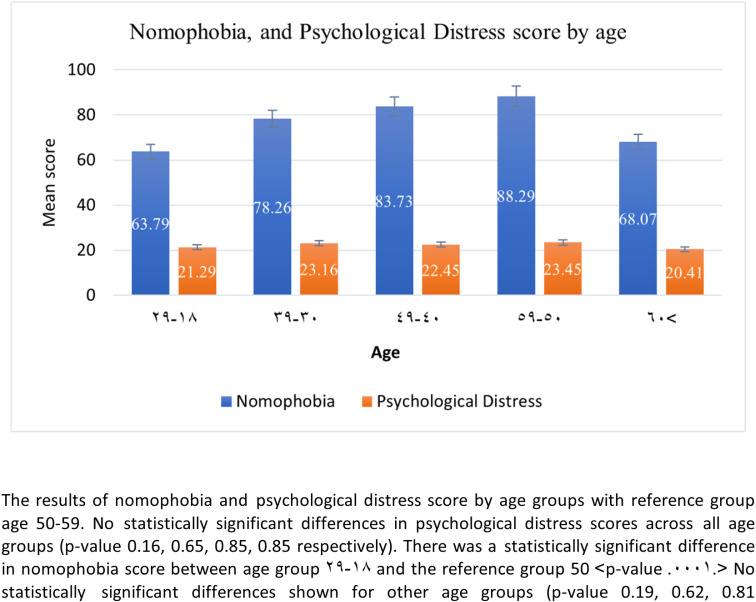
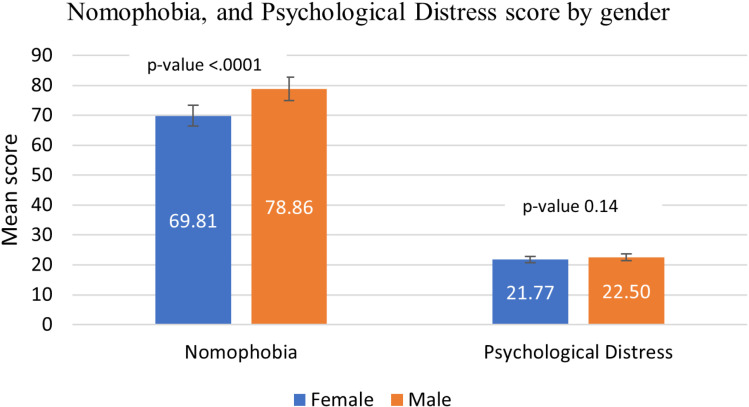
Result: A total of 704 Saudi and non-Saudi adults completed the questionnaire. The mean nomophobia score among all participants indicated a moderate level at 73.71, while the mean psychological distress score reflected a mild disorder at 22.08. Saudis reported a statistically higher significant mean nomophobia score than non-Saudis (p-value <0.0001). Participants residing in the Eastern region were significantly more prone to nomophobia (p-value 0.0003), and to psychological distress (p-value 0.004).
Conclusion: The study reveals that men and Saudi nationals are particularly affected by nomophobia, likely due to their higher reliance on smartphones. Saudi nationality, educational attainment, and residing in the Eastern region of Saudi Arabia are considered predictors for nomophobia and psychological distress.




 京公网安备 11010802042870号
京ICP备2023020795号-1
京公网安备 11010802042870号
京ICP备2023020795号-1

 分享
分享

 求助内容:
求助内容: 应助结果提醒方式:
 扫码关注我们
