{"title":"MNMO: discover driver genes from a multi-omics data based-multi-layer network.","authors":"Zheng Deng, Jingli Wu, Xiaorong Chen, Gaoshi Li, Jiafei Liu, Zhipeng Hu, Rongyuan Li, Wansu Deng","doi":"10.1093/bioinformatics/btaf134","DOIUrl":null,"url":null,"abstract":"<p><strong>Motivation: </strong>Cancer as a public health problem is driven by genomic variations in \"cancer driver\" genes. The identification of driver genes is critical for the discovery of key biomarkers and the development of personalized therapy.</p><p><strong>Results: </strong>We propose a prediction method MNMO: a multi-layer network model based on multi-omics data. MNMO firstly constructs a dynamically adjusted four-layer network composed of miRNAs and three kinds of genes with different features. Then three kinds of scores, i.e. control capacity, mutation score, and network score, are devised and calculated by harmonic mean to produce the integrated gene score. Experiments were performed on three kinds of real cancer data to compare the identification performance of method MNMO with that of six state-of-the-art ones. The results indicate that method MNMO presents the best identification performance under most circumstances. The genes prioritized by method MNMO not only have a better match to the benchmark ones than those identified by the other methods, but also are all associated with the development and progression of cancers. In addition, some extended versions of method MNMO can further achieve better performance on most evaluation metrics for some specific datasets. They may be more conducive to identifying tissue-specific genes, which has been verified through a number of experiments.</p><p><strong>Availability and implementation: </strong>The source code and the R package \"MNMO\" are available at https://github.com/Zheng-D/MNMO. The dataset and code are archived at https://doi.org/10.5281/zenodo.14969986.</p>","PeriodicalId":93899,"journal":{"name":"Bioinformatics (Oxford, England)","volume":" ","pages":""},"PeriodicalIF":5.4000,"publicationDate":"2025-03-29","publicationTypes":"Journal Article","fieldsOfStudy":null,"isOpenAccess":false,"openAccessPdf":"https://www.ncbi.nlm.nih.gov/pmc/articles/PMC12033032/pdf/","citationCount":"0","resultStr":null,"platform":"Semanticscholar","paperid":null,"PeriodicalName":"Bioinformatics (Oxford, England)","FirstCategoryId":"1085","ListUrlMain":"https://doi.org/10.1093/bioinformatics/btaf134","RegionNum":0,"RegionCategory":null,"ArticlePicture":[],"TitleCN":null,"AbstractTextCN":null,"PMCID":null,"EPubDate":"","PubModel":"","JCR":"","JCRName":"","Score":null,"Total":0}
引用次数: 0
Abstract
Motivation: Cancer as a public health problem is driven by genomic variations in "cancer driver" genes. The identification of driver genes is critical for the discovery of key biomarkers and the development of personalized therapy.
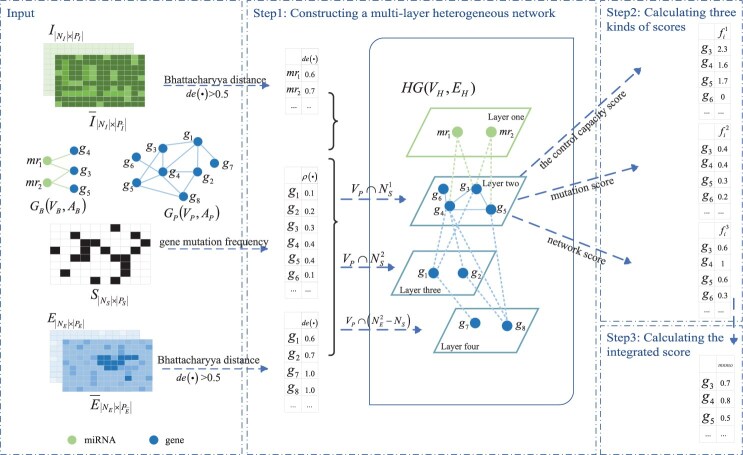
Results: We propose a prediction method MNMO: a multi-layer network model based on multi-omics data. MNMO firstly constructs a dynamically adjusted four-layer network composed of miRNAs and three kinds of genes with different features. Then three kinds of scores, i.e. control capacity, mutation score, and network score, are devised and calculated by harmonic mean to produce the integrated gene score. Experiments were performed on three kinds of real cancer data to compare the identification performance of method MNMO with that of six state-of-the-art ones. The results indicate that method MNMO presents the best identification performance under most circumstances. The genes prioritized by method MNMO not only have a better match to the benchmark ones than those identified by the other methods, but also are all associated with the development and progression of cancers. In addition, some extended versions of method MNMO can further achieve better performance on most evaluation metrics for some specific datasets. They may be more conducive to identifying tissue-specific genes, which has been verified through a number of experiments.
Availability and implementation: The source code and the R package "MNMO" are available at https://github.com/Zheng-D/MNMO. The dataset and code are archived at https://doi.org/10.5281/zenodo.14969986.





 京公网安备 11010802042870号
京ICP备2023020795号-1
京公网安备 11010802042870号
京ICP备2023020795号-1

 分享
分享

 求助内容:
求助内容: 应助结果提醒方式:
 扫码关注我们
