Arash Khoeini, Funda Sar, Yen-Yi Lin, Colin Collins, Martin Ester
{"title":"scMUSCL: multi-source transfer learning for clustering scRNA-seq data.","authors":"Arash Khoeini, Funda Sar, Yen-Yi Lin, Colin Collins, Martin Ester","doi":"10.1093/bioinformatics/btaf137","DOIUrl":null,"url":null,"abstract":"<p><strong>Motivation: </strong>Single-cell RNA sequencing (scRNA-seq) analysis relies heavily on effective clustering to facilitate numerous downstream applications. Although several machine learning methods have been developed to enhance single-cell clustering, most are fully unsupervised and overlook the rich repository of annotated datasets available from previous single-cell experiments. Since cells are inherently high-dimensional entities, unsupervised clustering can often result in clusters that lack biological relevance. Leveraging annotated scRNA-seq datasets as a reference can significantly enhance clustering performance, enabling the identification of biologically meaningful clusters in target datasets.</p><p><strong>Results: </strong>In this article, we propose Single Cell MUlti-Source CLustering (scMUSCL), a novel transfer learning method designed to identify cell clusters in a target dataset by leveraging knowledge from multiple annotated reference datasets. scMUSCL employs a deep neural network to extract domain- and batch-invariant cell representations, effectively addressing discrepancies across various source datasets and between source and target datasets within the new representation space. Unlike existing methods, scMUSCL does not require prior knowledge of the number of clusters in the target dataset and eliminates the need for batch correction between source and target datasets. We conduct extensive experiments using 20 real-life datasets, demonstrating that scMUSCL consistently outperforms existing unsupervised and transfer learning-based methods. Furthermore, our experiments show that scMUSCL benefits from multiple source datasets as learning references and accurately estimates the number of clusters.</p><p><strong>Availability and implementation: </strong>The Python implementation of scMUSCL is available at https://github.com/arashkhoeini/scMUSCL.</p>","PeriodicalId":93899,"journal":{"name":"Bioinformatics (Oxford, England)","volume":" ","pages":""},"PeriodicalIF":5.4000,"publicationDate":"2025-05-06","publicationTypes":"Journal Article","fieldsOfStudy":null,"isOpenAccess":false,"openAccessPdf":"https://www.ncbi.nlm.nih.gov/pmc/articles/PMC12065430/pdf/","citationCount":"0","resultStr":null,"platform":"Semanticscholar","paperid":null,"PeriodicalName":"Bioinformatics (Oxford, England)","FirstCategoryId":"1085","ListUrlMain":"https://doi.org/10.1093/bioinformatics/btaf137","RegionNum":0,"RegionCategory":null,"ArticlePicture":[],"TitleCN":null,"AbstractTextCN":null,"PMCID":null,"EPubDate":"","PubModel":"","JCR":"","JCRName":"","Score":null,"Total":0}
引用次数: 0
Abstract
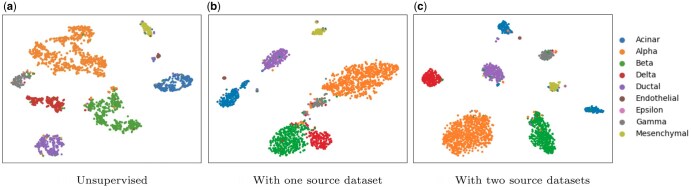
Motivation: Single-cell RNA sequencing (scRNA-seq) analysis relies heavily on effective clustering to facilitate numerous downstream applications. Although several machine learning methods have been developed to enhance single-cell clustering, most are fully unsupervised and overlook the rich repository of annotated datasets available from previous single-cell experiments. Since cells are inherently high-dimensional entities, unsupervised clustering can often result in clusters that lack biological relevance. Leveraging annotated scRNA-seq datasets as a reference can significantly enhance clustering performance, enabling the identification of biologically meaningful clusters in target datasets.
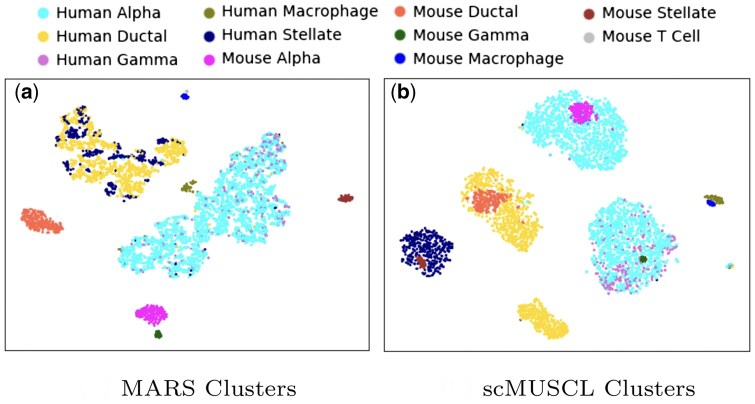
Results: In this article, we propose Single Cell MUlti-Source CLustering (scMUSCL), a novel transfer learning method designed to identify cell clusters in a target dataset by leveraging knowledge from multiple annotated reference datasets. scMUSCL employs a deep neural network to extract domain- and batch-invariant cell representations, effectively addressing discrepancies across various source datasets and between source and target datasets within the new representation space. Unlike existing methods, scMUSCL does not require prior knowledge of the number of clusters in the target dataset and eliminates the need for batch correction between source and target datasets. We conduct extensive experiments using 20 real-life datasets, demonstrating that scMUSCL consistently outperforms existing unsupervised and transfer learning-based methods. Furthermore, our experiments show that scMUSCL benefits from multiple source datasets as learning references and accurately estimates the number of clusters.
Availability and implementation: The Python implementation of scMUSCL is available at https://github.com/arashkhoeini/scMUSCL.




 京公网安备 11010802042870号
京ICP备2023020795号-1
京公网安备 11010802042870号
京ICP备2023020795号-1

 分享
分享

 求助内容:
求助内容: 应助结果提醒方式:
 扫码关注我们
