{"title":"Effectiveness of multiple mnemonic strategies for improving verbal memory in older adults.","authors":"Yu-Ruei Lin, Yu-Hsiang Cheng, Dai-Wei Lin, Yu-Chen Chuang, Hsiu-Ling Huang, Yann-Ying Hsiao, Chieh-Ning Huang, Ting-Jung Hsu, Jong-Ling Fuh","doi":"10.1097/JCMA.0000000000001228","DOIUrl":null,"url":null,"abstract":"<p><strong>Background: </strong>Cognitive training is an evidence-based intervention for preserving memory in older adults. The effectiveness of cognitive training varies, depending on the approach used. This study examined the efficiency of cognitive training using multiple mnemonic strategies in older adults.</p><p><strong>Methods: </strong>This study adopted a pretest-posttest control group design, with all participants undergoing two neuropsychological assessments. The cognitive training program consisted of four 60-minute sessions over a month. In the interventions, participants practiced the mnemonic strategies of elaboration and self-reference. The effect of cognitive training was analyzed using both dependent and independent t tests.</p><p><strong>Results: </strong>The mean ages were 69.7 ± 12.0 for the control group (n = 23) and 70.7 ± 5.6 for the intervention group (n = 27), with educational attainment of 11.9 ± 3.2 and 12.1 ± 3.9 years, respectively. Both groups showed an overall improvement in memory tests, but only the intervention group's learning and delayed recall aspects of the verbal memory test remained statistically significant after adjusting for multiple comparisons ( p < 0.00625).</p><p><strong>Conclusion: </strong>Our study demonstrates that multiple mnemonic strategy-based cognitive training effectively enhances memory function in older adults and should be regarded as an alternative intervention for older adults.</p>","PeriodicalId":94115,"journal":{"name":"Journal of the Chinese Medical Association : JCMA","volume":" ","pages":"375-382"},"PeriodicalIF":2.4000,"publicationDate":"2025-05-01","publicationTypes":"Journal Article","fieldsOfStudy":null,"isOpenAccess":false,"openAccessPdf":"https://www.ncbi.nlm.nih.gov/pmc/articles/PMC12718695/pdf/","citationCount":"0","resultStr":null,"platform":"Semanticscholar","paperid":null,"PeriodicalName":"Journal of the Chinese Medical Association : JCMA","FirstCategoryId":"1085","ListUrlMain":"https://doi.org/10.1097/JCMA.0000000000001228","RegionNum":0,"RegionCategory":null,"ArticlePicture":[],"TitleCN":null,"AbstractTextCN":null,"PMCID":null,"EPubDate":"2025/3/28 0:00:00","PubModel":"Epub","JCR":"","JCRName":"","Score":null,"Total":0}
引用次数: 0
Abstract
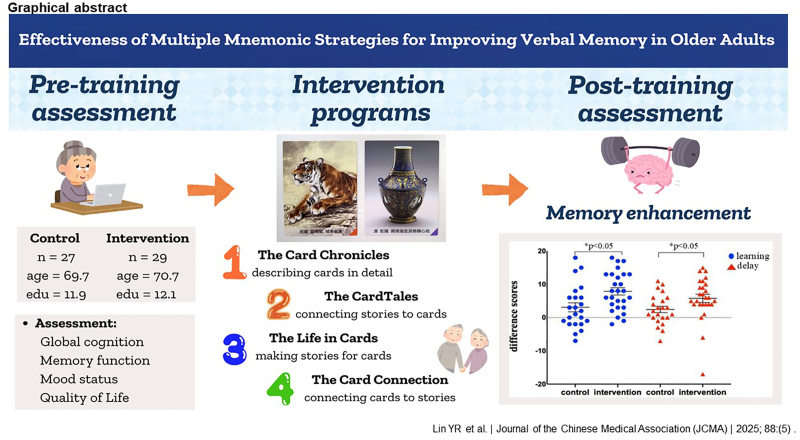
Background: Cognitive training is an evidence-based intervention for preserving memory in older adults. The effectiveness of cognitive training varies, depending on the approach used. This study examined the efficiency of cognitive training using multiple mnemonic strategies in older adults.
Methods: This study adopted a pretest-posttest control group design, with all participants undergoing two neuropsychological assessments. The cognitive training program consisted of four 60-minute sessions over a month. In the interventions, participants practiced the mnemonic strategies of elaboration and self-reference. The effect of cognitive training was analyzed using both dependent and independent t tests.
Results: The mean ages were 69.7 ± 12.0 for the control group (n = 23) and 70.7 ± 5.6 for the intervention group (n = 27), with educational attainment of 11.9 ± 3.2 and 12.1 ± 3.9 years, respectively. Both groups showed an overall improvement in memory tests, but only the intervention group's learning and delayed recall aspects of the verbal memory test remained statistically significant after adjusting for multiple comparisons ( p < 0.00625).
Conclusion: Our study demonstrates that multiple mnemonic strategy-based cognitive training effectively enhances memory function in older adults and should be regarded as an alternative intervention for older adults.





 京公网安备 11010802042870号
京ICP备2023020795号-1
京公网安备 11010802042870号
京ICP备2023020795号-1

 分享
分享

 求助内容:
求助内容: 应助结果提醒方式:
 扫码关注我们
