{"title":"Single-cell network biology enabling cell-type-resolved disease genetics.","authors":"Junha Cha, Insuk Lee","doi":"10.1186/s44342-025-00042-7","DOIUrl":null,"url":null,"abstract":"<p><p>Gene network models provide a foundation for graph theory approaches, aiding in the novel discovery of drug targets, disease genes, and genetic mechanisms for various biological functions. Disease genetics must be interpreted within the cellular context of disease-associated cell types, which cannot be achieved with datasets consisting solely of organism-level samples. Single-cell RNA sequencing (scRNA-seq) technology allows computational distinction of cell states which provides a unique opportunity to understand cellular biology that drives disease processes. Importantly, the abundance of cell samples with their transcriptome-wide profile allows the modeling of systemic cell-type-specific gene networks (CGNs), offering insights into gene-cell-disease relationships. In this review, we present reference-based and de novo inference of gene functional interaction networks that we have recently developed using scRNA-seq datasets. We also introduce a compendium of CGNs as a useful resource for cell-type-resolved disease genetics. By leveraging these advances, we envision single-cell network biology as the key approach for mapping the gene-cell-disease axis.</p>","PeriodicalId":94288,"journal":{"name":"Genomics & informatics","volume":"23 1","pages":"10"},"PeriodicalIF":0.0000,"publicationDate":"2025-03-27","publicationTypes":"Journal Article","fieldsOfStudy":null,"isOpenAccess":false,"openAccessPdf":"https://www.ncbi.nlm.nih.gov/pmc/articles/PMC11951680/pdf/","citationCount":"0","resultStr":null,"platform":"Semanticscholar","paperid":null,"PeriodicalName":"Genomics & informatics","FirstCategoryId":"1085","ListUrlMain":"https://doi.org/10.1186/s44342-025-00042-7","RegionNum":0,"RegionCategory":null,"ArticlePicture":[],"TitleCN":null,"AbstractTextCN":null,"PMCID":null,"EPubDate":"","PubModel":"","JCR":"","JCRName":"","Score":null,"Total":0}
引用次数: 0
Abstract
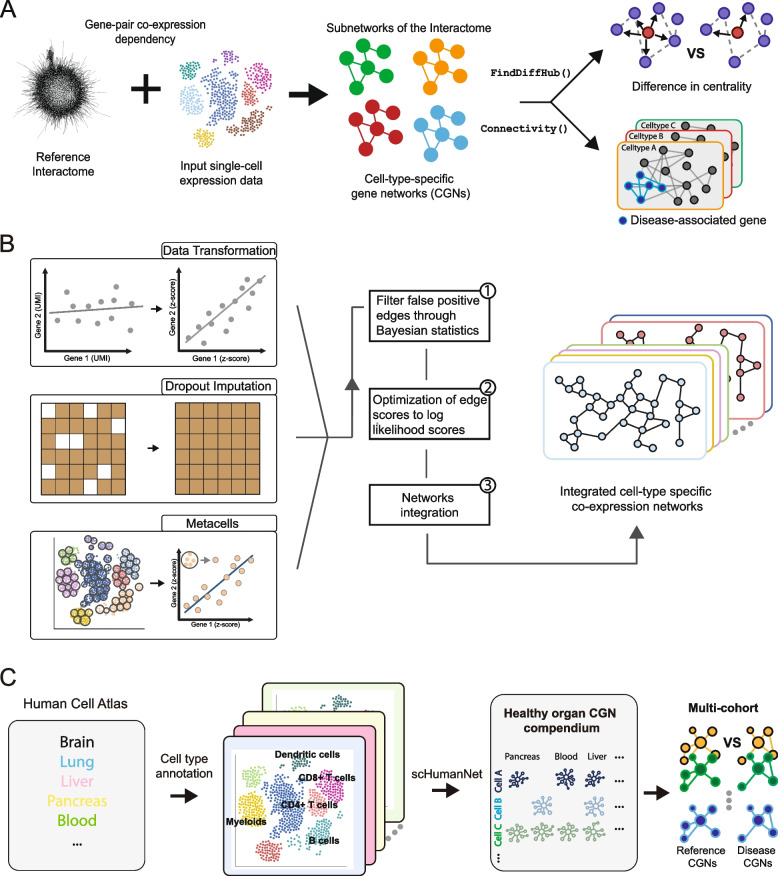
Gene network models provide a foundation for graph theory approaches, aiding in the novel discovery of drug targets, disease genes, and genetic mechanisms for various biological functions. Disease genetics must be interpreted within the cellular context of disease-associated cell types, which cannot be achieved with datasets consisting solely of organism-level samples. Single-cell RNA sequencing (scRNA-seq) technology allows computational distinction of cell states which provides a unique opportunity to understand cellular biology that drives disease processes. Importantly, the abundance of cell samples with their transcriptome-wide profile allows the modeling of systemic cell-type-specific gene networks (CGNs), offering insights into gene-cell-disease relationships. In this review, we present reference-based and de novo inference of gene functional interaction networks that we have recently developed using scRNA-seq datasets. We also introduce a compendium of CGNs as a useful resource for cell-type-resolved disease genetics. By leveraging these advances, we envision single-cell network biology as the key approach for mapping the gene-cell-disease axis.



 京公网安备 11010802042870号
京ICP备2023020795号-1
京公网安备 11010802042870号
京ICP备2023020795号-1

 分享
分享

 求助内容:
求助内容: 应助结果提醒方式:
 扫码关注我们
