Lixia Fang, Xueyan Hao, Jie Fan, Xiaolei Liu, Yaru Chen, Lian Wang, Xiaoying Huang, Hao Song, Yingxiu Cao
{"title":"Genome-scale CRISPRi screen identifies pcnB repression conferring improved physiology for overproduction of free fatty acids in Escherichia coli","authors":"Lixia Fang, Xueyan Hao, Jie Fan, Xiaolei Liu, Yaru Chen, Lian Wang, Xiaoying Huang, Hao Song, Yingxiu Cao","doi":"10.1038/s41467-025-58368-3","DOIUrl":null,"url":null,"abstract":"<p>Microbial physiology plays a pivotal role in construction of superior microbial cell factories for efficient biosynthesis of desired products. Here we identify that <i>pcnB</i> repression confers improved physiology for overproduction of free fatty acids (FFAs) in <i>Escherichia coli</i> through genome-scale CRISPRi modulation combining fluorescence-activated cell sorting (FACS) and next-generation sequencing (NGS). The repression of <i>pcnB</i> can enhance the stability and abundance of the transcripts of genes involved in the proton-consuming system, thereby supporting global improvements in membrane properties, redox state, and energy level. Based on <i>pcnB</i> repression, further repression of <i>acrD</i> increases FFAs biosynthesis by enhancing FFAs efflux. The engineered strain <i>pcnB</i><sup>i</sup>-<i>acrD</i><sup>i</sup>-<i>fadR</i><sup>+</sup> achieves 35.1 g L<sup>−1</sup> FFAs production in fed-batch fermentation, which is the maximum titer reported to date in <i>E. coli</i>. This study highlights the significance of uncovering hidden genetic determinants that confer improved microbial physiology for enhancing the biosynthesis of desired products.</p>","PeriodicalId":19066,"journal":{"name":"Nature Communications","volume":"30 1","pages":""},"PeriodicalIF":15.7000,"publicationDate":"2025-03-29","publicationTypes":"Journal Article","fieldsOfStudy":null,"isOpenAccess":false,"openAccessPdf":"","citationCount":"0","resultStr":null,"platform":"Semanticscholar","paperid":null,"PeriodicalName":"Nature Communications","FirstCategoryId":"103","ListUrlMain":"https://doi.org/10.1038/s41467-025-58368-3","RegionNum":1,"RegionCategory":"综合性期刊","ArticlePicture":[],"TitleCN":null,"AbstractTextCN":null,"PMCID":null,"EPubDate":"","PubModel":"","JCR":"Q1","JCRName":"MULTIDISCIPLINARY SCIENCES","Score":null,"Total":0}
引用次数: 0
Abstract
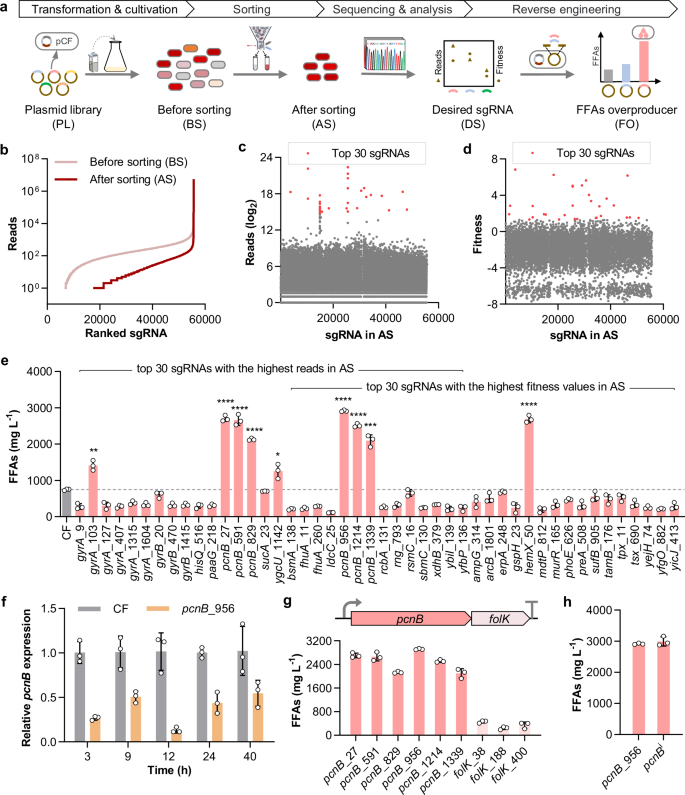
Microbial physiology plays a pivotal role in construction of superior microbial cell factories for efficient biosynthesis of desired products. Here we identify that pcnB repression confers improved physiology for overproduction of free fatty acids (FFAs) in Escherichia coli through genome-scale CRISPRi modulation combining fluorescence-activated cell sorting (FACS) and next-generation sequencing (NGS). The repression of pcnB can enhance the stability and abundance of the transcripts of genes involved in the proton-consuming system, thereby supporting global improvements in membrane properties, redox state, and energy level. Based on pcnB repression, further repression of acrD increases FFAs biosynthesis by enhancing FFAs efflux. The engineered strain pcnBi-acrDi-fadR+ achieves 35.1 g L−1 FFAs production in fed-batch fermentation, which is the maximum titer reported to date in E. coli. This study highlights the significance of uncovering hidden genetic determinants that confer improved microbial physiology for enhancing the biosynthesis of desired products.
微生物生理学在构建高效生物合成所需产物的优良微生物细胞工厂中起着关键作用。在这里,我们发现pcnB抑制通过结合荧光激活细胞分选(FACS)和下一代测序(NGS)的基因组级CRISPRi调制,改善了大肠杆菌中游离脂肪酸(FFAs)过量产生的生理学。pcnB的抑制可以增强质子消耗系统中相关基因转录本的稳定性和丰度,从而支持膜性质、氧化还原状态和能量水平的整体改善。在抑制pcnB的基础上,进一步抑制acrD通过增强FFAs外排来增加FFAs的生物合成。工程菌株pcnBi-acrDi-fadR+在补料分批发酵中可产生35.1 g L−1的游离脂肪酸,这是迄今为止在大肠杆菌中报道的最高滴度。这项研究强调了揭示隐藏的遗传决定因素的重要性,这些决定因素赋予改善微生物生理学以增强所需产品的生物合成。
期刊介绍:
Nature Communications, an open-access journal, publishes high-quality research spanning all areas of the natural sciences. Papers featured in the journal showcase significant advances relevant to specialists in each respective field. With a 2-year impact factor of 16.6 (2022) and a median time of 8 days from submission to the first editorial decision, Nature Communications is committed to rapid dissemination of research findings. As a multidisciplinary journal, it welcomes contributions from biological, health, physical, chemical, Earth, social, mathematical, applied, and engineering sciences, aiming to highlight important breakthroughs within each domain.



 京公网安备 11010802042870号
京ICP备2023020795号-1
京公网安备 11010802042870号
京ICP备2023020795号-1

 分享
分享
 求助内容:
求助内容: 应助结果提醒方式:
 扫码关注我们
