Rossana Droghetti, Philippe Fuchs, Ilaria Iuliani, Valerio Firmano, Giorgio Tallarico, Ludovico Calabrese, Jacopo Grilli, Bianca Sclavi, Luca Ciandrini, Marco Cosentino Lagomarsino
{"title":"Incoherent feedback from coupled amino acids and ribosome pools generates damped oscillations in growing E. coli","authors":"Rossana Droghetti, Philippe Fuchs, Ilaria Iuliani, Valerio Firmano, Giorgio Tallarico, Ludovico Calabrese, Jacopo Grilli, Bianca Sclavi, Luca Ciandrini, Marco Cosentino Lagomarsino","doi":"10.1038/s41467-025-57789-4","DOIUrl":null,"url":null,"abstract":"<p>Current theories of bacterial growth physiology demonstrate impressive predictive power but are often phenomenological, lacking mechanistic detail. Incorporating such details would significantly enhance our ability to predict and control bacterial growth under varying environmental conditions. The “Flux Controlled Regulation” (FCR) model serves as a reference framework, linking ribosome allocation to translation efficiency through a steady-state assumption. However, it neglects ppGpp-mediated nutrient sensing and transcriptional regulation of ribosomal operons. Here, we propose a mechanistic model that extends the FCR framework by incorporating three key components: (i) the amino acid pool, (ii) ppGpp sensing of translation elongation rate, and (iii) transcriptional regulation of protein allocation by ppGpp-sensitive promoters. Our model aligns with observed steady-state growth laws and makes testable predictions for unobserved quantities. We show that during environmental changes, the incoherent feedback between sensing and regulation generates oscillatory relaxation dynamics, a behavior that we support by new and existing experimental data.</p>","PeriodicalId":19066,"journal":{"name":"Nature Communications","volume":"59 1","pages":""},"PeriodicalIF":15.7000,"publicationDate":"2025-03-29","publicationTypes":"Journal Article","fieldsOfStudy":null,"isOpenAccess":false,"openAccessPdf":"","citationCount":"0","resultStr":null,"platform":"Semanticscholar","paperid":null,"PeriodicalName":"Nature Communications","FirstCategoryId":"103","ListUrlMain":"https://doi.org/10.1038/s41467-025-57789-4","RegionNum":1,"RegionCategory":"综合性期刊","ArticlePicture":[],"TitleCN":null,"AbstractTextCN":null,"PMCID":null,"EPubDate":"","PubModel":"","JCR":"Q1","JCRName":"MULTIDISCIPLINARY SCIENCES","Score":null,"Total":0}
引用次数: 0
Abstract
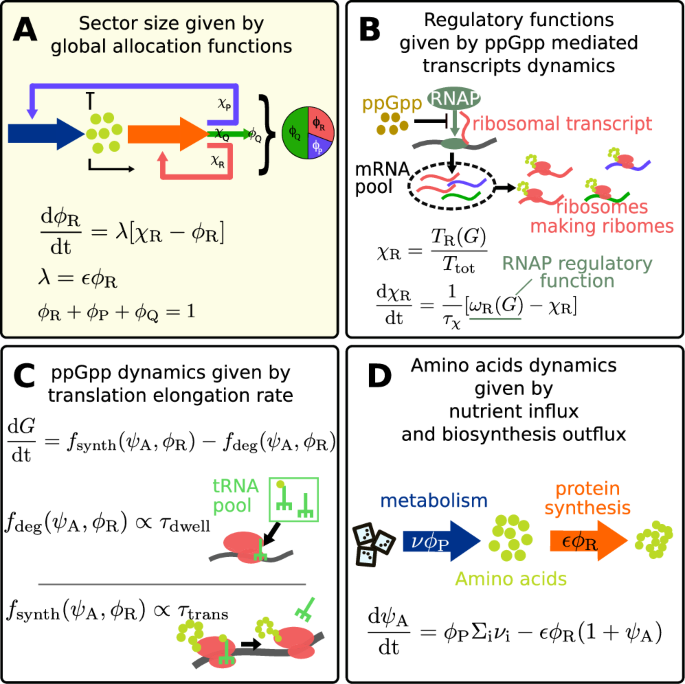
Current theories of bacterial growth physiology demonstrate impressive predictive power but are often phenomenological, lacking mechanistic detail. Incorporating such details would significantly enhance our ability to predict and control bacterial growth under varying environmental conditions. The “Flux Controlled Regulation” (FCR) model serves as a reference framework, linking ribosome allocation to translation efficiency through a steady-state assumption. However, it neglects ppGpp-mediated nutrient sensing and transcriptional regulation of ribosomal operons. Here, we propose a mechanistic model that extends the FCR framework by incorporating three key components: (i) the amino acid pool, (ii) ppGpp sensing of translation elongation rate, and (iii) transcriptional regulation of protein allocation by ppGpp-sensitive promoters. Our model aligns with observed steady-state growth laws and makes testable predictions for unobserved quantities. We show that during environmental changes, the incoherent feedback between sensing and regulation generates oscillatory relaxation dynamics, a behavior that we support by new and existing experimental data.
期刊介绍:
Nature Communications, an open-access journal, publishes high-quality research spanning all areas of the natural sciences. Papers featured in the journal showcase significant advances relevant to specialists in each respective field. With a 2-year impact factor of 16.6 (2022) and a median time of 8 days from submission to the first editorial decision, Nature Communications is committed to rapid dissemination of research findings. As a multidisciplinary journal, it welcomes contributions from biological, health, physical, chemical, Earth, social, mathematical, applied, and engineering sciences, aiming to highlight important breakthroughs within each domain.



 京公网安备 11010802042870号
京ICP备2023020795号-1
京公网安备 11010802042870号
京ICP备2023020795号-1

 分享
分享
 求助内容:
求助内容: 应助结果提醒方式:
 扫码关注我们
