Mizuhiro Kominato, Takumi Koshiba, Fuminori Misaizu and Asuka Fujii
{"title":"Observation of the hemibond formation in (H2O–Arn)+ radical cation clusters by electronic spectroscopy and ion imaging technique†","authors":"Mizuhiro Kominato, Takumi Koshiba, Fuminori Misaizu and Asuka Fujii","doi":"10.1039/D5CP01001B","DOIUrl":null,"url":null,"abstract":"<p >The hemibond is a non-classical covalent bond formed by the overlap of non-bonding orbitals of a radical (cation) and a closed-shell molecule. For (H<small><sub>2</sub></small>O–Ar<small><sub><em>n</em></sub></small>)<small><sup>+</sup></small> radical cation clusters, competition between the hemibonded type and hydrogen-bonded (H-bonded) type isomers has been discussed on the basis of infrared spectroscopy and theoretical computations. It has been commonly recognized that the H-bonded type is predominant, while the coexistence of the hemibonded type remains a topic of debate. Hemibonded species are known to exhibit very strong electronic transitions in the ultraviolet and/or visible (UV-vis) region, which are marker bands for hemibond formation. In this study, we performed electronic spectroscopy and photofragment ion imaging experiments on (H<small><sub>2</sub></small>O–Ar<small><sub><em>n</em></sub></small>)<small><sup>+</sup></small> to observe the hemibond formation between H<small><sub>2</sub></small>O<small><sup>+</sup></small> and Ar. The observed spectra of (H<small><sub>2</sub></small>O–Ar<small><sub><em>n</em></sub></small>)<small><sup>+</sup></small> (<em>n</em> = 1–3) exhibit absorption in the UV and visible regions. A comparison with quantum chemical calculations suggests the coexistence of the hemibonded type in (H<small><sub>2</sub></small>O–Ar<small><sub><em>n</em></sub></small>)<small><sup>+</sup></small> (<em>n</em> = 1 and 2). In addition, the photofragment ion imaging experiment on (H<small><sub>2</sub></small>O–Ar)<small><sup>+</sup></small> showed an angular distribution attributed to the absorption of the hemibonded type, providing firm experimental evidence of the coexistence of the hemibonded type.</p>","PeriodicalId":99,"journal":{"name":"Physical Chemistry Chemical Physics","volume":" 16","pages":" 8286-8294"},"PeriodicalIF":2.9000,"publicationDate":"2025-03-28","publicationTypes":"Journal Article","fieldsOfStudy":null,"isOpenAccess":false,"openAccessPdf":"https://pubs.rsc.org/en/content/articlepdf/2025/cp/d5cp01001b?page=search","citationCount":"0","resultStr":null,"platform":"Semanticscholar","paperid":null,"PeriodicalName":"Physical Chemistry Chemical Physics","FirstCategoryId":"92","ListUrlMain":"https://pubs.rsc.org/en/content/articlelanding/2025/cp/d5cp01001b","RegionNum":3,"RegionCategory":"化学","ArticlePicture":[],"TitleCN":null,"AbstractTextCN":null,"PMCID":null,"EPubDate":"","PubModel":"","JCR":"Q3","JCRName":"CHEMISTRY, PHYSICAL","Score":null,"Total":0}
引用次数: 0
Abstract
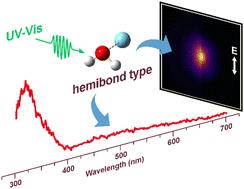
The hemibond is a non-classical covalent bond formed by the overlap of non-bonding orbitals of a radical (cation) and a closed-shell molecule. For (H2O–Arn)+ radical cation clusters, competition between the hemibonded type and hydrogen-bonded (H-bonded) type isomers has been discussed on the basis of infrared spectroscopy and theoretical computations. It has been commonly recognized that the H-bonded type is predominant, while the coexistence of the hemibonded type remains a topic of debate. Hemibonded species are known to exhibit very strong electronic transitions in the ultraviolet and/or visible (UV-vis) region, which are marker bands for hemibond formation. In this study, we performed electronic spectroscopy and photofragment ion imaging experiments on (H2O–Arn)+ to observe the hemibond formation between H2O+ and Ar. The observed spectra of (H2O–Arn)+ (n = 1–3) exhibit absorption in the UV and visible regions. A comparison with quantum chemical calculations suggests the coexistence of the hemibonded type in (H2O–Arn)+ (n = 1 and 2). In addition, the photofragment ion imaging experiment on (H2O–Ar)+ showed an angular distribution attributed to the absorption of the hemibonded type, providing firm experimental evidence of the coexistence of the hemibonded type.
期刊介绍:
Physical Chemistry Chemical Physics (PCCP) is an international journal co-owned by 19 physical chemistry and physics societies from around the world. This journal publishes original, cutting-edge research in physical chemistry, chemical physics and biophysical chemistry. To be suitable for publication in PCCP, articles must include significant innovation and/or insight into physical chemistry; this is the most important criterion that reviewers and Editors will judge against when evaluating submissions.
The journal has a broad scope and welcomes contributions spanning experiment, theory, computation and data science. Topical coverage includes spectroscopy, dynamics, kinetics, statistical mechanics, thermodynamics, electrochemistry, catalysis, surface science, quantum mechanics, quantum computing and machine learning. Interdisciplinary research areas such as polymers and soft matter, materials, nanoscience, energy, surfaces/interfaces, and biophysical chemistry are welcomed if they demonstrate significant innovation and/or insight into physical chemistry. Joined experimental/theoretical studies are particularly appreciated when complementary and based on up-to-date approaches.




 京公网安备 11010802042870号
京ICP备2023020795号-1
京公网安备 11010802042870号
京ICP备2023020795号-1

 分享
分享
 求助内容:
求助内容: 应助结果提醒方式:
 扫码关注我们
