Yao Tan, Wenhao Ni, Jianwen Yang, Yanwei Li, Zhengwei Xie, Bin Huang
{"title":"Y-Doped Na4Fe3(PO4)2(P2O7) as a High-Performance Cathode Material for Sodium-Ion Batteries","authors":"Yao Tan, Wenhao Ni, Jianwen Yang, Yanwei Li, Zhengwei Xie, Bin Huang","doi":"10.1021/acssuschemeng.4c10844","DOIUrl":null,"url":null,"abstract":"The Na<sub>4</sub>Fe<sub>3</sub>(PO<sub>4</sub>)<sub>2</sub>(P<sub>2</sub>O<sub>7</sub>) (NFPP) cathode material for sodium-ion batteries (SIBs) is modified through a facile yttrium (Y)-doping approach. The crystal structures, surface morphologies, and electrochemical performances of the pristine and Y-doped samples are comparatively investigated. The results indicate that the structure and morphology of the material are almost unchanged after Y doping. Doping with an appropriate amount of Y can enhance the electronic conductivity and electrochemical kinetics of the material, leading to superior electrochemical performance. Among the four samples prepared with different Y-doping levels, the optimum one exhibits the highest capacity of 115.8 mAh g<sup>–1</sup> (0.1C, 2–4 V, 1C = 129 mA g<sup>–1</sup>), as well as outstanding cycling stability and rate capability (retaining a capacity of 87.8 mAh g<sup>–1</sup> after 3000 cycles at 20C, with a retention of 92.7%). Furthermore, scanning electron microscopy (SEM) and X-ray diffraction (XRD) measurements after cycling reveal that Y doping can stabilize the material structure, thereby further enhancing its lifespan during long-term cycling.","PeriodicalId":25,"journal":{"name":"ACS Sustainable Chemistry & Engineering","volume":"56 1","pages":""},"PeriodicalIF":7.3000,"publicationDate":"2025-03-28","publicationTypes":"Journal Article","fieldsOfStudy":null,"isOpenAccess":false,"openAccessPdf":"","citationCount":"0","resultStr":null,"platform":"Semanticscholar","paperid":null,"PeriodicalName":"ACS Sustainable Chemistry & Engineering","FirstCategoryId":"92","ListUrlMain":"https://doi.org/10.1021/acssuschemeng.4c10844","RegionNum":1,"RegionCategory":"化学","ArticlePicture":[],"TitleCN":null,"AbstractTextCN":null,"PMCID":null,"EPubDate":"","PubModel":"","JCR":"Q1","JCRName":"CHEMISTRY, MULTIDISCIPLINARY","Score":null,"Total":0}
引用次数: 0
Abstract
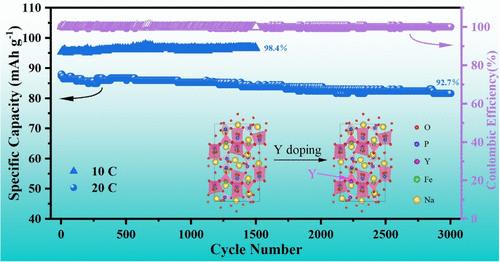
The Na4Fe3(PO4)2(P2O7) (NFPP) cathode material for sodium-ion batteries (SIBs) is modified through a facile yttrium (Y)-doping approach. The crystal structures, surface morphologies, and electrochemical performances of the pristine and Y-doped samples are comparatively investigated. The results indicate that the structure and morphology of the material are almost unchanged after Y doping. Doping with an appropriate amount of Y can enhance the electronic conductivity and electrochemical kinetics of the material, leading to superior electrochemical performance. Among the four samples prepared with different Y-doping levels, the optimum one exhibits the highest capacity of 115.8 mAh g–1 (0.1C, 2–4 V, 1C = 129 mA g–1), as well as outstanding cycling stability and rate capability (retaining a capacity of 87.8 mAh g–1 after 3000 cycles at 20C, with a retention of 92.7%). Furthermore, scanning electron microscopy (SEM) and X-ray diffraction (XRD) measurements after cycling reveal that Y doping can stabilize the material structure, thereby further enhancing its lifespan during long-term cycling.
采用简便的钇(Y)掺杂方法对钠离子电池(sib)正极材料Na4Fe3(PO4)2(P2O7) (NFPP)进行了改性。比较研究了原始样品和掺y样品的晶体结构、表面形貌和电化学性能。结果表明,Y掺杂后材料的结构和形貌几乎没有变化。掺杂适量的Y可以增强材料的电子导电性和电化学动力学,从而获得优异的电化学性能。在不同y掺杂水平制备的4个样品中,最佳的样品容量最高,为115.8 mAh g-1 (0.1C, 2-4 V, 1C = 129 mA g-1),并且具有出色的循环稳定性和倍率能力(在20C下循环3000次后仍保持87.8 mAh g-1的容量,保留率为92.7%)。此外,循环后的扫描电镜(SEM)和x射线衍射(XRD)测试表明,Y掺杂可以稳定材料结构,从而在长期循环中进一步提高材料的寿命。
期刊介绍:
ACS Sustainable Chemistry & Engineering is a prestigious weekly peer-reviewed scientific journal published by the American Chemical Society. Dedicated to advancing the principles of green chemistry and green engineering, it covers a wide array of research topics including green chemistry, green engineering, biomass, alternative energy, and life cycle assessment.
The journal welcomes submissions in various formats, including Letters, Articles, Features, and Perspectives (Reviews), that address the challenges of sustainability in the chemical enterprise and contribute to the advancement of sustainable practices. Join us in shaping the future of sustainable chemistry and engineering.



 京公网安备 11010802042870号
京ICP备2023020795号-1
京公网安备 11010802042870号
京ICP备2023020795号-1

 分享
分享
 求助内容:
求助内容: 应助结果提醒方式:
 扫码关注我们
