Biotransformation-induced chemical modifications and nitrite production in beetroot and arugula extracts: Toward natural alternatives to synthetic preservatives in the meat industry
Halley Dayane dos Santos Ribeiro , José Narciso Francisco da Silva Filho , Isabelly da Silva Ramalho , Elen Carla Alves da Silva , Maria de Fátima Clementino dos Santos , Aline Macedo Dantas , Juliane Maciel Henschel , Diego Silva Batista , José Evangelista Santos Ribeiro , Íris Braz da Silva Araújo , Valquíria Cardoso da Silva Ferreira , Fábio Anderson Pereira da Silva
{"title":"Biotransformation-induced chemical modifications and nitrite production in beetroot and arugula extracts: Toward natural alternatives to synthetic preservatives in the meat industry","authors":"Halley Dayane dos Santos Ribeiro , José Narciso Francisco da Silva Filho , Isabelly da Silva Ramalho , Elen Carla Alves da Silva , Maria de Fátima Clementino dos Santos , Aline Macedo Dantas , Juliane Maciel Henschel , Diego Silva Batista , José Evangelista Santos Ribeiro , Íris Braz da Silva Araújo , Valquíria Cardoso da Silva Ferreira , Fábio Anderson Pereira da Silva","doi":"10.1016/j.foodchem.2025.144127","DOIUrl":null,"url":null,"abstract":"<div><div>The search for natural food additives is a growing priority for the modern food industry, especially in efforts to replace synthetic curing salts, which are linked to adverse health effects in processed meat products. One promising approach involves the use of pre-converted nitrate-rich plant extracts as an alternative to commercial sodium nitrite. However, the impact of the biotransformation process on the chemical and antioxidant properties of these extracts remains poorly understood. This study investigated the effects of biotransformation duration on the chemical composition and antioxidant capacity of beetroot and arugula extracts using commercial starter culture (Lyocarni SBM-11). Three extract formulations were prepared: R100 (100 % arugula), R50B50 (50 % arugula +50 % beetroot) and B100 (100 % beetroot). Throughout the incubation period, the beetroot extract exhibited the highest levels of total phenolics (139.4 to 99.1 mg GAE.100 mL<sup>−1</sup>) and antioxidant activity, as assessed by DPPH (8.7 to 4.2 mmol TE.L<sup>−1</sup>) and FRAP (638.4 to 451.4 mmol TE.L<sup>−1</sup>) assays. The R100 sample demonstrated the highest iron-chelating ability during biotransformation until 12 h of biotransformation (95.6 % to 52.7 %). The duration of biotransformation significantly influenced the chemical properties and antioxidant capacity of arugula and beetroot extracts. Notably, the 100 % arugula extract produced the highest nitrite concentration at 24 h (245.4 ppm). However, extended incubation time appeared to diminish the antioxidant potential of the extracts. In conclusion, the biotransformation of beetroot, arugula, and their mixtures using commercial starter cultures presents a promising strategy for developing natural bio-additives for the meat industry, provided that phenolic content and antioxidant properties are carefully preserved.</div></div>","PeriodicalId":318,"journal":{"name":"Food Chemistry","volume":"482 ","pages":"Article 144127"},"PeriodicalIF":9.8000,"publicationDate":"2025-03-29","publicationTypes":"Journal Article","fieldsOfStudy":null,"isOpenAccess":false,"openAccessPdf":"","citationCount":"0","resultStr":null,"platform":"Semanticscholar","paperid":null,"PeriodicalName":"Food Chemistry","FirstCategoryId":"97","ListUrlMain":"https://www.sciencedirect.com/science/article/pii/S0308814625013780","RegionNum":1,"RegionCategory":"农林科学","ArticlePicture":[],"TitleCN":null,"AbstractTextCN":null,"PMCID":null,"EPubDate":"","PubModel":"","JCR":"Q1","JCRName":"CHEMISTRY, APPLIED","Score":null,"Total":0}
引用次数: 0
Abstract
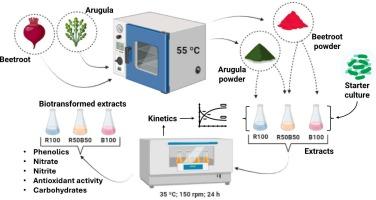
The search for natural food additives is a growing priority for the modern food industry, especially in efforts to replace synthetic curing salts, which are linked to adverse health effects in processed meat products. One promising approach involves the use of pre-converted nitrate-rich plant extracts as an alternative to commercial sodium nitrite. However, the impact of the biotransformation process on the chemical and antioxidant properties of these extracts remains poorly understood. This study investigated the effects of biotransformation duration on the chemical composition and antioxidant capacity of beetroot and arugula extracts using commercial starter culture (Lyocarni SBM-11). Three extract formulations were prepared: R100 (100 % arugula), R50B50 (50 % arugula +50 % beetroot) and B100 (100 % beetroot). Throughout the incubation period, the beetroot extract exhibited the highest levels of total phenolics (139.4 to 99.1 mg GAE.100 mL−1) and antioxidant activity, as assessed by DPPH (8.7 to 4.2 mmol TE.L−1) and FRAP (638.4 to 451.4 mmol TE.L−1) assays. The R100 sample demonstrated the highest iron-chelating ability during biotransformation until 12 h of biotransformation (95.6 % to 52.7 %). The duration of biotransformation significantly influenced the chemical properties and antioxidant capacity of arugula and beetroot extracts. Notably, the 100 % arugula extract produced the highest nitrite concentration at 24 h (245.4 ppm). However, extended incubation time appeared to diminish the antioxidant potential of the extracts. In conclusion, the biotransformation of beetroot, arugula, and their mixtures using commercial starter cultures presents a promising strategy for developing natural bio-additives for the meat industry, provided that phenolic content and antioxidant properties are carefully preserved.
期刊介绍:
Food Chemistry publishes original research papers dealing with the advancement of the chemistry and biochemistry of foods or the analytical methods/ approach used. All papers should focus on the novelty of the research carried out.




 京公网安备 11010802042870号
京ICP备2023020795号-1
京公网安备 11010802042870号
京ICP备2023020795号-1

 分享
分享
 求助内容:
求助内容: 应助结果提醒方式:
 扫码关注我们
