Sunmoon Yu, Hiroki Yamauchi, Davide Menga, Shuo Wang, Antonia Herzog, Hongbin Xu, Daniel J. Zheng, Xiao Wang, Haldrian Iriawan, Botao Huang, Alexander Nitsche, Yang Shao-Horn
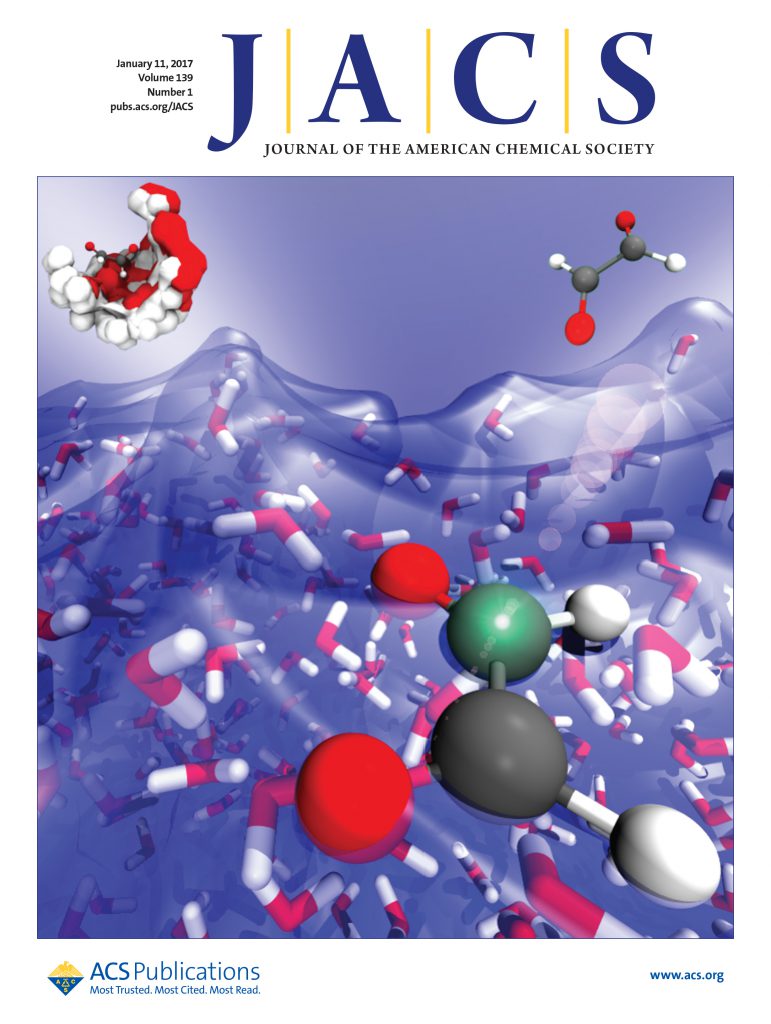
{"title":"Reactivating Molecular Cobalt Catalysts for Electrochemical CO2 Conversion to Methanol","authors":"Sunmoon Yu, Hiroki Yamauchi, Davide Menga, Shuo Wang, Antonia Herzog, Hongbin Xu, Daniel J. Zheng, Xiao Wang, Haldrian Iriawan, Botao Huang, Alexander Nitsche, Yang Shao-Horn","doi":"10.1021/jacs.5c02411","DOIUrl":null,"url":null,"abstract":"Molecular catalysts immobilized on a carbon support have demonstrated electrocatalytic CO<sub>2</sub> conversion capabilities distinct from those of metallic surfaces. For instance, cobalt phthalocyanine supported on carbon nanotubes (CoPc/CNT) is capable of selective CO<sub>2</sub>-to-methanol conversion with ∼30% selectivity, which cannot be accomplished by other metal catalysts, such as cobalt, silver, and copper. However, despite its promising methanol selectivity, the CoPc/CNT catalyst exhibits a gradual decrease in the methanol production rate during the electrochemical CO<sub>2</sub> reduction reaction (CO<sub>2</sub>RR). This catalytic instability impedes its practical application, yet little is known about the origin of the activity decay and viable solutions to circumvent it. In this study, we show that the catalytic deactivation is not an irreversible process caused by the chemical degradation of the catalyst and present reactivation strategies to recover the catalytic performance for stable methanol production. We propose that formaldehyde, an intermediate generated during the CO<sub>2</sub>RR, can act as a poisoning species, and its adsorption configuration on the cobalt site can determine the fate of its reaction pathway: carbon-down (*CH<sub>2</sub>O) versus oxygen-down (*OCH<sub>2</sub>) pathways. In contrast to the carbon-down configuration leading to methanol production, the oxygen-down configuration can inhibit its further reduction, poisoning the cobalt active site and causing the deactivation.","PeriodicalId":49,"journal":{"name":"Journal of the American Chemical Society","volume":"662 1","pages":""},"PeriodicalIF":15.6000,"publicationDate":"2025-03-29","publicationTypes":"Journal Article","fieldsOfStudy":null,"isOpenAccess":false,"openAccessPdf":"","citationCount":"0","resultStr":null,"platform":"Semanticscholar","paperid":null,"PeriodicalName":"Journal of the American Chemical Society","FirstCategoryId":"92","ListUrlMain":"https://doi.org/10.1021/jacs.5c02411","RegionNum":1,"RegionCategory":"化学","ArticlePicture":[],"TitleCN":null,"AbstractTextCN":null,"PMCID":null,"EPubDate":"","PubModel":"","JCR":"Q1","JCRName":"CHEMISTRY, MULTIDISCIPLINARY","Score":null,"Total":0}
引用次数: 0
Abstract
Molecular catalysts immobilized on a carbon support have demonstrated electrocatalytic CO2 conversion capabilities distinct from those of metallic surfaces. For instance, cobalt phthalocyanine supported on carbon nanotubes (CoPc/CNT) is capable of selective CO2-to-methanol conversion with ∼30% selectivity, which cannot be accomplished by other metal catalysts, such as cobalt, silver, and copper. However, despite its promising methanol selectivity, the CoPc/CNT catalyst exhibits a gradual decrease in the methanol production rate during the electrochemical CO2 reduction reaction (CO2RR). This catalytic instability impedes its practical application, yet little is known about the origin of the activity decay and viable solutions to circumvent it. In this study, we show that the catalytic deactivation is not an irreversible process caused by the chemical degradation of the catalyst and present reactivation strategies to recover the catalytic performance for stable methanol production. We propose that formaldehyde, an intermediate generated during the CO2RR, can act as a poisoning species, and its adsorption configuration on the cobalt site can determine the fate of its reaction pathway: carbon-down (*CH2O) versus oxygen-down (*OCH2) pathways. In contrast to the carbon-down configuration leading to methanol production, the oxygen-down configuration can inhibit its further reduction, poisoning the cobalt active site and causing the deactivation.
期刊介绍:
The flagship journal of the American Chemical Society, known as the Journal of the American Chemical Society (JACS), has been a prestigious publication since its establishment in 1879. It holds a preeminent position in the field of chemistry and related interdisciplinary sciences. JACS is committed to disseminating cutting-edge research papers, covering a wide range of topics, and encompasses approximately 19,000 pages of Articles, Communications, and Perspectives annually. With a weekly publication frequency, JACS plays a vital role in advancing the field of chemistry by providing essential research.




 京公网安备 11010802042870号
京ICP备2023020795号-1
京公网安备 11010802042870号
京ICP备2023020795号-1

 分享
分享
 求助内容:
求助内容: 应助结果提醒方式:
 扫码关注我们
