Hans Bolinsson , Martin Cramer Pedersen , Maria Glantz , Fátima Herranz-Trillo , Jacob Judas Kain Kirkensgaard , Lars Nilsson
{"title":"Sum-weighted casein micelle AF4-UV-SAXS data disentangled - A new method for characterization and evaluation of widely size distributed samples","authors":"Hans Bolinsson , Martin Cramer Pedersen , Maria Glantz , Fátima Herranz-Trillo , Jacob Judas Kain Kirkensgaard , Lars Nilsson","doi":"10.1016/j.foodhyd.2025.111377","DOIUrl":null,"url":null,"abstract":"<div><div>Casein micelles are key structures in milk, influencing stability, nutritional properties, and functionality. Their hierarchical architecture, which is dynamic and responsive to environmental conditions, plays a crucial role in dairy processing. Understanding the structural and dynamic properties of casein micelles is essential for optimizing dairy products and processing techniques. This study presents a novel method for characterizing and evaluating casein micelles using a combination of Asymmetrical Flow Field-Flow Fractionation (AF4) and Small-Angle X-ray Scattering (SAXS) at synchrotron facilities. By coupling AF4 with SAXS, we can fractionate milk samples according to micelle size and gain insights into their structural organization. However, the high-throughput data generated in such experiments pose challenges for traditional data analysis. We introduce an automated data processing pipeline utilizing the McSAS software in combination with Indirect Fourier Transformation, allowing for efficient fitting of SAXS data and extraction of structural parameters such as radius of gyration (<em>R</em><sub><em>g</em></sub>) and maximum particle dimension (<em>D</em><sub><em>max</em></sub>). This integrated approach provides a more detailed understanding of the heterogeneity and structural dynamics of casein micelles, revealing distinct features of their size distribution, internal cavities, and overall micelle structure across different fractions. The method offers a powerful tool for future investigations into the behavior of casein micelles under varying environmental conditions, with potential applications in optimizing dairy product formulations and studying casein micelle dynamics.</div></div>","PeriodicalId":320,"journal":{"name":"Food Hydrocolloids","volume":"166 ","pages":"Article 111377"},"PeriodicalIF":11.0000,"publicationDate":"2025-10-01","publicationTypes":"Journal Article","fieldsOfStudy":null,"isOpenAccess":false,"openAccessPdf":"","citationCount":"0","resultStr":null,"platform":"Semanticscholar","paperid":null,"PeriodicalName":"Food Hydrocolloids","FirstCategoryId":"97","ListUrlMain":"https://www.sciencedirect.com/science/article/pii/S0268005X25003376","RegionNum":1,"RegionCategory":"农林科学","ArticlePicture":[],"TitleCN":null,"AbstractTextCN":null,"PMCID":null,"EPubDate":"2025/3/24 0:00:00","PubModel":"Epub","JCR":"Q1","JCRName":"CHEMISTRY, APPLIED","Score":null,"Total":0}
引用次数: 0
Abstract
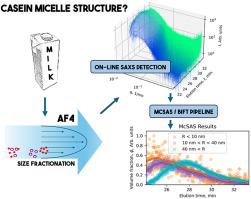
Casein micelles are key structures in milk, influencing stability, nutritional properties, and functionality. Their hierarchical architecture, which is dynamic and responsive to environmental conditions, plays a crucial role in dairy processing. Understanding the structural and dynamic properties of casein micelles is essential for optimizing dairy products and processing techniques. This study presents a novel method for characterizing and evaluating casein micelles using a combination of Asymmetrical Flow Field-Flow Fractionation (AF4) and Small-Angle X-ray Scattering (SAXS) at synchrotron facilities. By coupling AF4 with SAXS, we can fractionate milk samples according to micelle size and gain insights into their structural organization. However, the high-throughput data generated in such experiments pose challenges for traditional data analysis. We introduce an automated data processing pipeline utilizing the McSAS software in combination with Indirect Fourier Transformation, allowing for efficient fitting of SAXS data and extraction of structural parameters such as radius of gyration (Rg) and maximum particle dimension (Dmax). This integrated approach provides a more detailed understanding of the heterogeneity and structural dynamics of casein micelles, revealing distinct features of their size distribution, internal cavities, and overall micelle structure across different fractions. The method offers a powerful tool for future investigations into the behavior of casein micelles under varying environmental conditions, with potential applications in optimizing dairy product formulations and studying casein micelle dynamics.
期刊介绍:
Food Hydrocolloids publishes original and innovative research focused on the characterization, functional properties, and applications of hydrocolloid materials used in food products. These hydrocolloids, defined as polysaccharides and proteins of commercial importance, are added to control aspects such as texture, stability, rheology, and sensory properties. The research's primary emphasis should be on the hydrocolloids themselves, with thorough descriptions of their source, nature, and physicochemical characteristics. Manuscripts are expected to clearly outline specific aims and objectives, include a fundamental discussion of research findings at the molecular level, and address the significance of the results. Studies on hydrocolloids in complex formulations should concentrate on their overall properties and mechanisms of action, while simple formulation development studies may not be considered for publication.
The main areas of interest are:
-Chemical and physicochemical characterisation
Thermal properties including glass transitions and conformational changes-
Rheological properties including viscosity, viscoelastic properties and gelation behaviour-
The influence on organoleptic properties-
Interfacial properties including stabilisation of dispersions, emulsions and foams-
Film forming properties with application to edible films and active packaging-
Encapsulation and controlled release of active compounds-
The influence on health including their role as dietary fibre-
Manipulation of hydrocolloid structure and functionality through chemical, biochemical and physical processes-
New hydrocolloids and hydrocolloid sources of commercial potential.
The Journal also publishes Review articles that provide an overview of the latest developments in topics of specific interest to researchers in this field of activity.




 京公网安备 11010802042870号
京ICP备2023020795号-1
京公网安备 11010802042870号
京ICP备2023020795号-1

 分享
分享
 求助内容:
求助内容: 应助结果提醒方式:
 扫码关注我们
