Microfibrillated cellulose derived from Gelidium amansii controls the thermo-physical properties of emulsion gel composite as the base for cheese alternative
Nur Istianah , Ju Hyun Min , Teti Estiasih , Widya Dwi Rukmi Putri , Sri Suhartini , Young Hoon Jung
{"title":"Microfibrillated cellulose derived from Gelidium amansii controls the thermo-physical properties of emulsion gel composite as the base for cheese alternative","authors":"Nur Istianah , Ju Hyun Min , Teti Estiasih , Widya Dwi Rukmi Putri , Sri Suhartini , Young Hoon Jung","doi":"10.1016/j.foodhyd.2025.111376","DOIUrl":null,"url":null,"abstract":"<div><div>The utilization of microfibrillated cellulose (MFC) in a Pickering emulsion has become popular recently. However, its application on semi-solid emulsion gel (EG) for cheese structuring has not been invented yet. This study aimed to investigate the effect of <em>Gelidium amansii-</em>derived MFC addition on the thermo-physical properties of EG composite as the ingredient for vegan cheese manufacture. MFC and isolated soy protein (ISP) were incorporated in the EG composites at the concentration levels of 0–1.0 % wt. and 5–30 % wt. accordingly. As a result, the interaction of MFC and ISP could increase the emulsion gel network through the oil droplets bridging and stabilizing under the microfibrillar network of MFC. Higher MFC concentration improves gel stability and texture but reduces the lightness and meltability at a particular ISP level. The prepared cheese model using the selected EG composite (MFC 0.25 % - ISP 15 %) and corn starch hydrogel has a close color, texture, and meltability compared to the commercial dairy sliced cheese. In conclusion, MFC has a critical role in regulating the thermo-physical properties of EG–based cheese alternatives.</div></div>","PeriodicalId":320,"journal":{"name":"Food Hydrocolloids","volume":"166 ","pages":"Article 111376"},"PeriodicalIF":11.0000,"publicationDate":"2025-10-01","publicationTypes":"Journal Article","fieldsOfStudy":null,"isOpenAccess":false,"openAccessPdf":"","citationCount":"0","resultStr":null,"platform":"Semanticscholar","paperid":null,"PeriodicalName":"Food Hydrocolloids","FirstCategoryId":"97","ListUrlMain":"https://www.sciencedirect.com/science/article/pii/S0268005X25003364","RegionNum":1,"RegionCategory":"农林科学","ArticlePicture":[],"TitleCN":null,"AbstractTextCN":null,"PMCID":null,"EPubDate":"2025/3/24 0:00:00","PubModel":"Epub","JCR":"Q1","JCRName":"CHEMISTRY, APPLIED","Score":null,"Total":0}
引用次数: 0
Abstract
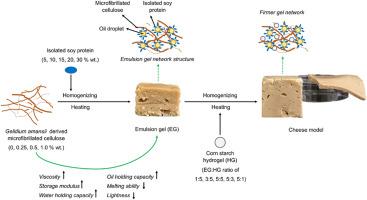
The utilization of microfibrillated cellulose (MFC) in a Pickering emulsion has become popular recently. However, its application on semi-solid emulsion gel (EG) for cheese structuring has not been invented yet. This study aimed to investigate the effect of Gelidium amansii-derived MFC addition on the thermo-physical properties of EG composite as the ingredient for vegan cheese manufacture. MFC and isolated soy protein (ISP) were incorporated in the EG composites at the concentration levels of 0–1.0 % wt. and 5–30 % wt. accordingly. As a result, the interaction of MFC and ISP could increase the emulsion gel network through the oil droplets bridging and stabilizing under the microfibrillar network of MFC. Higher MFC concentration improves gel stability and texture but reduces the lightness and meltability at a particular ISP level. The prepared cheese model using the selected EG composite (MFC 0.25 % - ISP 15 %) and corn starch hydrogel has a close color, texture, and meltability compared to the commercial dairy sliced cheese. In conclusion, MFC has a critical role in regulating the thermo-physical properties of EG–based cheese alternatives.
期刊介绍:
Food Hydrocolloids publishes original and innovative research focused on the characterization, functional properties, and applications of hydrocolloid materials used in food products. These hydrocolloids, defined as polysaccharides and proteins of commercial importance, are added to control aspects such as texture, stability, rheology, and sensory properties. The research's primary emphasis should be on the hydrocolloids themselves, with thorough descriptions of their source, nature, and physicochemical characteristics. Manuscripts are expected to clearly outline specific aims and objectives, include a fundamental discussion of research findings at the molecular level, and address the significance of the results. Studies on hydrocolloids in complex formulations should concentrate on their overall properties and mechanisms of action, while simple formulation development studies may not be considered for publication.
The main areas of interest are:
-Chemical and physicochemical characterisation
Thermal properties including glass transitions and conformational changes-
Rheological properties including viscosity, viscoelastic properties and gelation behaviour-
The influence on organoleptic properties-
Interfacial properties including stabilisation of dispersions, emulsions and foams-
Film forming properties with application to edible films and active packaging-
Encapsulation and controlled release of active compounds-
The influence on health including their role as dietary fibre-
Manipulation of hydrocolloid structure and functionality through chemical, biochemical and physical processes-
New hydrocolloids and hydrocolloid sources of commercial potential.
The Journal also publishes Review articles that provide an overview of the latest developments in topics of specific interest to researchers in this field of activity.



 京公网安备 11010802042870号
京ICP备2023020795号-1
京公网安备 11010802042870号
京ICP备2023020795号-1

 分享
分享
 求助内容:
求助内容: 应助结果提醒方式:
 扫码关注我们
